It is the 9 days of the 9 Emperor Gods (Jiu Huang Ye) and it is also the 9 days of Navarathri. Right in Chinatown where the oldest Hindu Temple, Sri Mariamman Temple, is, there will be nights of programmes to celebrate Navarathri.
On 1 Oct 08, at 9pm, there will be a Classical Indian Dance by Arul Ramiah and two lovely Dutch girls.
Come and enjoy Indian Classical Dances in the oldest Hindu Temple right in the heart of Chinatown!
Monday, September 29, 2008


Thursday, September 04, 2008
Chinatown Mid Autumn Light Up: Here comes Brazilian Samba
To the oldies, the strain of Yam Kim Fai might bring nostalgic memories of Chinatown.
But to the youngsters of today, the world is their town. And so, in this Mid-Autumn night, the students of the Singapore Management University brought in the Brazilian Samba! It will bring smiles to the grannies' faces as they watch how their children have gone to know the world better.
It certainly reminded some of the days when they or their ancestors arrived on this shore where everything was new to them. Some got to learn about the local Malay culture and took to joget!
But Brazil was too far an imagination for them. Well, until now ..
But to the youngsters of today, the world is their town. And so, in this Mid-Autumn night, the students of the Singapore Management University brought in the Brazilian Samba! It will bring smiles to the grannies' faces as they watch how their children have gone to know the world better.
It certainly reminded some of the days when they or their ancestors arrived on this shore where everything was new to them. Some got to learn about the local Malay culture and took to joget!
But Brazil was too far an imagination for them. Well, until now ..
Chinatown Mid Autumn Light Up: Giant Puppets
Once upon a time, puppet shows were popular. They not only entertained, but they also impart the Chinese values as well as the Chinese history.
Arts and skills were required to be able perform the puppet shows, where one uses one's hands to move the multiple strings of the puppets, making the necessary gesture while singing or making dialogues.
The puppets grew bigger, and bigger, and bigger. And at the Mid Autumn lightup, the biggest moving puppets took part. They too are telling stories of Chinese culture. But how many knew?
Arts and skills were required to be able perform the puppet shows, where one uses one's hands to move the multiple strings of the puppets, making the necessary gesture while singing or making dialogues.
The puppets grew bigger, and bigger, and bigger. And at the Mid Autumn lightup, the biggest moving puppets took part. They too are telling stories of Chinese culture. But how many knew?
Monday, September 01, 2008
Mid-Autumn Celebrations kick off
On 31 Aug 08, songs, dances, and noises of the fireworks brought Chinatown back to its old days when every night was a bustling nite. In those days, it was of necessity that one stays out late to make some money, have late supper or stay cool, away from the congested rooms in the old pre-war houses.
But on this night, that was almost history, and the young brought joys and news aspirations while looking back at the days when, maybe, their grannies or even great-grannies had irked out a living here.
But on this night, that was almost history, and the young brought joys and news aspirations while looking back at the days when, maybe, their grannies or even great-grannies had irked out a living here.
Ah, the nostalgic days ....
Chinatown redefined
Mid-Autumn 2008 kicked off with a rousing night of fireworks, dragons and lions, and dances galore, put up by some 700 performers, from as young as 5 years olds. It was another unforgettable night, not so much about moon cakes but of remembering Chinatown of the old by the young.

What must be stirring to many older residents of Chinatown must be the performance by the young remembering what it was like in Chinatown. It certainly conjured the days gone by, when children did not have the luxury of life as it is today. While the children still had the chance to carry lanterns, they would not have heard of the Brazilian Sambal performed by the Singapore Management University. While Cantonese might be the language of the day in this part of the Chinatown (where the People's Park Complex stands), tonight it was English and Mandarin. The song remembering Chinatown had some Cantonese in it, if my ears still tell me the truth.
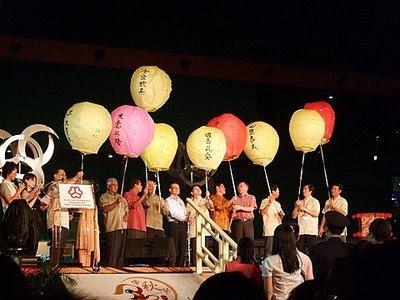
Watching the performance, I could not help thinking that we have come a long way. Many of these young performers must have had one of their grannies or relatives who once upon a time had lived in Chinatown. It is indeed a good occasion to gather in Chinatown again, the source or water head of the Chinese diaspora from Chinatown in Singapore? In such celebrations, it is great to remember the people who have helped what we have arrived to today.

Ah, as I looked back at Chinatown of my childhood days and watching these kids performed, I thought to myself, it is and will be a Chinatown Redefined. Many would not have known about Chinatown that we know. But so long there are roots, the trees will grow, bigger.
Saturday, August 30, 2008
Mid-Autumn arrives in Chinatown
Or is it? The flowers remind me of Spring. (^^)

30 Aug 2008 this year marks the last day of the month of the Hungry Ghosts (a term used locally to mean the 7th Lunar Month). And so, from 31 Aug 2008 this year, it is the first day of the 8th Lunar Month, which signals the preparation for the 15th of the Lunar Month, which is celebrated by the Chinese as Zhong Qiu Jie or Mid-Autumn Festival. Again, locally, they call it the MoonCake Festival.

Come Mid-Autumn, when we used to offer our prayers to the Moon Goddess with moon-cakes, water caltrops, Pomelo and mini-yams with tea and cake-powder (once popular with the Chinese Ladies who use it to powder their faces) and kids carrying the lanterns, in modern times, it would be different. Lanterns would not be those made of glass papers with candles. But there will still be some. While the eating part continues, there might be less prayers to the Moon Goddess.
The MoonCakes bring along its tales of history in ancient China, just as the bright moon on this 15th Day with its shadows would remind grannies to tell the stories of Chang Er and the rabbit on the moon.
While Chinatown used to be the scene of much activities with the wet marketing selling pomelos, water caltrops, mini yams and moon cakes, these days, one could get them anywhere, everywhere. Moon cakes have gone upmarket with aggressive marketing by hotels, aided by credit card companies. Would there be still queues for the traditional Cantonese moon cake shops in Chinatown like Dai Zhong Kok? I think there will as the elderly folks would still prefer to the traditional taste.
In the days when there were less light and less bright, there was the additional fun as the kids would gather to light up the candles inside their lantern and do the walk. Adults would gather with the neighbours, sharing their peeled pomelos (in those day, the pink ones from Ipoh, Malaysia, were said to be the best), boiled small yams and moon cakes. Dai Zhong Kok's moon cakes used to be the ones. For some, they would come with the tomboh or hammer to crack open the boiled water caltrops to eat.

Would Mid-Autumn Festival be still as exciting to modern kids?
Wednesday, July 23, 2008
From the ashes arose a Phoenix
Abandoned school buildings seem to be the right candidates for hostels, or now, boutique hotels. Many could be the older buildings with some older characteristics of probably the 50s.
But here by the Pearl's Hill, a rather modern looking school building, although it has a long and interesting history with some proiment people coming from this school (see my earlier blog) , has become a hotel!

Would anyone have guessed that once upon a time, children ran up and down this first multi-storey school? Ah, many fathers and mothers would be telling their children about their days in this school, when they pass by or come to this hotel.

But here by the Pearl's Hill, a rather modern looking school building, although it has a long and interesting history with some proiment people coming from this school (see my earlier blog) , has become a hotel!
And, so this tallest school in Singapore has reincarnated as the Re! Hotel.
Would anyone have guessed that once upon a time, children ran up and down this first multi-storey school? Ah, many fathers and mothers would be telling their children about their days in this school, when they pass by or come to this hotel.
An interesting name, Re! In Chinese it is Re Li .. and this Re - pronounced as Swee in Hokkien -could it be part of the Chin Swee Road that runs by it?

Saturday, July 19, 2008
The washing machine
It must have been decades since the last I saw this modern gadget that was part of the bathroom, where we would use to help us rub off the dirt, probably using the AXE Brand bar soap. The grooves helped to trap some of the soap onto the clothing and hence helped to create a lather.
It was fun to watch Mum doing the scrubbing or just using the hands to rub the clothings off the groves of this "suay-sa-pang" (Washing Cloth Wood as literally translated from Hokkien), resulting in plenty of soap lather. From time to time, Mum would dip her hands into a pail of water to splash a little on the drying clothes as the water ran off. Often, Mum would sit on a small stool (ah, some of you might have seeen hawkers selling from real small stools to tall ones, as they walked from house to house), which gave her a good leverage.

As we grew bigger and Mum had to go and work to supplement income - talking about dual income families, but with more kids than these days - we had to take over the duties. Amongst brothers and sister, we divided our chores, washing clothes and preparing meals.
Using the bar soap (versus the detergent of today) and the scrubbing board, we tried to make the clothings as clean as possible. In a less than clean environment in those days, I think, the clothings were dirtier than these days. Sweat (yes, on aircond!), dirt and possibly after days of wearing the same clothing agan and again (no, not like one per outing these days), it was a challenge. White shirts just cannot stay white! So, we use the "lam-chi" by putting the powder into a pail of water to make it blue and then putting the white shirts in them to give a light bluish hue. And to make the shirt lasts longer and probably less likely to get wrinkle, we put the shirts into a pail of starch before handing them in the sun.

The final part is to iron the shirts with a charcoal iron. Ah, but that's another story. Ah, someone has decided finally to part with the scrubbing board.
It was fun to watch Mum doing the scrubbing or just using the hands to rub the clothings off the groves of this "suay-sa-pang" (Washing Cloth Wood as literally translated from Hokkien), resulting in plenty of soap lather. From time to time, Mum would dip her hands into a pail of water to splash a little on the drying clothes as the water ran off. Often, Mum would sit on a small stool (ah, some of you might have seeen hawkers selling from real small stools to tall ones, as they walked from house to house), which gave her a good leverage.
As we grew bigger and Mum had to go and work to supplement income - talking about dual income families, but with more kids than these days - we had to take over the duties. Amongst brothers and sister, we divided our chores, washing clothes and preparing meals.
Using the bar soap (versus the detergent of today) and the scrubbing board, we tried to make the clothings as clean as possible. In a less than clean environment in those days, I think, the clothings were dirtier than these days. Sweat (yes, on aircond!), dirt and possibly after days of wearing the same clothing agan and again (no, not like one per outing these days), it was a challenge. White shirts just cannot stay white! So, we use the "lam-chi" by putting the powder into a pail of water to make it blue and then putting the white shirts in them to give a light bluish hue. And to make the shirt lasts longer and probably less likely to get wrinkle, we put the shirts into a pail of starch before handing them in the sun.
The final part is to iron the shirts with a charcoal iron. Ah, but that's another story. Ah, someone has decided finally to part with the scrubbing board.
Monday, July 14, 2008
Couldn't he have a better aid?
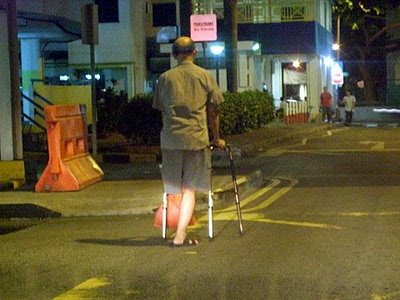
As I was coming home one day, I had to slow down to allow this man to take his time to walk down this narrow road. At first I thought he was using the four-legged gadget to help him walk, as is the case with older people where a walking stick is not enough.
On closer look, I saw that he had only one leg. I couldn't help thinking if he couldn't have a better gadget to help him? Like an artificial limb? Was it a case of ignorance?
Which brought me to another case where there is this old lady (maybe in her 60s) who uses a stool to walk to buy food from the coffeeshop. Her back was bent and apparently she could not stand straight. The only way to help her maintain her balanace was to put her hands on the stool and walk, each step at a time.
There must be something that we could do for our older folks, who have contributed much to what Singapore is today? We still have a fair number of older people who are illiterate and could only speak dialects.
On closer look, I saw that he had only one leg. I couldn't help thinking if he couldn't have a better gadget to help him? Like an artificial limb? Was it a case of ignorance?
Which brought me to another case where there is this old lady (maybe in her 60s) who uses a stool to walk to buy food from the coffeeshop. Her back was bent and apparently she could not stand straight. The only way to help her maintain her balanace was to put her hands on the stool and walk, each step at a time.
There must be something that we could do for our older folks, who have contributed much to what Singapore is today? We still have a fair number of older people who are illiterate and could only speak dialects.
Friday, June 27, 2008
The Chinese Clogs - Cha Gia
Wasn't it some years ago when one could see the ladies carrying their rattan weaved baskets (in various forms and fashion) - talking about being green, in their dainty samfoo and walking to the Chinatown wet market. Wearing clogs, but of course.
Once there was a very picturesque shop selling clogs at Temple Street. When the streets were wet and dirty, the common shared kitchen in the houses in Chinatown wet and dirty as well, clogs reined. Clogs of all sizes for kids who started walking to the adults where there are different ones with different colours and designs. The ladies had their shapely hour-glass ones while the macho men might their tongkang (bumboat) lookalikes with tire rubber(?) for cover their feet.

And then, more tourists visited his shop than customers. And I suppose flashes from the cameras irritated the poor guy trying to earn a living that he declared - no photography! That was before the days when forms at 400 was considered the most sensitive ones and not to mention the digital cameras of today where flash is hardly necessary. Well, not for glamour photos anyway.
As the wet and dirty streets of morning market in Chinatown - that spanned Temple Street, Smith Street, Trengganu St, Pagoda Street and Sago Street too - became dry as the stalls were moved into the basement of the Chinatown complex, and the fashion of samfoo, and rattan baskets fade, the days of the humble clogs were too numbered. But actually, the wet market that had gone "underground" was still as wet and dirty and even slippery, and requires that "platform" shoe!
Today, getting a pair of the clogs is not as easy and walking to Temple Street to get one. I heard that long long ago, there was also one at Telok Ayer, run by a grandmother of a friend. But for many less than modern homes, the clogs are still useful. One could still pairs of them in the bathrooms. Gone were the days when in a typical common kitchen - visit the Chinatown Heritage museum to have a good feel of the kitche, alas, there were no signs of the clogs, I think - of such multi-family homes, there would be at least some 4 pairs of clogs, one for father, one for mother and perhaps, two for the kids, and they just shared even though the family size grew. There were just no space for so many pairs in the kitchen, a wet kitchen actually.
For the tourists, they would have to contend with the small souvenir ones that is still being sold in a small stall along Sago St. Perhaps, there are some bigger ones .. alas, they could be priced comparably to the designer ones.

Perhaps, one day, Chinatown might decide to have a catwalk of ladies in samfoo and clogs. Or would the fashion return? (^^)
Subscribe to:
Posts (Atom)