Wednesday, July 23, 2008

From the ashes arose a Phoenix

Abandoned school buildings seem to be the right candidates for hostels, or now, boutique hotels. Many could be the older buildings with some older characteristics of probably the 50s.

But here by the Pearl's Hill, a rather modern looking school building, although it has a long and interesting history with some proiment people coming from this school (see my earlier blog) , has become a hotel!
And, so this tallest school in Singapore has reincarnated as the Re! Hotel.


Would anyone have guessed that once upon a time, children ran up and down this first multi-storey school? Ah, many fathers and mothers would be telling their children about their days in this school, when they pass by or come to this hotel.


An interesting name, Re! In Chinese it is Re Li .. and this Re - pronounced as Swee in Hokkien -could it be part of the Chin Swee Road that runs by it?

Saturday, July 19, 2008

The washing machine

It must have been decades since the last I saw this modern gadget that was part of the bathroom, where we would use to help us rub off the dirt, probably using the AXE Brand bar soap. The grooves helped to trap some of the soap onto the clothing and hence helped to create a lather.


It was fun to watch Mum doing the scrubbing or just using the hands to rub the clothings off the groves of this "suay-sa-pang" (Washing Cloth Wood as literally translated from Hokkien), resulting in plenty of soap lather. From time to time, Mum would dip her hands into a pail of water to splash a little on the drying clothes as the water ran off. Often, Mum would sit on a small stool (ah, some of you might have seeen hawkers selling from real small stools to tall ones, as they walked from house to house), which gave her a good leverage.


As we grew bigger and Mum had to go and work to supplement income - talking about dual income families, but with more kids than these days - we had to take over the duties. Amongst brothers and sister, we divided our chores, washing clothes and preparing meals.


Using the bar soap (versus the detergent of today) and the scrubbing board, we tried to make the clothings as clean as possible. In a less than clean environment in those days, I think, the clothings were dirtier than these days. Sweat (yes, on aircond!), dirt and possibly after days of wearing the same clothing agan and again (no, not like one per outing these days), it was a challenge. White shirts just cannot stay white! So, we use the "lam-chi" by putting the powder into a pail of water to make it blue and then putting the white shirts in them to give a light bluish hue. And to make the shirt lasts longer and probably less likely to get wrinkle, we put the shirts into a pail of starch before handing them in the sun.


The final part is to iron the shirts with a charcoal iron. Ah, but that's another story. Ah, someone has decided finally to part with the scrubbing board.

Monday, July 14, 2008

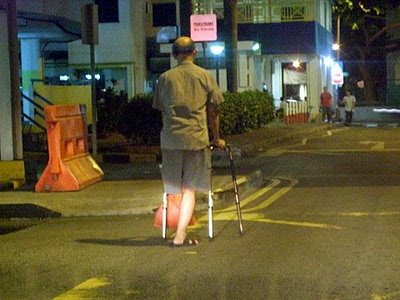
Couldn't he have a better aid?

As I was coming home one day, I had to slow down to allow this man to take his time to walk down this narrow road. At first I thought he was using the four-legged gadget to help him walk, as is the case with older people where a walking stick is not enough.

On closer look, I saw that he had only one leg. I couldn't help thinking if he couldn't have a better gadget to help him? Like an artificial limb? Was it a case of ignorance?


Which brought me to another case where there is this old lady (maybe in her 60s) who uses a stool to walk to buy food from the coffeeshop. Her back was bent and apparently she could not stand straight. The only way to help her maintain her balanace was to put her hands on the stool and walk, each step at a time.

There must be something that we could do for our older folks, who have contributed much to what Singapore is today? We still have a fair number of older people who are illiterate and could only speak dialects.

Friday, June 27, 2008

The Chinese Clogs - Cha Gia

Wasn't it some years ago when one could see the ladies carrying their rattan weaved baskets (in various forms and fashion) - talking about being green, in their dainty samfoo and walking to the Chinatown wet market. Wearing clogs, but of course.

Once there was a very picturesque shop selling clogs at Temple Street. When the streets were wet and dirty, the common shared kitchen in the houses in Chinatown wet and dirty as well, clogs reined. Clogs of all sizes for kids who started walking to the adults where there are different ones with different colours and designs. The ladies had their shapely hour-glass ones while the macho men might their tongkang (bumboat) lookalikes with tire rubber(?) for cover their feet.

And then, more tourists visited his shop than customers. And I suppose flashes from the cameras irritated the poor guy trying to earn a living that he declared - no photography! That was before the days when forms at 400 was considered the most sensitive ones and not to mention the digital cameras of today where flash is hardly necessary. Well, not for glamour photos anyway.

As the wet and dirty streets of morning market in Chinatown - that spanned Temple Street, Smith Street, Trengganu St, Pagoda Street and Sago Street too - became dry as the stalls were moved into the basement of the Chinatown complex, and the fashion of samfoo, and rattan baskets fade, the days of the humble clogs were too numbered. But actually, the wet market that had gone "underground" was still as wet and dirty and even slippery, and requires that "platform" shoe!

Today, getting a pair of the clogs is not as easy and walking to Temple Street to get one. I heard that long long ago, there was also one at Telok Ayer, run by a grandmother of a friend. But for many less than modern homes, the clogs are still useful. One could still pairs of them in the bathrooms. Gone were the days when in a typical common kitchen - visit the Chinatown Heritage museum to have a good feel of the kitche, alas, there were no signs of the clogs, I think - of such multi-family homes, there would be at least some 4 pairs of clogs, one for father, one for mother and perhaps, two for the kids, and they just shared even though the family size grew. There were just no space for so many pairs in the kitchen, a wet kitchen actually.

For the tourists, they would have to contend with the small souvenir ones that is still being sold in a small stall along Sago St. Perhaps, there are some bigger ones .. alas, they could be priced comparably to the designer ones.

Perhaps, one day, Chinatown might decide to have a catwalk of ladies in samfoo and clogs. Or would the fashion return? (^^)

Tuesday, April 22, 2008

No Smoking - No Joke

This morning, I was crossing the road when I saw this guy with the sign "No Smoking in this area". I thought to myself, wah, have they intensified the No Smoking Campaign to this extent? It did look like a great gimmick.


An European couple crossing the road with me was also tickled and asked the guy for permission to take a photo.


But no, this is not a gimmick. It was a serious matter. Some gas leakages were detected and there was a gang of workers looking for the source. In the meanwhile, the public was warned not to smoke, lest there be fireworks ahead of the next celebration in Chinatown. (^^)

Monday, April 14, 2008

The Chinatown Triangle

The sign that shows three blocks along three streets did not betray the interesting history of this part of Chinatown. In fact, I am also at a loss trying to map what it is today with what it was in the old days. So, perhaps, a collective memory collection might be necessary (^^)


Each day as I passed this sign which was strategically placed at the corner of Blk.34 along Upper Cross St, I could not help wondering and trying to jot my memory what it was like in my young days. Not matter how, this part of the memory seemed to be hidden deep in the vault.

But I could remember the night-soil station, somewhere around here. I am trying to pinpoint its exact spot. I could only remember vividly once visiting a schoolmate's (I could not even be sure) home (which is a residence block for the night soil carrier). Was it smelly? The sight of the "36 door lorry" could have conjured up the smell. (^^) It was tough work for the night soil carriers as they have to transport them from many houses in Chinatown which were still using the bucket system (visit the Chinatown Heritage Museum to see one real one, though not used) to the specially designed night soil carrier (in this case the truck). At this station, the carriers were washed cleaned and parked away for yet another day. The night soil clearing process seemed to be carried out in the morning.

As time and tide wait for no man, the night soil carrier also waited for no man. One could find a quick replacement while one was in the progress of one's most important function. (^^) I wonder if there is still any of these night soil carrier alive. Could well be.

The Block 32 (HDB People's Park) was built to house the stall holders after the fire at the old People's Park. The cloth sellers occupied the second storey. Until recently (even though many still manage today), many still went to find the cloth they like and then buy them to sew the clothes themselves or send to a tailor. It was often an adventure trying to buy cloth from these cloth shops. Franca Lingua is Cantonese, normally. While the shopkeeper might try his or her best Cantonese to persuade you to buy, he or she could turn to the other extreme of the colourful spectrum of colourful Cantonese to chide you for not buying. It could be heard for miles! (^^) Ah, the opening price could be sky high and one need to have the skills to bargain to a reasonable price, sometimes depending on the mood of the shopkeeper. If you are the first customer, God forbid, if you walk away without buying. Storms and thunder were sure to follow. These shopkeepers have this belief that the first sale must be successful, and they would go real low to achieve that. Imagine what happens if you are just a frivolous buyer?

I had the good fortune of sitting in a shop to watch - alas I was a poor seller, I could not put up a hard and good bargain, giving all the tall stories. (^^) But looking from inside the shop, I realised that these poor shopkeepers were often dumped with a set of say, five different colours of one patterned cloth - that's the wholesaler's offer. Of five rolls of cloth, one would be lucky if two of them sell well. I often wonder how stupid (^^) the designers could be in printing colours that the customers don't want. But then, one taste could be another's distaste. And so, to make a small profit and to cover the loss of the other possible three rolls, the shopkeeper has to try to offer at very high prices. Watch them talk and calculate at the same time. No, the schools do not teach one how to do mental sums while talking with the customers.

Some poor shopkeepers maintained a frugal life of simple food and selling not too expensive, and thanks to the low rents offered by HDB (for those affected by the fire), they could live a reasonably spartan yet comfortable life. But like in any society, these people saw how their neighbouring shops innovated by offering new wares and actually increased their income many folds. Like in any kampung (village) here, new tenants came in, paying sky high rents, and yet could still make money. And so, today if you walk through the refurbished HDB People's Park, you would see a few of such shops, manned by the second or third generation of the original stallholders of the old People's Park.

Block 34, I saw it grew as I walked home from work each evening. But somehow, I could not recall how the place looked like before this new flat was built. The two schools behind had seen its share of history. From two schools, it became one and then it was gone. A government agency took over and then left. In the foreign worker and student boom, it became a hostel. And that school left these two buildings to a mult-storey building just around the Pearl's Hill. It had seen its better days and, was gone. Thanks to the hotel squeeze, it is now a hotel!

It must have been in 1969 to early 70s when these flats along Upper Cross St were completed. Unknown to me, these flats would change the lives of many in the following years. It was to be for the relocation of the residents of Chinatown (in the Chin Chew and Upper Chin Chew St - known as Tau Foo Kai (Tofu St) consisting of mainly Cantonese and the residents of the Teochew enclave along where else, but Teochew St and there about.

Blk. 34, being 3-room flats, along with the other 1-room flats, saw the city kampongs (village) transformed from horizontal ones to vertical ones. Intra-flat traffic was high as relatives and neighbours were at different floors of the flats. Many of the residents knew each other. Instead of sitting by the five foot way each evening and chatting with neighbours, the corridors along these flats were narrow and it required a little more effort for gathering. Some older men gathered at the coffeeshop.

Over time, as some resident families expanded, they moved out. Some moved out, making a tidy sum of money, thanks to the climbing property market. Others moved in. Intra-floor traffic lessened. Strangers became more common. Children grew up and married out. For the new residents, interestingly, for them, in the lift, at best it was just a smile as a kind of recognition. Barring a nasty neighbour, one's neighbourly relationship could be only two doors away, each side. Ah, but when a baby arrives in that family, things changed. The smiles became greetings, often focussing on the baby. "Ooh, how has he grown!" Mothers were the fastest in getting to know each other and exchanging notes. From baby food it would progress to childcare centre, on to kindergarten and yes, the complicated process of getting into the school of their desire. The fathers, more often than not, smiled and maybe said "Hi".

Unlike the old kampong days, be it along a street in the city, most of the neighbourhood in the flat are not conducive for the kids to play with each other. In some neighbourhood, the playgrounds help. But given the "in-security" of flat dwellers, most parents do not allow their children to go outdoors on their own. And so, developing into a village in the flat is still a challenge.

The flats around this triangle have been around for some 30 years. These days seem to see the diminishing number of the early residents. The traditional Teochew funeral wakes, complete with traditional rituals, seem to be a regular affair. And so, one by one, the older residents bid their old neighbours goodbye. For some who were left behind in this flat while their descendants have moved elsewhere, it meant one "kaki" (friend) less for their old comrades.

But life moves on, with influx of new residents. Life in the upper floors differ from the rapid stream of people moving along the five foot way on the ground floor.

Friday, March 28, 2008

Nanyin Night at Thian Hock Keng meets with overwhelming response

On 26 March, 2008, the 19th day of the 2nd Lunar Month, the first of the three dates in a year when celebration is held in honour of Guan Yin (Kuan Yin) - the other being 6M19 and 9M19 - Thian Hock Keng continued to have its traditional Nan Yin Night. Siong Leng has been performing the Nan Yin concerts in Thian Hock Keng for these three occasions for the past 20 years or more.

These are the dates that Nan Yin fans have always been watching out for. And they never fail to turn up. It is enlightening to see that while the old familiar faces were there (average age is 60 ?), there are more and more younger faces being seen in the audience. Siong Leng itself has successfully rejuvenated with more young performers. A good sign for this age old (since Tang Dynasty) Chinese Southern Sounds (music).


For many of the elders, it was a nostalgic moment bringing them back to the old days when such music could be heard from street performers to street wayangs (operas) to the late night programme from Rediffusion (cable radio). It would have brought them back to their jia-xiang (home village) from where they left to brave the new world, eventually settling down in Singapore.


For the older folks, they might view the above rendition with nostalgia as they sang the song of Tng Sua Ah Pek 唐山阿伯 (Tang Shan Ah Bo).

Friday, February 01, 2008

Chinese New Year Shopping

For some reasons, one's Chinese New Year preparations is not complete until one visits Chinatown. At least thought a number, judging from the congestion in the multistorey carpark where I park my car. This spells good news to the vendors in Chinatown.

Taking the opportunity to find out what's new, especially in the makan (food) goodies and the flowers, I went on my prowl. I was too early, then, for the makan goodies. But they certainly got me on my memory trail of the days when neighbours and relatives would be making their own kueh-kueh (cakes) and sharing them, or selling them. One would start keeping the used tins, like the big Milo tins (a favourite) and the plastic containers too.


While the nyonyas (the Peranakans) fancied more complicated kueh2, the others, depending on the dialect groups, might opt for their own. I think the Cantonese loved to make kok-jai (a mini curry puff lookalike with grounded peanuts and sugar inside). One of the more popular ones could be the "love letters". I still wonder if anyone had inserted love-letters in these thin crust. In the old days, I remember watching, and well helping out in making these thin pancake-like crust-like kueh. In Hokkien, I think it is called kuey-nern-gern (meaning rolled eggs). One spreaded a thin layer of flour dough onto the circular plated and then closing it with a similar plate, it is placed on a charcoal fire. It gets cooked easily and with a flip, it is done. The tricky part is using your hands to roll them when they are hot and still soft.

As kids we love to put these rolled love-letters as if they were cigars.

These days, less and less people are indulging in the making of these kueh-kueh. And there are dozens of them available in the market. Definitely cheaper that what one would have spent in making them. But maybe, they lack the loving touch.


For those who can afford, especially those in business, getting potted plants with fruits and flowers are a must. Each year, the florists try to bring in more varieties. If there is anything that links the Chinese of Singapore to that of China, the plants could well be one of the links. Pussy willows are only endemic to China. The plum-blossoms - the plum blooms in late winter - are amongst one of the popular ones. One puts them in a giant vase and watch the flowers bloom and possibly the leaves sprouting. And that's it. There are also the narcissus - shui xian - that the Chinese have a way of carving the bulbs to make them bloom earlier, especially in the hot climate in Singapore.

The kumquat - kumkat or kajai in Cantonese - is an all time favourite with businesses and temples. Possibly because of the word "kum" which is synonymous with Gold in Cantonese. There was one belief that if one wants to have a baby boy, one should steal a kumquat fruit from someone's plant. But in modern day Singapore, it could well be an offence! (^^)

To many Cantonese at home, they would start early, probably a month or so before the Chinese New Year, to buy a few chi-ku 慈姑 (in Cantonese for arrowhead) and plant them in a shallow bowl of water and pebbles. Anyone knows its significance? Chi-ku is a favourite bulb cooked in soups by the Cantonese.

Probably all Chinese would hang the red banner across the main front of the house. More religiously so in doing it were the Peranakans. But with flats these days, it is getting rare and the red banners could be shrunk to just cover the doorway. In the old days, it would be red banners, red clothings, yes, red packets, and plenty of red in the fire-crackers. Red date tea was also served. So, you can imagine the "old fashion" elders seeing red when they saw the kids wearing black!

Saturday, January 26, 2008

Metropole Cinema, Kum Wah, Kim Hua 金華

Thanks to the memory jots from Algae and Moon, I decided to run down my little memory lane about Kum Wah (in Cantonese) or Kim Hua (in Hokkien). And in English, Metropole Cinema (you can see a picture of it in LaoKokok's blog).
I vaguely remember wandering around that area when they were building this almost circular building. I was curious, but not as curious as with the fish tanks in the nearby open-air fish-shop. It was still beyond my means to buy fishes from the fish shop, I was still in the primary school then. But I could spend hours watching them. And I would gaze at the building with the pole scaffording.

It was a new cinema in Chinatown! I suppose the first could be Majestic (Dai Hua in Hokkien), and then, Oriental (Tong Hong in Hokkien) at the corner of Kreta Ayer St with New Bridge Rd. If my memories did not fail me, a worker during the building of the Metropole Cinema fell and died. It was hearsay as I was still too young and poor to have access to the newspapers. And soon, there was rumour of ghosts. (^^)

But that did not deter the cinema goers from going to watch great Cantonese movies like "Yi Lai Shang Cheong" (The Buddha Hand - a famous gongfu force then) and Mu Lam Sap Sam Keen (The thirteen swordsmen?).

As we grew older and moved to another part of Chinatown, and getting more immersed in the English speaking world, our world was cinemas like Globe (Great World), Orchard (now the Orchard Cinemaplex), Odean and Cathay.

And without realising it, one day I walked by and saw Metropole Cinema being replaced by Fairfield Methodist Church. At one point in my life, my house was very close to the original Fairfield Methodist Church and Girls' School. Until this day, the uniform of Fairfield Girls' School, now Fairfield School (for boys and girls), has been and is still, I think, unique in colour. I couldn't help thinking if this is Methodist churches' colour. (^^)
When our kids came of age, our natural consideration was to get them to attend the kindergarten in Fairfield Church. Ah, and so, we got the opportunity to sit in what was once a cinema. But this time, it was more of a theatre, and well, a chapel, where we got to see our children performed in their graduation night.

And so, in various ways, for people like us who lived in this part of Chinatown, that building - be it Metropole Cinema or Fairfield Methodist Church - it has a part in our lives. And for some, it's still to come. (^^)


Wednesday, January 23, 2008

Chinatown prepares to welcome the Year of the Rat

Or should it be the Year of the Mouse, the Mickey Mouse to be more accurate? (^^) Yes, Chinatown is decorated with the likes of Mickey Mouse in welcoming yet another new year. The year of the Rat starts another new cycle, and from what we know about rats - there were plenty in Chinatown - it would be tough to romanticise the rats. And so Mickey Mouse came to the rescue. A friend was wondering aloud, why not Mighty Mouse?


To many Singaporeans, and even Malaysians, visiting Chinatown just before the Chinese New Year seem to be a must. Despite the availability of anything Chinese in all the satellite towns, Chinatown has its special draw. The rows of old shophouses, despite their changing uses, give that aura of the Chinatown that most older Singaporeans would remember. To the young, it might be something different, maybe akin to the Universal Studios. I was jokingly telling my fella Chinatown residents that perhaps we should have some gongfu hustle kind of shows in the midst of the festivities, to add to the touch of the "real" Chinatown. (^^) Imagine someone flying out of the third floor landing onto a basket of, no, not durians. (^^) It would be a delight to the MICE tourists. Ah, there is a mouse connection here.

It is the time when grandpa and grandma would love to bring the kids, especially, the grandchildren to show what they must buy for the Chinese New Year. Alas, this year, the wet market could not return on time. So, a separate trip has to be made to its temporary place at Outram Park. But, there's still the waxed ducks and all kinds of sausages. To the Cantonese, these are some of the prerequisites for Chinese New Year. But wait, this year, there seems to be something missing. At least when I did my last recce, I missed seeing the man sawing the Yunnan Ham!

What's left of the core Chinatown - at the heart where most of the businesses are being held - is probably the ares served by Pagoda St, Temple St, Trengganu St, Smith St and Sago Lane/Rd. The Giao-Keng-Kau (Outside the Gambling Den(?) in Hokkien) is a shade of its past, where the current China St and Nankin St are. The Teochiu Kuay (Teochiu St) is now Central.


In this small area, the vendors compete for their business, some for the tourists and the rest for the locals. At this time, those who are preparing for the Chinese New Year. Flowers and fruits - the very important Mandarin Oranges - Kum in Cantonese, with similar sound as Gold, are beginning to appear. Tidbits to keep the mouths of visitors to the homes busy are in full display - red and black melon seeds, groundnuts, mua-chee (mochi or dafuku in Japanese) and all sorts of sweets. Chinese New Year songs - in Mandarin and in Hokkien - blare from the loudspeakers beckoning the shoppers to get some home.

Chinese New Year must be noisy and red - have you read or heard about the story of how the word Nian came about? And how fire-crackers were used to frighten the Nian away? It hates Red. And the Chinese congratulate each other "Kiong Hee, Kiong Hee" (in Hokkien and Kong Hee in Cantonese), meaning to congratulate each other for not being eaten by Nian. And so the story went.

What was not so visible in Chinatown these days must be the clothing and shoes. These were the essentials that Mum used to drag us kids, each holding the hand of the other tightly, in the claustophobic crowd (remember we were tiny then) to try out and buy, often the last few days before Chinese New Year. And that is if Pa has brought back the "Huay-Ang" (Bonus). Was it a way to force us to at least do something, apart from being poor? Chinese New Year, to us kids, was the time when we got to wear new cloths! Each having his or her own. The rest of the time would be "hand me downs". And yes, shoes too! That would also be the time when we could have bottled drinks - the bigger and rounder Fraser & Neave Orange and Sarsi. To the adults, again, Orange drink (Kum ma) is a must. To the kids, we would fancy the Cherry, which is red and Sarsi was a sensation.


And so, in a couple of days, Chinese New Year will arrive (7 Feb 08). Until then, shopping will get into a frenzy state, no matter how bad the stock exchange graphs might look. (^^) New Year will bring new luck and prosperity!