Friday, May 02, 2014

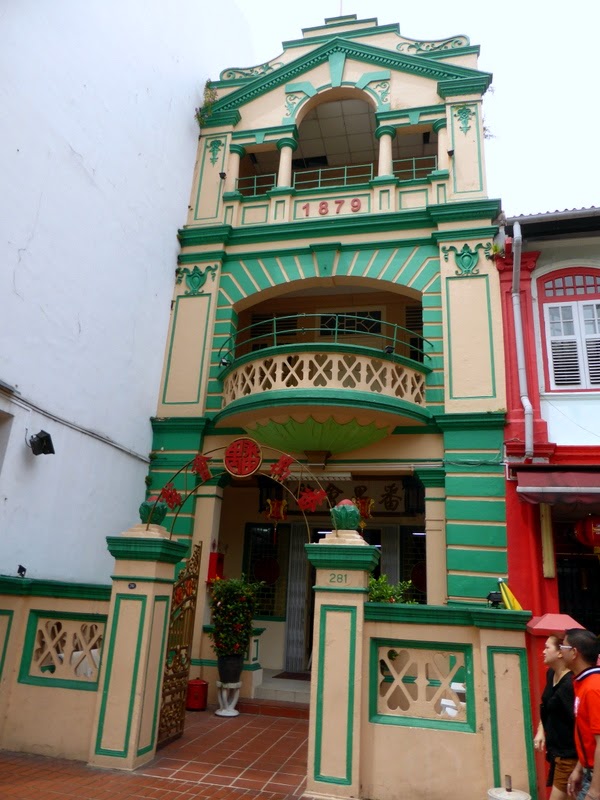
Lee Pan Hon from Sago Lane

Thanks to James Seah who unearthed a gem from our archives and put the stories together, I thought I should share with you, just in case you did not see it at his blog. :)

http://blogtoexpress.blogspot.sg/2014/05/young-talents-of-every-generation.html

Thought I steal a little of James' blog by linking the youtube video here, but you must read the collection of stories that James has put together. Ah, the stories of old Chinatown.


Friday, April 25, 2014

Mazu Festival

Each year on the 23rd day of the 3rd Moon (Chinese Lunar Calendar), two old temples in greater Chinatown would be crowded with devotees in celebrations of Mazu's birthday. This year, it falls on 22 April.


Thian Hock Keng (Tian Fu Gong) at Telok Ayer St had come up with a bigger programme kicking off the festival with a performance by popular Taiwanese folk singer, Deng Zhi Hao on 19 Apr 2014. He last performed in this temple in 1996 and 2010. Both Buddhist and Taoist rituals were conducted during this celebrations. There was also a Hokkien Marionette on the 22 April morning followed by a Getai (variety show) in the evening.


For Wak Hai Cheng Beo (Yue Hai Qing Miao, also known as Yueh Hai Ching Temple), this year is special because the temple has just completed its restoration and the temple was in full splendour with the celebration that included a two day performance of the Teochew iron-stick puppet, a puppetry unique to the Teochews.

Away from Chinatown, there are many more Mazu temples and shrines celebrating. Across the Singapore River is the Hainanese Tian Hou Gong at Beach Rd (you have to enter the Hainan Association building to see the temple). Further inland are the Cantonese Mazu temples in Sin Ming Industrial Estate and Ang Mo Kio St 44 Avenue 10. In Geylang is the HengHwa (Putian) Mazu Temple.

Mazu temples can be considered as closely linked to the early Chinese arriving in Singapore. Mazu, known as Goddess of the Sea, with many titles bestowed by different Chinese Emperors, amongst them the most commonly known is Tian Hou (Heavenly Empress), was the Goddess whom the Chinese would pray to thank upon coming ashore. It is said that when Admiral Cheng Ho (Zheng He) came to Nanyang and the oceans as far as off the African coast, his big ships would have the statues of Mazu to guide and protect the ships, and to whom they could seek for help when encountering stormy seas.


Thian Hock Keng and Wak Hai Cheng Beo are possibly the oldest Mazu temples in Singapore. In the old days, as is now, these temples were built for their own communities, usually dialect or associated vicinities in China. Thian Hock Keng would be mainly for Hokkiens from Hokkien (Fujian), China. Wak Hai Cheng Beo would be for the Teochews, and for Cantonese too as one could see Cantonese Taoist Priests performing rituals in this temple (since they all come from GuangDong).


While the deity, Mazu, is one and the same, the Taoist rituals, the tradition and customs of offerings and even entertainment such as puppet show or opera are uniquely different. During the Mazu festival, if you are keen to observe the traditions of different dialect groups in their celebrations, visit all the different temples. The Hainanese temple would have their Hainanese rod puppet. The Cantonese would usually have Cantonese Opera.


I remember when I was very young, during Chinese New Year eve, my grandma and mum would bring me to Thian Hock Keng on a trishaw late into the night to offer our first joss sticks to Mazu, whom we affectionally called Ma Chor Po (literally translated as Grandma Mazu). And on Ma Cho See (Mazu Birthday) too. As kids we were not too keen to go because of the smoke from the burning joss sticks and joss papers. Today, there is almost an absence of it as the burning joss sticks were efficiently taken off from the joss urns after a couple of minutes, in some cases, seconds. While the form might change, the sense of belief remains as I observe the devotees prayed fervently, communicating with Mazu, privately one-to-one. During lunch time, smartly dressed office workers would come to the temple to pay their respects and seek blessings. Only Mazu knows the many requests made of her, be it blessing, solving of a problem, or to lend a listening ear.

These two temples, built in 1800s (Thian Hock Keng in 1842 and Wak Hai Cheng Beo in 1855), with a couple of restorations, are amongst the oldest in Singapore. Only they alone witnessed the changing tides of Singapore. The sea is no longer visible, surrounded by towering concrete blocks. But when you enter the temple courtyard you enter into another world, easily one that could be 150 years ago.


Saturday, April 05, 2014

Qing Ming

Qing Ming this year falls on 5 April. It is one of the important time when Chinese would take time off and make efforts to remember their departed loved ones and ancestors. In some traditional families, their family members would travel vast distance, from where they might be in, be it studies, work or even living in, to come back to join the family in going to the tombs of their ancestors to pay their respect. In some small towns, the local hotels could be fully booked.

In modern times, especially in crammed cities, many Chinese are opting for cremations and hence the ashes of the departed would be placed in niches. Some might be placed in temple halls of ancestors. Others in public columbariums.

In the Singapore tradition as I know (not too sure if this is the general Chinese tradition), the Chinese would observe Qing Ming ten days before and ten days after the Qing Ming date. Because of the high concentration of tombs in the cemetery vicinity and niches in the columbarium, there is expected traffic congestions. Some people would go as early as 5am to beat the crowd. There are also some who would go one week before the ten days limit. Pragmatism prevails.

Rituals and offerings evolved over time and place. Where the tradition is to put coloured papers on the tombs (hence the Hokkien term of De Mong Chuah, meaning putting the paper onto the tomb), when there are no more tombs (as in the niches), this practice becomes non-existent in the columbarium.


Other traditions of the family gathering together in the bigger space of the tomb to have an extended family picnic, eating traditional food (such as popiah, Hokkien spring roll which seems to be the Hokkien tradition) and the offerings - usually including the favourite food of the departed loved ones and traditional dialect food - becomes almost impossible. I remembered following the Zhong Shan Clan to Peck Shan Teng (Bishan) in the old days during Qing Ming, where the clan members would go to pay respect to their respective ancestors and came back together to have a picnic at the main clan tomb memorial. There would be more than half a dozen huge roast pigs in the offering to the collective ancestors of the Zhong Shan Clan. The butcher members would later chop up the roast pig for us to enjoy with the traditional Chinese in the picnic. I could not understand the Zhong Shan dialect, but I enjoyed the roast pork. :)  With the removal of the tombs in Peck Shan Teng, this annual tradition stopped.


Offerings to the departed and ancestors continued, food, tea and wine (for some, which could range from XO to beer), and of course, joss papers and other worldly goods to be transported across the realms. As in life, with evolution, so would be the offerings. The lookalikes of mobile phones, ipads and tablets could be found being sold in the joss shop. Dishes too. And if one needs some medication, they are available too.


In the Cantonese quarter of Chinatown (where most people would know as Chinatown), there are still two joss shops meeting the needs of the people in Chinatown and anyone coming into town. One is at Blk.5 off Banda St and the other at Smith St. If one wants to look for traditional Chinese joss papers, Chinatown shops are surely the best place. Over time, some of them are also getting rare. And many of the offering are becoming "mainstream" with all the dialect groups.


While the congestions might be as far as Choa Chu Kang/Lim Chu Kang area (where the cemetery is) or Mandai (where the huge government built columbarium complex is), a number of clan associations's ancestral halls in Chinatown are being visited by the descendants. Many of the older members have their tablets placed in the clan association ancestral halls.


As in the Chinese tradition, Spring and Autumn are two seasons when one remembers one's ancestors. And so, Qing Ming in Spring reminds us of our ancestors, for without them, we would not have been here. For many of us in Singapore, we could but marvel at the challenges our ancestors met and overcome over the ancient to not too recent years to bring us to where we are today. It is a time to be grateful.


Wednesday, April 02, 2014

Chinatown Retro

Well, not really. But it was interesting in the past week to see STB (Singapore Touristm Board) with CBA (Chinatown Business Association) coming together to sponsor another interesting event, the Chinatown coLAB (now I learnt about the use of hashtags #chinatowncolab ). Here, anyone interested in the heritage of Chinatown could participate in the weekend event to come up with ideas leveraging on digital technologies to create more access into the history and cultural heritage of Chinatown.

A workshop was held on Tuesday, 25 March 2014 at the Tooth Relic Temple auditorium where interested public turned up to understand more about this Hackathon. First timer like me was curious on what a Hackathon is all about. Ah nothing to do with hacking that layman like me thinks.  By the end of the two hour session, for those of us attending the first time, we were clearer now.

Momentum took up on Friday, 28 March 2014, when various speakers talked about Chinatown, from history to culture to technologies. I was fortunate to be invited to give a 15 minute blast on what Chinatown has. For a long winded person like me, bursting to share, from one end to the other end of the greater Chinatown, 15 minutes was impossible. Nevertheless, I tried and hopefully, it caught the attention of the audience, if not all, at least some, as they had fed back me. :)

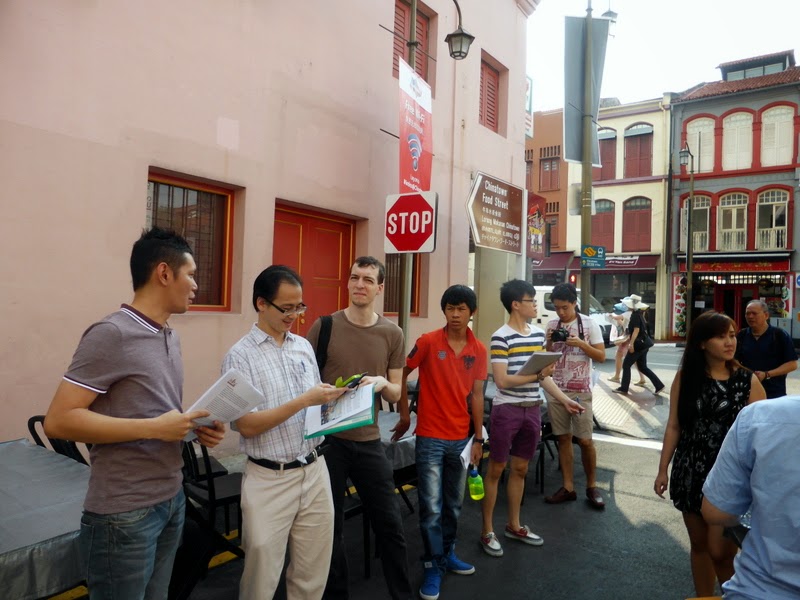
To walk the talk, well, at least part of the talk, I led a group underground to look at the wet market of Chinatown. There were quite a number of walks so that participants could select the walks that they were interested in to come up with an application idea. My walk started with the Food Street Walk, led by Wallace and Mei Ping of Select. Alas, it was a little early at 9.15am and so the group could not experience the atmosphere and got to see the stalls preparing and serving their food. The names of the food stalls were impressive as they were specially invited to set up shop here.


At the Food Street

We went into the cool with a faint smell of what a wet market should be. For the wet market enthusiasts, and if you are a cook or chef, you must be enjoying the smell, wet floor (hence wet market) and the chattering of the customers. Nothing like chatting with the stall holders, exchanging notes about not only the things they are selling, be it vegetables, eggs, fish or poultry, but also the mutual friends who could be just customers. "Ah, here are the fresh vegetables just arrived," the stall holder would call out to his regular customer, in Cantonese. "How to cook it?" asked the customer.


A wide array of vegetables

I was challenging my group, consisting of members from ITE (with their lecturer who is an expert on Asian cooking!) to A*STAR researcher, if they could identify all the vegetables being sold. The friendly lady stall holder responded almost immediately, in English, that I would give a prize if they could! I replied suggesting getting some fresh chillies as prizes :)

The Chinatown wet market of today is certainly more friendly to tourists than in the early days, although in those days, there would be excitement of snake killing along Trengganu St, when the wet market was on the streets. I hope that if we do more wet market tours, especially, with locals, we could generate more business for them. I remember the last time when I brought two restaurant friends from Sydney who were keen to know the local wet market scene, one fishmonger actually took up a huge fish to show them! Pictures were taken and certainly one plus point for us Singaporeans! :) To add to that experience, I brought them to enjoy one of our signature dish, the Fish Head Curry, where they could see how the head of that huge fish could be cooked and served. Another Italian friend, a Scientist visiting Singapore to share his know-how was so impressed by the Fish Head Curry that when he went back home, to US, where he is living, he actually cooked a Fish Head Curry for his friends. Ah, Singapore is not made known to more people. And the wet market was his favourite haunt, given his love for cooking!


Dried ingredients in the wet market

We meandered from row to row, looking at the dried ingredients so important to Asian cooking, then the vegetables, the poultry (alas, no live chicken to see - I always love to ask anyone whom I bring to the wet market what is the colour of the feather of the black skinned chicken - meat too), fish - certainly the place with the most smells (could not see the killing of the Toman or Snakehead), eggs (how to identify the salted eggs and century eggs), pork, yong-tow-foo and fruits.

We were running late but the participants seemed more interested in staying longer in the market! I hope they get to visit it again, and again. And if someone could develop some interesting mobile apps, it might help them identify the many things sold there. Of course, there is nothing like shopping and chatting with the stall holders, which my wife did, shopping as we went along, and sharing her stories with the group as well. Many of the stall holders speak Mandarin and English. Of course, nothing like chatting in Cantonese and seeing the animated face as the stall holder shares with you all kinds of stories.

Back to the Chinatown coLAB venue which had been shifted from the Tooth Relic Temple on Friday evening, this former OCBC (Overseas Chinese Banking Corporation as it was once called) has a very interesting and nice atmosphere that I thought was conducive to creative ideas. After another round of presentations, the teams that were formed on Friday night (I was told it is like speed dating except that you are looking for someone to complement you in forming a team so that you have the content providers and the techies who will develop applications for the POC - proof of concept). Wow, first time I was watching strangers approaching each other to seek them out, after the initial 1 minute pitch of his or her ideas to the audience on Friday night, after my supposed-to-be-inspirational-talk. :)  Although I was not involved in the team, on hindsight, I should have joined. But maybe, it would be too stressful for me. :)

Nevertheless, it was a great time, meeting the young people and getting to know them. Some asked me for more input and also bounced their ideas off me. Someone fed back to me that my blog posts were too few and too far in between. Ah, I must work harder! :)


All gathered, excited to see the ideas

On Sunday (30 Mar 14) afternoon at 2.30pm, the teams were ready! 16 ideas were presented, some complete with demonstrations of their applications! 3 minutes to present and demonstrate their ideas was certainly very challenging but all managed to put their ideas across, with proof of concepts demonstrated too!


 She came, she saw, she joined in .. presenting her team's idea

The guys at Chinatown coLAB certainly did a great job, with the support of members from CBA and STB. And with the objective of making heritage of Chinatown more accessible to both the Singaporean and foreign visitors, it looks like we are certainly on the way, the right way. I look forward to the fruition of some of these great ideas. Of course, a living heritage needs more than technologies. We will get to see more developments coming up. I like the comments that if Singaporeans find interests in Chinatown and through their more often visit makes it vibrant, the foreign visitors will be sure to follow. They want to know why the Singaporeans (not just Chinese) visit Chinatown. There are many interesting nuggets waiting to be discovered, not to mention that many associations such as the clan associations and arts groups are waiting for new members - young and old. Want to know more about the Chinese heritage? Come to Chinatown. Many of these organisations are already open to any Singaporeans.


Thursday, March 27, 2014

Clan Associations

In the old days, apart from the temples initially being the place for worship, they were also community centres for the Chinese to meet to seek help or employment (kind of employment centre as well). Soon as more people from the same town or village arrived, they started to form clan associations so that they could look out for each other. And then, in each clan, they would worship their ancestral patron Deity. As time went by and the members become well to do, arts began to flourish. Opera (of the dialect of the clan association), music group, Lion and Dragon dance troupe were formed. This gave the members activities where those who had the skills could share with the other members, especially the children as families began to form.

Schools became another necessary facility for the children to go to. Many early Chinese schools were started by the clan associations. Here is one posting on the Ning Yeung School set up by Ning Yeung Wui Kuan 宁阳会馆, probably the earliest clan association in Singapore.


And then, as the people got old there was a need for mutual help. Mutual Aid funds were started to help look after the old, to help the bereaved family in the expense of the funeral when they pass away. Some of the Teochew clans are well known for their "Kong Kuan" (percussion group) that would be performed during festive events, including temple celebrations, as well as for funerals. At that time, they would only perform for members only. In many clan associations, there are also a "Tang" 堂 (hall) where there is an altar where the tablets of members who have passed away are placed. Many clan members in the early days, especially the single coolies and majie, would reserve a tablet in their clan association knowing that they might not make it home (back to China). Sadly, many died without their friends knowing that they had already reserved their own tablets in the clan association. You could see fading red papers still covering these tablets in the Tang.


At the last count, through my walk along the streets of the greater Chinatown (Dai Po in Cantonese, Tua Po in Hokkien/Teochew and Da Po in Mandarin), I have counted some 55 of such clan associations in this area alone. While there are much more all over the older parts of town, that spans from Geylang Road to Jalan Besar and Beach Road (check out this facebook group on clan associations), most of the oldest clan associations were set up in Chinatown.

Because of urban renewal programme in the early days, some of the clan associations have moved. The Cantonese ones moved into the inner part of Chinatown, such as Ang Siang Hill or Keong Saik Rd. Some moved to Geylang which seemed to be the next concentration of clan associations. Some Hokkien clan associations could be found in Telok Ayer St and Amoy St area. For the Teochew clan associations, they are probably found more in Geylang and Upper Serangoon (Hougang), that was known to be where the Teochew live (more of the country side). These are my very general observations that would need deeper studies.


The Chinatown portal provides some information on the clan associations. The URA has also been active in promoting heritage and conducts tours to clan associations during events like Heritage Fest and the coming Chinatown coLAB event (which is an interesting project between CBA - Chinatown Business Association - and STB - Singapore Tourism Board which brings together interested participants to come up with ideas on how to leverage digital technology to record, store and share knowledge, experiences and information on our Chinatown heritage).


While quite a number of clan associations are hoping to get more younger members to join and be active in the activities of the association, there are also a number of the associations which are active with many activities. There are some associations where you can find the old people gathering each day to meet up old friends and chat (how many could speak the beautiful dialects?). There are some with programmes such as opera singing, wushu (martial art) and lion/dragon dance that are bringing in new members of various ages. The younger members are beginning to make their associations known in the cyberspace work, notably in the facebook where most of the youngsters "meet", and probably moving to Instagram as well. Events were uploaded to these sites almost instantly to be shared with friends. Some went viral within minutes.

In the old days, clan associations were there to serve many purposes. Self help within the community from the same place back home was the main objective. In later days when businesses were growing, clan associations provide the linkage to fellow clans around the world. These days, various clan associations in different parts of the world take turns to host international conference of the same clan associations. Singapore has been one favourite place and many of our local clan associations have hosted such events. When you see fellow clansmen (similar with women) meet and greeting each other in their local dialect, you can see and feel the familial warmth! Of course, in conferences, the official language would be Mandarin (the putong hua) and the dialect, as many descendants could not longer speak their "mother tongue".

Today, most of the young who are born in Singapore do not see any need of the clan association, unless they have been brought there when young and appreciate the linkage to the ancestors as well as fellowship with the same clansmen. Hence, there is a challenge for the associations to see renewal in membership and leadership. But it could be seen that there is still hope as some clan associations have shown the way.


Of the buildings conserved in Chinatown, probably, some of the most outstanding ones are those of the clan associations. Sadly, some were demolished before their heritage values could be appreciated.

Monday, March 17, 2014

Haw Par Villa Revisited

Many older folks in Singapore would know Haw Par Villa as Haw Par Bit-su (in Hokkien). To probably the English-speaking world or the tourists, maybe would know it as Tiger Balm Gardens. What an innovative way to introduce one to the garden and to the world famed Tiger Balm. It is a "cure-all" that my grandma and mum would use, from mosquito bites to bed bugs (in the old days, they were our constant companions) to headache and sniffing noses. We would use the white cream (although the red cream is said to be stronger, they stained the clothing) and oil. One could almost never get away from it, be it in a bus or even in a plane when the old folks travel!


Haw Par Villa is a favourite place for us kids in the old days but we got to visit it only during the Chinese New Year holidays. That's the time when our parents would bring us there, probably the cheapest to go because there was no admission fee and all we needed was bus fare. Although I have been to this park for many a times, I could not fully understand all the characters there. Apart from the marketing part of it (which was also great for us to see miniatures of other countries), it was Chinese mythologies and teachings. Grandpa (interestingly, in such a case, grandpa would take over, well, in my case, it would be my father who came from China) would be seen as the authority on the stories of ancient China.


Ancient China has three teachings (I would consider them as teachings, to be closer to the Chinese description of them as san jiao, meaning three teachings, versus religions) that cross-influence society since a long time. As a result, we have the best of all worlds in having a better society. If we were to adopt, that is. In modern times, much of the teachings have gone down the hill in a rapid and frightening diminishing rate. Haw Par Villa might help to arrest the slide and kick off an interest in our young and not so young about our cultural heritage, which is part of Singapore's cultural heritage.


But I leave the discussions on Haw Par Villa, its colourful history (the park and the original owners) and characters to the forum at this facebook group known as Friends of Haw Par Villa.

The Chinatown Connection
In the greater part of Chinatown, you can say that it is just at the outskirt of Cantonese speaking Chinatown, at the corner of Craig Road and Neil Road is an iconic building. This is the building that has seen many different tenants in succession over the years. The residents of Craig Road, which was where I enjoyed my childhood, called this building simply as Eng Aun Tong or Aw Boon Haw (after the person who ran this business with his brother, Aw Boon Par - more stories about them can be found in Haw Par Villa facebook page or in a recently published book on Aw Boon Har (in Chinese) by the Char Yong Association.

The Aw Family stories span from China to Burman (Myanmar) to Malaya and Singapore, and HongKong (which used to have a Tiger Balm Garden as well, but I understand that it is no longer there). More information can be found on Aw Boon Haw from the National Library.


Back to this iconic building. In the 50s, when I was still a kid, running up the length of Craig Rd, oblivious to the existence of any secret societies or gangsters, I used to go to the Aw Boon Haw building, especially in the evening. In front of the main office, which would have been closed, would be placed a charpoy (a rope weaved bed on strong wooden frame) where the Indian Jagas would be sleeping or rather lying down and ensuring that no one tried to break in. As kids, we could sit and lie on the charpoy much to the amusement of the jagas.

I remember one of our neighbours (we were just a tenant family in this house along Craig Rd which had many tenants with a rather strict Bibik - Peranakan lady) was working in the Aw Boon Haw building. I think on the upper floor was a factory or assembly plant. The ladies would be wearing light blue samfoos to work. At 4pm each day, they would end the day and that was when we would see them streaming out of the building.


There seemed to be a warehouse (we were not so curious in those days) on the other side of what used to be the railway track (long before my time) which was then a basketball court and park on which the Chin Woo pugilistic association would have their martial arts (including Taiji) and lion dance training. At that time, it seems like Chin Woo was the only association with the northern lions. Oh yes, the warehouse was the place where the jaga would live during the day. Where the warehouse was, today it is part of the huge Pinnacle flats.

When I was much older and could take a bus to Pasir Panjang Road where the Haw Par Villa is, I would sometimes meet the same jagas there.


Diagonally across from the Aw Boon Haw building, on the row of shop houses, is the Eng Teng Association which was supported by Aw Boon Haw. The Aw family came from Eng Teng (Yong Ding) in Fujian province, I wonder if they were a member of this association. You can see the names of Aw Boon Haw and Aw Boon Par inscribed in many stelle in Malaysia and Singapore, as they donated generously to the society. In another Hakka Guild in Singapore, the Nayang Khek Community Guild, you can also find the connection.

Will Singapore remember Aw Boon Haw's legacy? I think the Haw Par Villa and the Eng Aun Tong building probably will be the visual memory, with much information kept in the National Library and the related Hakka associations.


Wednesday, January 29, 2014

It's Chinese New Year again!

How time flies, and when such festivities arrive, it triggers a flood of memories. One could help looking at the present and comparing with the past. Nostalgic memories came flooding, and these days with social media and more heritage gatherings, there were more sharing. I realise how little I know about the Chinese New Year (CNY) festivities.


In the Cakap Heritage organised by the Singapore Heritage Society (SHS) and Urban Renewal Authority (URA) on 25 Jan 14 at the URA Centre, many participants shared their experiences, as well as what they heard from their parents and grandparents. We all know that buying flowers was always part of CNY, but I never gave it a thought about the symbolism of different flowers, of which some soothe sayings could be found. And it might differ from say, Cantonese to Hokkien. If the older folks could be persuaded to such events, it would be a great gathering, but then, even four hours would not be enough as torrents of memories flowed as each participant began sharing their younger days.


What what has changed? For sure, to me, getting the traditional Chinese New Year cards is quite challenging, In the old days (say in the 60s, and even later), one could find the Chinese New Year cards in almost every other stalls lined along Pagoda St and the other streets. Many came glittering with the golden specks. Cards of 15 cents to 30 cents are now more than a dollar. Yes, there are still cheaper ones if you look hard enough. What has replaced them? There was the SMS (short messages) that came with words being formed to give some pictures. Then, it was pictures over MMS. Now with new mobile apps, it would be animations over the likes of whats app. The trickle of such messages would start early on CNY eve and breaks into a rush as the clock reaches midnight.


Chinatown, to many would mean the "inner or Cantonese part of China" is still very much alive comes Chinese New Year. This year, it seems to me that the streets were especially crowded. The Taiwanese mochi probably took the main stage with their offerings. The sackfull of kuah-chi (melon seeds) and peanuts were found in different stalls with similar set up, a franchise or chain? The Farmer brand peanuts are still there, my favourite as I like the boiled nuts.

Surprisingly, amongst the stalls were those offering Wedding packages and yes, mobile phone package promotions! From the look of it, they were getting interested customers.


There are the traditional "waxed" products, meaning the Chinese sausages, waxed ducks & chicken, Yunnan Ham and an assortment of the salted pork. There are so many kinds of Chinese sausages that one can find. You can find them at Smith St where there are two. In the old days, not sure if it is still being practised widely, some of these products could be bought as gifts to the in-laws or well, the future in-laws. Apart from these would be the popular canned abalones, dried Shitake (mushrooms) and deep fried fish maw. And for sweets, for many tee-kueh (or Nian Gao in Mandarin although they could mean other things) is a must. For the traditional Chinese, tee-kueh (sweet cake) is a must to offer to the Kitchen when sending him off to the Heavens for his annual reporting - 24th day of the 12 lunar month. The tee-kueh is sweet and sticky and so you can imagine what effect it has. (^^) For the traditionalists, they would look for tee-kueh (lin koh in Cantonese) in Tai Chong Kok and Tong Heng. Authentic tee-kueh should become hardened after a couple of days. And later, they make great desserts, be it being sliced and deep fried with batter or steamed and eat with freshly grated coconut.


Probably a decade or so ago, lohei became very popular (the tossing of various types of vegetables symbolising all the great things in life with fish, which is also a symbol) and it has become a must, first in the restaurants, and then, takeaways to do it at home. And then, because of time (or is it because of kiasuism?) lohei starts way before the start of the new year! This year, in Chinatown there is a new addition in special offer - German sausages! Won't the kids love it. I suppose you can still toss them, but label them with some special meanings first. (^^)


Chinatown only becomes crowded and bright in the month before the CNY day. The two weeks would probably be the start of the rush with the crescendo reaching on the eve of the eve. Of course, on CNY eve, after reunion dinner, many would flock to Chinatown to look for cheap sales. On the morning of the CNY eve, the wet market would be a place of chaos as many would be shopping all the fresh stuff for the cooking on CNY Eve Reunion dinner and the days to come. In the old days, the town would be dead from CNY Day to as long as fourth or fifth day. For some longer, for others shorter. Some might consult their fengshui book (Tong Shu) to see which day is good to open the door of the shop or office. Many Chinese would tell you that they start CNY with Chinese food and then follow with Malay or Indian food because many Chinese stalls would be closed. Not today!. Many reunion dinners are held in the restaurants and said to be in the Food Centres too. Besides, there are so many kind of restaurants available these days.


With the active participation of the community organisations more events are organised in Chinatown. There is the lights-up, the crossing into the CNY and the Cap-Goh-Meh (15th Night of the CNY). And so, crowds wanting to have fun and see the sights and sounds would be going to Chinatown for it. There's nightly getai at Chinatown Square. It was always crowded with the people, mainly the middle-age ones, who would sit and enjoy the Chinese songs, that could be in various dialects and Mandarin. There are also Chinese dance performances.


This year's decorations on the streets of Chinatown - along Eu Tong Sen St with New Bridge Rd and along South Bridge Rd - can be said the best collectively. This probably also brings in crowds who want to capture them with their cameras or phones, both in the daytime and at night. A great atmosphere as we are ushered into the year of the Horse. But what will it bring? We don't know but for sure, we cannot afford to be horsing around. :)

Saturday, September 28, 2013

Bidding a neighbour farewell

As I came home, I spotted a red piece of paper pasted on the wall between the two lifts. Hmm, someone has passed away I thought to myself, but there was no sign of a wake downstairs in the limited space within my block of flats.

Later, the son came to inform that his father has passed away. Since suffering from a stroke and gradually recovering, we have seen less of him. It was still a shock to learnt of his passing in the hospital, not from the problem that he went there for.

Last night we went to the wake that was put up in a neighbouring cluster of HDB flats that have a bigger space for the wake. It seems that the neighbourhood (if there is still the same impression, and the neighbours who really know each other) got to meet each other and sit down to chat only during wakes. Koptiams are no longer the watering holes of the old, save a few. So, at best was "a good morning, wah your children have grown, how's your parents?" ... the usual questions, often waiting or inside the lift, where more of the people are strangers. Kids and pets are usually the ice-breaking points.

Back to our neighbour. We must have been neighbours for a good 40 years, since the urban renewal when many people from the old pre-war houses of the Teochew community (around the then Ellenborough Market that is not wiped out of the area and replaced by the Central shopping mall) and the Cantonese & Hokkien community (in the Chin Chew St to Hokkien St area). I was "married in" to stay with my later mother-in-law because of the HDB policy. But that's another story.

I remember this neighbour as a strict and yet doting father, as his son-in-law described him in his facebook page. More so as a grandfather as he tried to balance being a strict and yet dotting grandpa. As we are next door neighbours, there was more than the passing conversations. The ladies of the row of apartments between the lift and the end of the row were probably the main communicators. And then, the children. Imagine in this row, we have Teochew, Cantonese, Hainanese and Hokkien. No problem, we could communicate, in one of the dialects.

In the early days, my (would be) mother-in-law was very frugal. She knows what is poverty and would not spend more than what is necessary. When we treated her to a meal outside, and she found out that they "yau-choy" (you cai) cost much more than what she could buy from the wet market and cook, she chided us for wasting money. I remember those days when we wanted to watch live telecast of the National Day parade, we would hop over to his house to watch. His kids were still young then.

In 1976, I was sent to Japan for training. I was given a 20 minute "collect call" (meaning I make a call from Japan and Singapore pays, in this case, my company) back to Singapore. But I had no phone at home, or my then girl friend (now my wife). We found out that our neighbour had a phone and so we asked to use his phone. Imagine the trouble we caused to him and family each time I called back, once a week, for some 16 weeks!

And when he went shopping for his favourite Teochew kueh, he never forgot about us. We got to eat the best Teochew Png-Kueh (the pink cake in the same of a peach but flat) and Tsu-Kak Kueh (the black version of Ang Ku Kueh using the leaves of a plant for the flavouring of the skin).

When our kids came, they would often pop over next door. Interestingly, just at about meal time. Kids are great in their art of getting what they want. They would tell the wife how her cooking smells so nice. And when they returned home, they announced that they already had their dinner!

While he has seen our kids grow from babies to what they are now (hovering around 20s), we have seen his kids grew, got married and have kids.

As modern vertical communities do not have much common facilities for interactions, unlike a kampong or a street community, where there is always the inevitable coffeeshop or temple, communications amongst neighbours are few and sometimes far in between. Like the Chinese would say, we probably meet and communicate more during red (weddings, baby month old celebrations) and white (death) events. Despite the short and few communications, we appreciate the neighbourliness and care of our neighbour and his family.

With sadness and acceptance of the inevitability, we thank him for all the wonderful times and for taking care of us and our children in many ways and wish him a smooth journey ahead. To his extended family, we offer our sincere and deep condolences.


Sunday, September 01, 2013

MId-Autumn Festival is just around the week

As if to chase away the "yin" energies away, Chinatown Singapore will welcome the Mid-Autumn festival with gusto, plenty of "yang" energies.

As I strolled through the streets of the "inner" Chinatown, also known as Gnau Chair Shui or Bullockcartwater this evening, I noticed that lanterns were being displayed. A couple of moon cakes too. I could not help reminiscing the olden days as I strolled down from Sago lane through Tregganu St into Pagoda St and the along New Bridge Rd. How much had changed other than the remaining standing shop houses?


For a start, my wife and I decided to have a picnic in Chinatown. Yes, with Bratwurst, Gherkin and Sauerkraut with Stiegl Weissen! At the only Wurstelstand in Chinatown, just above the equator. In my younger days I would not have even imagined about this meal! Enjoying the wurst (sausages) and listening to the chattering of Hokkien (interestingly, I would have expected Cantonese) in the coffeeshop, I noticed quite a mix of population. There was Austrian, Thai and Chinese food. There must be at least some four to five languages being spoken at any instant. In the old days, at this place, it would have been only Cantonese.

After a fulfilling meal, we decided to take a slow stroll back. Ah, the old Wurstelstand has become a perfume stall! And just across from it were hung new plastic inflated lantern lookalike. Now, what would be the new additions this year. You can guess as much when you see the picture.


In the old days, my wife and I (well, we were kids then) would run to this small stall with kindergarten chairs to have our favourite yau-yi-ong-choy (cuttleflish with kangkong) but those would only remain in our memories. I am trying hard to remember the crunch of the jellyfish and the taste of the dark red sauce with chill, and visualising the ever fierce and strict matriarch overseeing her daughter and daughter-in-law. It is becoming cloudy these days. What I saw was Tiger Beer and Chilli Crab. In Chinatown!! Yes, in the old days, it would be difficult to see any foreigners in Chinatown at night, but these days, it might be the reserve. One small kid was stopped just in time by his father from erasing the chalked writing on the menu-board. Ah, the wan-pi (mischievous) kid, who would have risked a thrashing in the old days.


Wow, the romantic red lantern with the Chinese characters "Double Happiness" beaming the soft rays on the foreign couples as they enjoyed the Singapore food.

More lanterns, these time some of the old versions similar to those in the 50s. My wife was complaining that they are not adding the gills to the goldfish! Why did you know, I asked. She remembered being paid five cents to paste the gills onto these fish lanterns.


In the old days, Chinatown would have been the place to buy moon cakes, especially the Cantonese moon cakes. These days, while famous old names like Dai Chong Kok (Da Zhong Quo) still thrive, most of the moon cake businesses seem to be centred around hotels selling them as corporate gifts. Vivo City has become one of the biggest Moon Cake fairs!

Chinatown is going to usher in the 8th Moon (lunar month), which begins on 5 Sep 13, with a light-up on Saturday 7 Sep 13. Many activities have been planned. You now almost don't need any paper to know the schedules (well we still have any senior citizens who have yet to get into the net) as all the details could be found here: Chinatownfestivals  Well, this young man came to offer me a pamphlet and invited me to the event. Down the road, he might tell his own story of our Chinatown. (^^)


And soon, kids and adults alike will be reminded of the stories centering around the Moon and Autumn (which has not climatic bearing in Singapore), yes, with food as well such as moon cake (but of course, and with it history and stories of ancient China), water caltrops, small yams and pomelos.


Wednesday, August 14, 2013

Seven Sisters

A few decade ago, on the 7th day of the 7th Moon (lunar month) and you are likely to see the celebration in hour of the Seven Sisters, known to the Cantonese as "Chart Jie" (Qi Jie). There would be big displays as the young ladies would celebrate.

In the book written by See Cheng, there was a chapter on the Seven Sisters.

Poster at the Chinatown Heritage Museum

On the eve of the 7th of 7th Moon, as I was walking home along New Bridge Road, I chanced upon this offering being placed and prepared for prayers. In the Chinese concept of time, 11pm of the day is the beginning of the next day.


Some friends commented that they remembered that "Chart Jie" celebrations were commemorated on the actual day of the 7th. Interestingly too, in the old days, most temple events would start on the beginning of the actual day, meaning perhaps, dawn. These days, most would do it at 11pm on the night before. But we know that we welcome the Chinese New Year on the even at 11pm. A trend for other celebrations perhaps.

I am looking for more tales of the celebration of the 7 Sisters.