The Tiger is on his way out. The fun rabbits are waiting to hop in. Tonight, Singapore Chinatown, better known as Niu Che Shui 牛车水 or Ngau Chair Sui (Cantonese) or Gu Chia Chwee (Hokkien) or Kreta Ayer (Malay), and probably more names to it, was lighted up, preparing for the welcome of yet another Lunar New Year.
With my wife, we decided to do an 'inspection' of Chinatown this afternoon to see what's new in preparing for the new year. We probably have been pounding the streets of Chinatown - particularly Smith Street, Temple Street and Trengganu St - for more than 50 years. Each year before the Spring Festival (met an old guy at the Heritage Exhibition who advised me that in China, we should say Chun Jie 春节 and not Xin Nian 新年), we would eagerly join in the jostle to see what's new. In the old days, we were probably hoping to get our new clothes. These days, it is not so much about clothes but about what to buy for the family and to add more colours to the house.
Upon entering Temple Street, despite the touristy atmosphere (imagine the Olde Cuban in Chinatown!), we could sense more colours of red. Many usual stalls seemed to have made way for the once-a-year stalls selling goodies for the Chinese New Year.
"Come and try it, it's free," yelled the guys across the street. "Just arrived from Taiwan, " they added. There was quite a selections of sweets from jelly like (Konyaku?) to mochi. And there were also the melon seeds, disguised in many forms such as green tea melon sweets. And there were the black groundnuts!! It would be quite a challenge to look for the traditional black and red melon seeds and the boiled groundnuts. But of course, they are there, displayed in better forms.
Despite all the free ang-pows (red packets) from the banks, retail stores and even petrol kiosks, we were attracted to the beautifully designed ones. Offers were at S$1 to S$2 for a pack of 6 to 10. There were also cute paper bags for one to put two mandarin oranges when one goes visiting or paying the Chinese New Year respects to the elders. And stickers of all kinds for one to paste on the walls in the house, including nice ones of Shen Cai (the God of Wealth). Electronic fire crackers that would 'explode' upon being touched was a delight amongst some, scaring the wits out of the unsuspecting shoppers.
To the more serious Chinese New Year shoppers, the "lap-ark" (waxed duck), "lap-cheong" (Chinese sausages) and other delicious ones like the famous Yunnan Ham, were their targets. It's the time when I longed to have just hot steamed rice with the steamed lap-ark.
Walking through the lane to Sago St, there were already the flowers of the Chinese New Year being offered. There were also some pots of bare branches .. the plum flowers that bloom in winter. The pomelos were also in abundance, and Pakistani mandarin oranges were being offered at S$1 for four. Across the street, our Austrian friend was kept busy with orders for his Bratwurst and other wursts.
At the Chinatown Square, the usual draughts (dum) players were oblivious to the noises around them. This lady busker was singing karaoke with participation from the old men. Apparently, she was familiar to many of them, and they she. She encouraged the onlookers to take the seats (the chairs were arranged for performance in the evening) telling them that they sit facing her in the day and could stay on to turn to face the main stage in the night. With a great voice, she certainly did attract a number of guys to go and sing duets with her, be it Mandarin or Hokkien songs.
At one corner, a little exhibition was being set up. It was a small mobile display on the Chinese New Year - the stories about the Rabbit and also the Reunion Dinner. Wife noticed a bottle of Champagne in the picture. Wow, these people had seen better lives in the days when we weren't that fortunate.
The mobile exhibition from the National Heritage Board and that of the paper cuttings depicting Singapore scenes were certainly great opportunities for strangers to chat. One old guy thought that I was a reporter, but I told him these days, it doesn't matter as we could report in our blog. (^^). He was saying that the exhibition was a good idea to share with the tourists. I added in that it was too for some of our kids and even ourselves. Another was showing his young daughter or niece the pictures and was sharing with me that these kids did not know about the scenes of the 50s. I heartily agreed with him. The young lady must have heard more from him after my encouragement. (^^)
Cai Shen must be one of the attractions of the Lunar New Year. And so, there must be an icon of him. I found him facing the confluence of the Maxwell and South Bridge Rd with Neil Rd. Yes, I think we are ready for Chinese New Year, or the Spring Festival.
Sunday, January 16, 2011
Monday, January 03, 2011
Chinese New Year is in the horizon
It's a Monday, the first working day of the new year for most. For students, and those on 5-day week, it's tomorrow. I went to the barber's thinking that it would be a quiet day. It was noon when I reached one of my regular barbershop. Oh, there was a queue. Not too bad, just half an hour's wait.
As I sat and read my book, with the occasional check on the movement within the barbershop, and being distracted by activities around me, I could not help thinking. Hmm ...in the old days, barbershop was for the men and boys. Hairdressers were for the ladies and girls. It was relatively cheap to have a haircut compared to a lady's cut, wash or perm. Ah, the Hokkien ladies would say, I want to go and "dian tao mern" (electrify the hair, meaning making permanent waves on their hair).
It seemed to be the custom that for the guys, they must go and have a hair cut before the Chinese New Year! For many busy guys, they would be trying their luck at the last minute, desperate for a haircut before the reunion dinner. Probably so for the ladies too. For them, a new perm would probably be the norm. These days, there's so much choices.
The men's haircut probably hovers at S$10 with some shops offering as low as S$6 in Chinatown (competition?) on weekdays. And it is unisex these days with many ladies going for the haircut. I saw one lady bringing her elderly mother to the barbershop for her haircut. Nothing fanciful, but functional. Haircut in Singapore has also joined in the "fast delivery" chain. 10 minutes and it is done.
So, have you gone for your haircut yet? Before the price increase starts. Or would they? Perhaps, the traditional ones.
As I sat and read my book, with the occasional check on the movement within the barbershop, and being distracted by activities around me, I could not help thinking. Hmm ...in the old days, barbershop was for the men and boys. Hairdressers were for the ladies and girls. It was relatively cheap to have a haircut compared to a lady's cut, wash or perm. Ah, the Hokkien ladies would say, I want to go and "dian tao mern" (electrify the hair, meaning making permanent waves on their hair).
It seemed to be the custom that for the guys, they must go and have a hair cut before the Chinese New Year! For many busy guys, they would be trying their luck at the last minute, desperate for a haircut before the reunion dinner. Probably so for the ladies too. For them, a new perm would probably be the norm. These days, there's so much choices.
The men's haircut probably hovers at S$10 with some shops offering as low as S$6 in Chinatown (competition?) on weekdays. And it is unisex these days with many ladies going for the haircut. I saw one lady bringing her elderly mother to the barbershop for her haircut. Nothing fanciful, but functional. Haircut in Singapore has also joined in the "fast delivery" chain. 10 minutes and it is done.
So, have you gone for your haircut yet? Before the price increase starts. Or would they? Perhaps, the traditional ones.
Sunday, November 28, 2010
The Dog who rules Chinatown
Yesterday, as I was on my "patrol" of Chinatown, cutting into my way was this dog. Could anyone identify the specie? Oblivious to me nor to anyone walking infront, by the side and behind him, he walked, at its own pace, apparently knowing its way. He walked alone with the owner trailing behind.
The proud owner (I am not sure who owns who) declared to anyone who wants to hear, in Mandarin, that his dog knows its way home. He even offered anyone who wanted it. I suppose with a dog which knows its life, it is not going to happen.
The many pet-friendly people were soon trying to pat it or follow it. Ah, probably this chubby dog will beat any baby to it! Apart of pausing awhile, obliging the pats occasionally, it strolled its way home.
Let's see if our paths crossed again. If so, I might want to interview it. (^^)
Ah and this brought to mind an old black dog who lived in my block. That must be some 2 decades ago. It lived on the 4th storey, where there are associations/offices with an open air space. When it felt too tired to climb up the stairs or walked down the stairs, it would take a lift, waiting patiently for it to stop and open. Sometimes, it would patiently wait for the lift to go up to 19th storey before descending down to ground floor to get out. Those who knew it, would help to press 3th storey for it to get out when going up.
A dog's life in Chinatown.
The proud owner (I am not sure who owns who) declared to anyone who wants to hear, in Mandarin, that his dog knows its way home. He even offered anyone who wanted it. I suppose with a dog which knows its life, it is not going to happen.
The many pet-friendly people were soon trying to pat it or follow it. Ah, probably this chubby dog will beat any baby to it! Apart of pausing awhile, obliging the pats occasionally, it strolled its way home.
Ah and this brought to mind an old black dog who lived in my block. That must be some 2 decades ago. It lived on the 4th storey, where there are associations/offices with an open air space. When it felt too tired to climb up the stairs or walked down the stairs, it would take a lift, waiting patiently for it to stop and open. Sometimes, it would patiently wait for the lift to go up to 19th storey before descending down to ground floor to get out. Those who knew it, would help to press 3th storey for it to get out when going up.
A dog's life in Chinatown.
Friday, November 05, 2010
Li Jia Ba Buay 你吃饱没?
A couple of days ago, as my wife and I went into the lift, we met this friendly old man, who lived a couple of floors down. His greeting to us was "Li Jia Ba Buay 你吃饱没?" in Hokkien, which is "have you eaten enough" (ba in Hokkien is full). I suppose this has been the greetings between Chinese in Singapore for a long time. Even in China too.
It was some 20 years ago, when even in China, the greetings have started to change from "Li Jia Ba Buay" 你吃饱没? to "Li Jia Ho Buay"你吃好没?, meaning "have you eaten?". In Mandarin, it would be Ni Chi Bao Le Ma 你吃饱了吗 to Ni Chi Hao Le Ma 你吃好了吗? In our exchange of notes between friends in China and Singapore, we agreed that perhaps times had changed and it was time to use the latter greetings.
In the old days, hunger would probably be the constant in many of the lives of Chinese. It is also true in old Singapore. For the elderly, who are probably in their seventies now, their greetings would have already been ingrained in them.
And so, in Chinatown, it could be greetings in Hokkien, Teochew, Cantonese or any Chinese dialects, such greetings would still be the same. Listen for the key words the next time you come across such a greeting. Of course, in the morning, it would be Gao Zha (in Hokkien or Teochew) and Jo San (in Cantonese).
Ths same old man who greeted us on this morning, he has been collecting the discarded cardboards (from boxes) and read newspapers to sell as part of his income. While it could have been his means of income and survival, unknown to him and to many, he helps to recycle many materials which would have found their way to the garbage dump or incinerator, long before the word green become vogue. He must be in his 70s now, a tad older, slimmer and less steady, but he carried on his work.
There was another friendly old man in the block whom I used to meet, almost on the daily basis some 10 years ago, if my memory does not fade. He worked hard collecting the cardboard boxes, flattened them and pushed in his little push card to sell. He worked hard so as to help his son go to school, university right to his PhD, I was told.
Unknown to many, he is amongst many of the builders of modern Singapore, pushing relentlessly on themselves so that their children could have a brighter future. And collectively, the nation - Singapore. They might be illiterate, but they are educated (through operas, through story-tellers, through radios and TV) and they are very focussed on their vision and mission. A better tomorrow for their children, and their children's children.
We must remember the "source of the water from which we drink from" as the saying goes. Yin Shui Si Yuan 饮水思源
It was some 20 years ago, when even in China, the greetings have started to change from "Li Jia Ba Buay" 你吃饱没? to "Li Jia Ho Buay"你吃好没?, meaning "have you eaten?". In Mandarin, it would be Ni Chi Bao Le Ma 你吃饱了吗 to Ni Chi Hao Le Ma 你吃好了吗? In our exchange of notes between friends in China and Singapore, we agreed that perhaps times had changed and it was time to use the latter greetings.
In the old days, hunger would probably be the constant in many of the lives of Chinese. It is also true in old Singapore. For the elderly, who are probably in their seventies now, their greetings would have already been ingrained in them.
And so, in Chinatown, it could be greetings in Hokkien, Teochew, Cantonese or any Chinese dialects, such greetings would still be the same. Listen for the key words the next time you come across such a greeting. Of course, in the morning, it would be Gao Zha (in Hokkien or Teochew) and Jo San (in Cantonese).
Ths same old man who greeted us on this morning, he has been collecting the discarded cardboards (from boxes) and read newspapers to sell as part of his income. While it could have been his means of income and survival, unknown to him and to many, he helps to recycle many materials which would have found their way to the garbage dump or incinerator, long before the word green become vogue. He must be in his 70s now, a tad older, slimmer and less steady, but he carried on his work.
There was another friendly old man in the block whom I used to meet, almost on the daily basis some 10 years ago, if my memory does not fade. He worked hard collecting the cardboard boxes, flattened them and pushed in his little push card to sell. He worked hard so as to help his son go to school, university right to his PhD, I was told.
Unknown to many, he is amongst many of the builders of modern Singapore, pushing relentlessly on themselves so that their children could have a brighter future. And collectively, the nation - Singapore. They might be illiterate, but they are educated (through operas, through story-tellers, through radios and TV) and they are very focussed on their vision and mission. A better tomorrow for their children, and their children's children.
We must remember the "source of the water from which we drink from" as the saying goes. Yin Shui Si Yuan 饮水思源
Tuesday, October 19, 2010
Singapore in 1957 - see part of Chinatown
Thought that this footage on Singapore might bring back memories for some of you, especially on Chinatown.
Come share your memories then.
Saturday, September 11, 2010
Chinatown welcomes Autumn
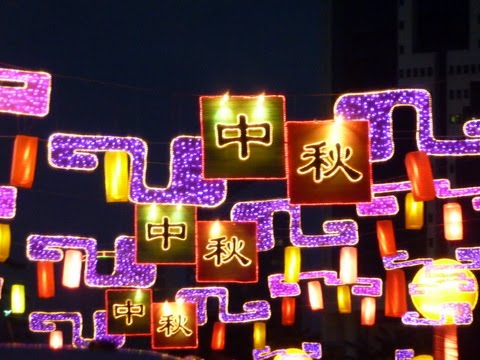
Tonight, 11 Sep 10, Chinatown in Singapore welcomes Autumn with a lights-up and grand performance as we prepare for the Mid-Autumn Festival - Zhong Qiu Jie.
What was missing were the delightful clear-glass lanterns that would have been of fishes and even aeroplanes (considered as modern then). Tonight it was modern technologies in full display with dance modernised with modern beat. Something that is atuned with the younger Singaporeans.
While the older people sat back, or rather stood, to watch the performance, it must be the performers who enjoyed and probably appreciate the Mid-Autumn festival of current times.
With full grandeur, performance after performance graced the stage and carried on to perform on the streets to the people who came from afar to watch. It was an event where Singaporeans, working foreigners and tourists came together to enjoy.
Wait, it was not just the younger people who performed with their energetic leaps and dance, the other slightly older group from Sokka Association was also there - 36 of them I heard, performing the fusion line dance!
The young parents and the grandparents must have been the ones busy trying to carry their children/grandchildren over their shoulder to get a glimpse of the actions. An introduction to the culture of Singapore. Just the beginning.
What was missing were the delightful clear-glass lanterns that would have been of fishes and even aeroplanes (considered as modern then). Tonight it was modern technologies in full display with dance modernised with modern beat. Something that is atuned with the younger Singaporeans.
While the older people sat back, or rather stood, to watch the performance, it must be the performers who enjoyed and probably appreciate the Mid-Autumn festival of current times.
With full grandeur, performance after performance graced the stage and carried on to perform on the streets to the people who came from afar to watch. It was an event where Singaporeans, working foreigners and tourists came together to enjoy.
Wait, it was not just the younger people who performed with their energetic leaps and dance, the other slightly older group from Sokka Association was also there - 36 of them I heard, performing the fusion line dance!
The young parents and the grandparents must have been the ones busy trying to carry their children/grandchildren over their shoulder to get a glimpse of the actions. An introduction to the culture of Singapore. Just the beginning.
Hakka Songs Event @ Hong Lim Green
On 10 Sep 10, the Hakka community in Singapore and Malaysia came together to share a night of singing at the Hong Lim Green. Thanks to modern day Karaoke system and disks, there were plenty of songs from which the participants could use to sing and perform.
To the delight of the grandchildren who called out to their grannies as they walked to the stage to sing their favourite Hakka songs. There must have been some three to four generations of Hakkas present at this event. And there must be more than 200 of them as they sat, listen and cheered the performers on.
And from Johore came four members dressed in kabayas.
With the popular Taiwan soap opera on the TV, this Hokkien song also has a Hakka version.
To the delight of the grandchildren who called out to their grannies as they walked to the stage to sing their favourite Hakka songs. There must have been some three to four generations of Hakkas present at this event. And there must be more than 200 of them as they sat, listen and cheered the performers on.
And from Johore came four members dressed in kabayas.
With the popular Taiwan soap opera on the TV, this Hokkien song also has a Hakka version.
Mid-Autumn Festival comes to Chiinatown
As Chinatown feted the Good Brothers with grand offerings and sending off, the scene changes very quickly. 8 September 2010 is the first day of the 8th Lunar Month. The 15th of the 8th Moon (as described in Chinese) is the day dedicated to the full moon in the cool Autumn Night. In Singapore, the cool Autumn night might be missing (but who knows as cool to the Singaporeans could just be a drop of one or two degrees) but the celebrations will be colourful and loud. And almost hot!
As we await for the lights-up on 11 September, hours away, here is a sneak preview of what it is like this year.
Tuesday, August 31, 2010
Ghost Festival in Chinatown - Zhong Yuan Jie 中元节
Chinatown used to have many activities during the 7th Month or what is known to the English speaking world as Ghost Festival. And it would happen at various spots in Chinatown. Chinatown is known to most Singaporeans, and probably the world, to be from Sago Street to Temple Street, where the streets are interlinked by Trengganu St. These days, the ghost festival activities are somewhat concentrated in the still available free space next to the Tooth Relic Temple. But then, the activities are getting bigger and when there is a getai (variety show) on the street, then it would be jam packed.
I went to the Kreta Ayer Square (next to Chinatown Complex, which houses the wet market, small shops and a food court) where there is a stage and a free space. On the opposite end are the "dum" and chess tables which seem to be forever occupied no matter what time I was there. A favourite gathering place of the older men who exercise their brain over the strategy games.
This year, apart from the exhibition on Taoism, organised by the Youth Group of the Taoist Federation (the exhibition was enlarged compared to the last year), there was also a talk show conducted by Master Leong from HongKong who spoke in Cantonese and translated by Wei Yi, the General Secretary of the Youth Group. It was a very interesting presentation and if only more people were there. Many of the older people even stood right to the end to follow the explanation followed by short demonstrations by the Taoist Priests. Suddenly it seemed somewhat clearer to me as I listened to the explanation and then, the demonstration. I wish there are such narrations that could be put on slides that could be placed next to the event when the Taoist Priests are performing the rituals. Our command of the language, be it Cantonese, Hokkien, Mandarin or any dialect in which the priests are conducting are not enough to comprehend, not to mention understanding the intentions and objectives of the rituals. It was a good start. If the video taken of the event could be put into youtube, more people could learn. (^^)
While this was going on, another group of Taoist Priests were walking along the streets. I traced them to the tentage nearby where they were conducting the Zhong Yuan Jie. I was to learn later on that under this tentage, over two weeks, there were actually two Zhong Yuan Jie being conducted. On the first night I was there, it was organised by the occupants of the Chinatown Complex - probably from the wet market stallholders to the Food Court stallholders.
In the following week when I was there again, it was organised by the Chinatown Business Association. In conjunction with the Zhong Yuan Jie 中元节, Chinatown Business Association also works with Singapore Tourist Board to offer tours for tourists and Singaporeans to better understand Zhong Yuan Jie and getting to visit various interesting parts of Chinatown, led by two very knowledgeable Heritage Guides, Diana and Charlotte. On one tour, the participants even got to join in the grand dinner to experience a typical Zhong Yuan Jie dinner that comes with auctions.
14th evening of the 7th month is said to be the day when Cantonese would make their offerings to the "Good Brothers", a polite term used for the wandering souls. For the Hokkien, it would be 15th as well as the 1st and last day of the 7th month, when they would be receiving them with offerings and sending off with offerings as well. The 7th month is a reminder to the Chinese about their ancestors. Many would make offerings at home to their ancestors. For many who these days have the ancestor tablets in clan associations or temples, families would make a trip there. On the 15th day, Taoists would pay respect to the "Earth Official" known as Di Guan 地官.
Sunday, August 08, 2010
Chinatown Hungry Ghost Festival 2010
The Ghost Festival will start from 10 Aug 10 (the first day of the 7th Lunar Month). As residents and businesses of Chinatown prepares to make offerings during this month, the Chinatown Business Association is also sharing some of its activities with visitors. Read more from the poster below or at the Chinatown Business Association at http://www.chinatown.org.sg
Hungry Ghost Festival Cultural Exhibition (No admission charges)
ack: Chinatown Business Association
Hungry Ghost Festival Cultural Exhibition (No admission charges)
Date | : | 10 Aug to 7 Sep |
Venue | : | Kreta Ayer Square (Sago Street) |
Time | : | 10am to 10pm, daily |
Fees | : | Free Entry |
Staged in partnership with the Taoist Federation (Singapore), this month-long exhibition is an indept look at the mysteries of the Hungry Ghost Festival as it is celebrated in Singapore. What is the origin of the festival, what are its do's and don't's, and the significance of its rituals and offerings? Catch the festival in action too through staged demonstrations of rituals by the Federation's priests.
Hungry Ghost Festival Walking Tour
Birth, Life & Death in Chinatown
(All about Chinese Beliefs, Myths and Taboos)
Date | : | 14, 15, 28, 29 of Aug & 4, 5 of Sep |
Time | : | 4.30pm - 8pm (dinner provided) |
Fees | : | $33 per person |
Registration | : |
This tour gives you the lowdown on everything you ever wanted to know about Chinese beliefs, myths and taboos. Our guide will walk you through Chinatown to see Chinese beliefs as they are lived, through birth, marriage and death. Consult the Almanac and get your fortune told. Find out what lies behind ‘Dead Man’s Street’ and watch real-life demonstration rituals performed by the Taoist Federation. We’ll answer some burning questions too, like why it’s not safe to point at the moon, when it’s perfectly alright to not wash your hair and of course, how to live the great prosperous life!
Walking With the Good Brothers
(THE Hungry Ghost Festival Walk)
Date | : | 21 Aug (Sat) and 22 Aug (Sun) |
Time | : | 6pm - 9.30pm (dinner provided) |
Fees | : | 21 Aug: $33 per person 22 Aug: $43 per person |
Registration | : |
Enter into the world of deities, spirits and beliefs of the Hungry Ghost Festival. Our guide will take participants through a mystical evening of the Hungry Ghost festivities in Chinatown. Find out which deity acts as the festival’s ‘policeman’, what secrets lie in the ‘Fa Cai Ang Bao’ (prosperous red packet), watch the rituals and be immersed in the loud and electrifying action of the Ge Tai and Auction Dinner*. Walk with the ‘good brothers’ (a euphemism for the spirits) as they walk the earth once more.
* Auction dinner is on 22 Aug only.
Subscribe to:
Posts (Atom)