Ask anyone about Wet Market, and different people will give you different responses. To the young, you might see shudders and the involuntary move to cover the nose with the hand. Maybe, and hopefully not all. When I was young, not ready for school yet, I loved going to the wet market with my mother.
In those days, a wet market is a natural evolution where the sellers congregated and the buyers converged. Chances are it might be a few streets or lanes. Those were the days when anyone could get a cart and hawk. It was a day to earn a living than staying unemployed.
In my pre-primary school days, I lived in this downtown place called Turn-Tiam-Hung, meaning Pawnshop lane in Hokkien. I was and still puzzled as I could only count, at best two pawnshops. But the official road name is Craig Rd. Nearer towards Tanjong Pagar Rd, there was a lane. This lane marked the entrance to the wet market from Craig Rd side. It was connected to Narcis St at the other end of the lane.
A trip to the wet market was going to end up with black feet upon return. The thin "Japanese flipflops" were no help. Some ladies were better prepared by using on the clogs - these clogs could be seen in the kitchens of the then houses of many households, and then relegated to the bathrooms in the HDB flats and probably are moving towards extinction.
My task then was to help by carrying the market basket. Talk about the "green" days. No, there were hardly any plastic or paper bags. Besides most things were going to be wet. There were so many kind of market baskets, some soft and some hard made from cane. Some ladies would hang the baskets on their lower arm to carry. Most of the Chinese ladies in those days wore samfoos (two piece dress) to market.
Walking into the lane, there was a noodle stall selling prawn noodles and lor-mee (if I remember correctly) on my left. I was always eyeing this stall for a bowl of noodles, but it was a luxury. So, it was so near yet so far. Moving into the lane, there were the usual stalls, and there were the occasional stalls that appeared once in a while. Most of the stallholders knew the people doing the marketing there. It was the nearest for those living in that vicinity. The next one will be the bigger one at Smith St/Trengganu St enclave.
"Any pork today," the butcher would call out to my mum in Hokkien. "Hor guy chia bak, ka chia eh hor," my mum would ask the butcher. (Give me the lean meat, leaner ones) The butcher would try to get mum to buy more. "How about the liver, it is good and fresh. Ah, the hoon-chng (powdered intestines) is good." It depends on how much money Mum had in her tiny wallet. (^^)
It was not just meat alone that she had to buy. There was fish to buy. Ah, I learnt how to select the sliced sting-ray. "Smell it," instructed mum, "see if there's any urine smell." Apparently, if the fishmonger cuts the fish wrongly, the smell from the innards would permeate into the meat. I never really tried to find out. Ah, sting-ray fried with kiam-chye (salted vegetable) was and is still my favourite. Here, the leafy part of the kiam chye is better.
With a small budget, we had to get the cheapest and freshest fish. I think that's where the "Chi ka Pi" (fresh and chip) came from. (^^) Ikan Kambong, Ikan Selar and Ikan Kuning were amongst the cheapest. I kati of Ikan Kuning was 30 cents. Ah the cockles were even cheaper, 5 cents per kati.
Chicken seemed to be rather expensive and most were sold live. One could ask for it to be slaughtered and defeathered. Before big days like the Chinese New Year, mum would buy one or two chickens, and one duck, to bring back home, live, fatten them before slaughtering them on New Year eve. So, chickens were luxury then, only to be eaten during big days such as New Year, Hungry Ghost Festivals, and Anniversaries of the Death of ancestors. As children, we looked forward to these days, oblivious to the fact that Mum might be worrying where to get the extra money to buy them. Living in a multi-household house did not help because the kids were going to see what their neighbours ate.
So, instead of chicken, we would be looking for the frozen chicken hearts shipped from Australia. They were cheap and when fried with sesami oil, ginger and dark soya sauce, would make a good meal. Ah, I know where I got my cholesterol. (^^)
The cooked seafood was another source of relatively cheap food. The fish were apparently caught, put on trays and steamed before being brought to the market to be sold. We called them "Sic Hi" (cooked fish). The steamed tiny sotongs (squids) were a delight and so were the boiled prawns (that were much smaller than they are these days).
Marketing in those days was based on what's available. Mum never had any shopping list. She could not write and so, it was all committed to memory if she needed to buy anything specific like soya sauce. For fresh food, it was what was available and cheap. (^^)
When I was in Primary 6, I started going to the same wet market to buy and cook. Mum had to go and work to bring in additional income. Costs were increasing. The familiar faces in the market helped in that they would not overcharge me. There was no fixed price and unless one could read the Chinese weighing scale, one would not know if one was overcharged. There were many horror stories about how one could manipulate the scale.
I love to visit wet market, even if I am not buying anything. The range of things on sale is just big, and sometimes, exotic. I also do this when I go overseas. Wet markets are a lure for me.
Tuesday, December 22, 2009


Thursday, December 17, 2009
A death in the neighbourhood
I was picking up my mail from the mailbox at the common mailbox area, at the same time, staring at a huge canvas advertisement on the one-stop funeral service. Then, I saw a neighbour, supposedly talking with the funeral services manager. She walked towards me and told me that her husband had just passed away. Oh, I was taken aback and could only murmured, "when?". "Oh, he went to the toilet at midnight and went back to sleep. But this morning when I tried to wake him up at 5am for his breakfast, he was already no more."
To us neighbours, we will missed seeing him at the lift landing, where he would stand there to take a smoke. There are many elderly folks in my block of flats who were resettled from the Teochew part of Chinatown during the days of rapid urban renewal, in the late 70s. Ah, they were quite young then.
To the neighbours who moved from their old neighbourhood, it was still "kampung spirit" when they moved to this vertical village. It is not like running down the street but up or down the stairs. To the others, like me, who moved in from elsewhere, it took a while, perhaps, a long while to get to know the neighbours.
We did not really communicate with the neighbourhood in the block for years (save the immediate neighbours), till when the children came. Ah, according to a BBC survey, to be able to talk with strangers, the easiest way is to walk a dog. I suppose in our neighbourhood, a baby would open up communications. I too would always tease the baby in the lift, and without fail, the mother or grandma would coach it to call "Uncle". The neighbours in the lift would comment how big my kids have grown .. and soon, we smile and greet and make small talk.
Death to the Chinese is a little different because not all would want to get involved unless necessarily, probably from their beliefs. But for those who know the family or the deceased, paying the last respect is something that one would want to do. And so, we went to "chor yeah" (Cantonese for sitting in the night, meaning attending a funeral wake) to pay our respect to the deceased and to lend moral support to the wife and son. The neighbours were also there, and it was an opportune time to sit and chat as well.
Through death, perhaps, the community bond was strengthened, a little, as we expressed our concerns and support to the bereaved family.
To us neighbours, we will missed seeing him at the lift landing, where he would stand there to take a smoke. There are many elderly folks in my block of flats who were resettled from the Teochew part of Chinatown during the days of rapid urban renewal, in the late 70s. Ah, they were quite young then.
To the neighbours who moved from their old neighbourhood, it was still "kampung spirit" when they moved to this vertical village. It is not like running down the street but up or down the stairs. To the others, like me, who moved in from elsewhere, it took a while, perhaps, a long while to get to know the neighbours.
We did not really communicate with the neighbourhood in the block for years (save the immediate neighbours), till when the children came. Ah, according to a BBC survey, to be able to talk with strangers, the easiest way is to walk a dog. I suppose in our neighbourhood, a baby would open up communications. I too would always tease the baby in the lift, and without fail, the mother or grandma would coach it to call "Uncle". The neighbours in the lift would comment how big my kids have grown .. and soon, we smile and greet and make small talk.
Death to the Chinese is a little different because not all would want to get involved unless necessarily, probably from their beliefs. But for those who know the family or the deceased, paying the last respect is something that one would want to do. And so, we went to "chor yeah" (Cantonese for sitting in the night, meaning attending a funeral wake) to pay our respect to the deceased and to lend moral support to the wife and son. The neighbours were also there, and it was an opportune time to sit and chat as well.
Through death, perhaps, the community bond was strengthened, a little, as we expressed our concerns and support to the bereaved family.
Sunday, November 22, 2009
Hakka Food Fest
In conjunction with its 80th Anniversary, the Nanyang Khek Community Guild organised a street food fest just outside its Guild house at 20 Peck Seah St on Sunday, 22 Nov 09.

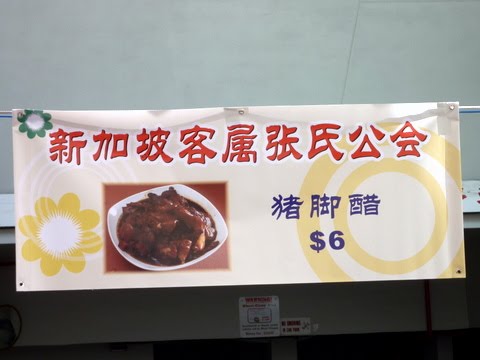
When I arrived at 1pm, almost all the spread of wonderful Hakka food were taken up. As the fest started at 10am, one can expect the delicious dishes prepared by various member organisations and members of the Guild to be taken up. I could only ogle at the posters showing the delicious dishes.

I got what is second best, a cookbook that was also produced by the Guild, with a simple title, Hakka Cook Book. Published in Chinese and English, the 120-page book has many Hakka dishes, some better known and others, perhaps, only known to the Hakkas. Many of the dishes have accompanying narrations about the dish, be it its origin or who it is for, like ladies in confinement.

According to the book, of some 3.3 million Hakkas in South East Asia, Singapore has 200,000. And its Hakka food stands out in the local Chinese cuisines. Many would have heard or tasted the famous Abacus Beads, amongst many famous dishes, we well as the Lei Cha, mistakenly translated as Thunder Tea rice. (^^)

There will also be a Hakka Night on 14 & 15 Dec 09, with performers from MeiZhou, China.


When I arrived at 1pm, almost all the spread of wonderful Hakka food were taken up. As the fest started at 10am, one can expect the delicious dishes prepared by various member organisations and members of the Guild to be taken up. I could only ogle at the posters showing the delicious dishes.
I got what is second best, a cookbook that was also produced by the Guild, with a simple title, Hakka Cook Book. Published in Chinese and English, the 120-page book has many Hakka dishes, some better known and others, perhaps, only known to the Hakkas. Many of the dishes have accompanying narrations about the dish, be it its origin or who it is for, like ladies in confinement.

According to the book, of some 3.3 million Hakkas in South East Asia, Singapore has 200,000. And its Hakka food stands out in the local Chinese cuisines. Many would have heard or tasted the famous Abacus Beads, amongst many famous dishes, we well as the Lei Cha, mistakenly translated as Thunder Tea rice. (^^)

There will also be a Hakka Night on 14 & 15 Dec 09, with performers from MeiZhou, China.

Saturday, November 07, 2009
Nanyin Concert @ Thian Hock Keng
It was the 19th day of the Ninth Moon (Thu 5 Nov 09), said to be the day Guan Yin 观音 ascended to the Heavens* and it was the last of the three da ri zi (big days) dedicated to Guan Yin. In Thian Hock Hock 天福宫, as for the past 20 years or more, Siong Leng 湘灵 Musical Association dedicates a Nanyin 南音performance to Guan Yin. And over the 20 years or more, the devotees of Thian Hock Keng and fans of Nanyin never fail to turn up to pay respects and to enjoy the Southern Sounds.
Nanyin is an ancient music, from the days of Tang Dynasty. It has been preserved through the daily lives of the Minnan people, mainly in the Quanzhou 泉州 are of Fujian, where at the end of the day, members of the villages could gather together and burst into a medley of Nanyin songs. In Quanzhou city these days, one could still see performances in the park or in the tea houses. Nanyin has just been recognised as one of the UNESCO Intangible Heritage.
In Singapore there are two associations where members gather to learn, play and enjoy the Nanyin. They are at the Bukit Pasoh Rd neighbourhood. Siong Leng is one of them.
On this night of performance at Thian Hock Keng, Siong Leng took a new approach in bringing the audience on a journey of story telling illustrated with a Li Yuan Opera and Nanyin Songs as we saw how the maid prevented Tan Sa 陈三 (Cheng San) from leaving, trying to convince him that Gor Niu's 五娘 (Wu Niang) heart was really with him. And then we were told that Tan Sa and Gor Niu tried to elope but was caught just as they approached Quanzhou and brought before the magistrate. The maid, again, tried to plead the case (all through Nanyin songs), but alas, she failed. As Gor Niu made her journey to her destination of punishment (in some foresaken place), she sang of the wonderful days.

Once again, Thian Hock Keng, illuminated with the lights, songs and beautiful Southern Sounds, stood as memory of the early migrants to Singapore. A pillar to modern Singapore that only this grand old dame would know but the sounds and sights will tell.

Now, we wait till 2M19 next year - 3 Apr 2010.
* Notes:
Guan Yin's three days of celebration, from Leon Comber's book: Through the Bamboo Window
Tan Sa Gor Niu is a popular opera to the Hokkiens & Teochews where it tells the story of a Hokkien man and a Teochew lady falling in love, quite ahead of its times
Sunday, October 25, 2009
Nanyin Concert in Thian Hock Keng on 5 Nov 09 @ 7.30pm
Three times a year, Thian Hock Keng (at Telok Ayer St) has a Nanyin Concert (which would include Nanyin music and songs, and sometimes, Li Yuan Opera) in honour of Guan Yin. They are 2M19, 6M19 and 9M19 (Chinese Lunar Calendar). 9M19 is 5 Nov 09 and this will be the last performance this year in Thian Hock Keng.

Nanyin can be loosely translated as the "Souther Sounds". This ancient music, dating some thousand years old, has recently been recognised as the UNESCO Intangible Heritage. The current main area in China where Nanyin is still very popular is in Quanzhou, Fujian, China. It used to be a typical musical part in the daily lives of the people there. At the end of the day, the farmer and his friends could be singing Nanyin songs. In the park of Quanzhou city centre, one could listen and watch Nanyin performance.
Admission is free and from past years' experience, the courtyard is usually quickly filled up by fans of Nanyin, Come and experience the ancient sounds. It would be good to be there by 7.30pm to get a place.

Nanyin can be loosely translated as the "Souther Sounds". This ancient music, dating some thousand years old, has recently been recognised as the UNESCO Intangible Heritage. The current main area in China where Nanyin is still very popular is in Quanzhou, Fujian, China. It used to be a typical musical part in the daily lives of the people there. At the end of the day, the farmer and his friends could be singing Nanyin songs. In the park of Quanzhou city centre, one could listen and watch Nanyin performance.
Admission is free and from past years' experience, the courtyard is usually quickly filled up by fans of Nanyin, Come and experience the ancient sounds. It would be good to be there by 7.30pm to get a place.
Monday, September 28, 2009
8th Moon: The Month of Weddings
After a ghostly month, the Chinese population prepares for the celebration of the moon. By co-incidence, it could well be said the month of honeymoons? Yes, to the Chinese traditionalists, 8th Lunar Month (or we call it 8th moon) is the month of weddings. Restaurants would have been booked months ahead, probably even a year if one wants a particular restaurant for a particular date.
Perhaps there was a shortage of restaurants? or was it the economic crunch? Regardless, Wedding lunches are becoming the trend these days.

In the old days, the bride could only wear the wedding gown once, and that is on her Wedding Day. But modernity has taken over, and it must have been since two decades ago when the couple would go for glamour photography. From a few places in Singapore, the photography sessions start to go overseas. Kind of pre-honeymoon trips. In our days, it was simple. We had two friends who became our official photographers taking pictures from the beginning of the day to the end of the wedding dinner. Photography sessions used to be a few popular garden spots. Mine was the Toa Payoh Garden.

But of course, some traditions will remain. Nothing is complete with the serving of tea to the elders. It was the moment of recognition of the marriage of the couple. Official civil marriages do not seem to count, except for the application for an HDB flat or for less than pleasant matters. Customary marriage was the event that most families must have. There are always somethings in the newlywed's bedroom that must have. There are still grannies and aunties to fuss over the hundred and one small things to look into. Customs vary from dialect group to dialect group, from village to village (in China). Red for most Chinese, and maybe pink for the Teochews? The Hokkien would have a complete bathroom set with spitoon as well.
And where would they look for the traditional things that are associated with weddings? Ah, hidden in one corner of Chinatown complex are a few shops, nestled together, selling all the traditional wedding paraphernalia.

For those who want to look for bridal gowns and glamour photography, just a couple of minutes' walk to Tanjong Pagar Road, there is a row of shops specialising in modern wedding gowns. The Cantonese "kua" seems to be hidden somewhere behind as the brides opt for plunging necklines for their wedding dinner's second dress.

Perhaps there was a shortage of restaurants? or was it the economic crunch? Regardless, Wedding lunches are becoming the trend these days.

In the old days, the bride could only wear the wedding gown once, and that is on her Wedding Day. But modernity has taken over, and it must have been since two decades ago when the couple would go for glamour photography. From a few places in Singapore, the photography sessions start to go overseas. Kind of pre-honeymoon trips. In our days, it was simple. We had two friends who became our official photographers taking pictures from the beginning of the day to the end of the wedding dinner. Photography sessions used to be a few popular garden spots. Mine was the Toa Payoh Garden.

But of course, some traditions will remain. Nothing is complete with the serving of tea to the elders. It was the moment of recognition of the marriage of the couple. Official civil marriages do not seem to count, except for the application for an HDB flat or for less than pleasant matters. Customary marriage was the event that most families must have. There are always somethings in the newlywed's bedroom that must have. There are still grannies and aunties to fuss over the hundred and one small things to look into. Customs vary from dialect group to dialect group, from village to village (in China). Red for most Chinese, and maybe pink for the Teochews? The Hokkien would have a complete bathroom set with spitoon as well.
And where would they look for the traditional things that are associated with weddings? Ah, hidden in one corner of Chinatown complex are a few shops, nestled together, selling all the traditional wedding paraphernalia.

For those who want to look for bridal gowns and glamour photography, just a couple of minutes' walk to Tanjong Pagar Road, there is a row of shops specialising in modern wedding gowns. The Cantonese "kua" seems to be hidden somewhere behind as the brides opt for plunging necklines for their wedding dinner's second dress.

Saturday, September 19, 2009
Mid-Autumn Festival 中秋节
If we were to list all the festivities of all different ethnic cultures in Singapore, we could be a festival city with practically something going on every day and night! Just imagine, in a short space of time, locals as well as foreign visitors are attracted and possibly distracted (^^) with so much excitement in the pre-Hari Raya Puasa (Ramadan) light-up in Geylang Serai, Deepavali in Little India and Mid-Autumn Festival in Chinatown. We could be breaking fast with friends in Little India or Kg. Glam, have a nice Masala Thosai in Little India and then have a nice bite of the moon-cake with some great Chinese tea in Chinatown!

Tonight, the cool weather added a touch to the light-up of Chinatown to start off the Mid-Autumn Festival. In a tropical city like ours in Singapore, we just have to add that extra imaginary effort to appreciate the cool crisp autumn air better. Unlike the old days when we had to imagine from our textbooks about autumn what it really is, these days, many kids are lucky enough to have gone outside Singapore to experience autumn.

Ask any older person about moon cakes, and chances are what came to mind could be Dai Zhong Kok 大中国 (Da Zhong Guo), Dai Tong 大同 (Da Tong), Nam Tong 南同 (Nan Tong) and more. Long queues could be seen outside Dai Zhong Kok as each patiently wait in the sweltering sun for their turn to buy the moon-cake, with single egg yolk or double egg-yolk. In the old days, one could even catch a glimpse of how the shop people prepare the ling-yong (lotus paste). For us kids the, it was the piggy in the traditional baskets that we looked forward to. For the eligible, it was time to impress on the potential in-laws with a box or two.

These days, moon cakes are big items as corporate gifts as vendors present to their clients. Big hotel names on glittering boxes contain moon cakes are making their round, from Shenton Way to Ayer Rajah. Ah, I miss the innovative canned moon cakes which I used to send to my friends in other other parts of the world, where moon cakes meant different things to them.
Talk about Zhong Qiu Jie 中秋节 (Mid-Autumn Festival), one will think of Chang Er and yes, the rabbit ... and history or legends come alive as grandpa tells a story. These days, well try the wikipedia or google. (^^) It was a time when something nice and delicious has to be had, moon cakes - the typical lotus paste in a soft crust. And there's the pomelo (In the old days, they seemed to only appear during this time. Of course these days, they are around almost all year round. Ipoh Lor-Yau was reputed to be the best), ling-kok (water-caltrop) and Chinese tea. To the southern Chinese, it would have been Ti Kuan Yim (Hokkien for Tie Guan Yin) or Luk Poh/Poh Li (Cantonese). These days, there are such a wide spread of different Chinese tea varieties.

And what happened to the lanterns that each kid would clamour for? Those tied together using bamboo chicks and covered by transparent coloured "glass" papers. In the centre was a small metal spring, into which one would put in a small candle. It was a challenge to keep the lanterns from catching fire. Then came the advent of battery operated lamps and plastic lanterns in the shape of Ultra-man. What would have been beautifully hung along the five-foot-ways outside the shops in Chinatown, they are conspiciously absent. The shops have changed. The children too.

This evening, the thousands who flocked from all over Singapore to Chinatown saw Mid Autumn Festival performance with a fusion between the traditional and the new. It was a performance of the young, who through performance will remember Mid Autumn Festival and their contributions towards keeping this tradition alive. Stories depicted in the modern form. Modern dances added to the gaiety of the event. Cameras of all shapes and sizes, professionals to the phone-cameras, they blocked the views, but many would be happy to bring back a piece of the action. Some would find their way to facebook and youtube. Others would have already been transmitted via MMS through the phones to their relatives and friends. I wonder if any did a 3G video-phone call to share the excitement with their grannies who could be at home. (^^) Next year, maybe, we could put it on blogtv.com or better still another site of our (Singapore) own with the next generation broadband network in place.
From now till the 15th of the 8th Moon, there will be many events in Chinatown.

Tonight, the cool weather added a touch to the light-up of Chinatown to start off the Mid-Autumn Festival. In a tropical city like ours in Singapore, we just have to add that extra imaginary effort to appreciate the cool crisp autumn air better. Unlike the old days when we had to imagine from our textbooks about autumn what it really is, these days, many kids are lucky enough to have gone outside Singapore to experience autumn.

Ask any older person about moon cakes, and chances are what came to mind could be Dai Zhong Kok 大中国 (Da Zhong Guo), Dai Tong 大同 (Da Tong), Nam Tong 南同 (Nan Tong) and more. Long queues could be seen outside Dai Zhong Kok as each patiently wait in the sweltering sun for their turn to buy the moon-cake, with single egg yolk or double egg-yolk. In the old days, one could even catch a glimpse of how the shop people prepare the ling-yong (lotus paste). For us kids the, it was the piggy in the traditional baskets that we looked forward to. For the eligible, it was time to impress on the potential in-laws with a box or two.

These days, moon cakes are big items as corporate gifts as vendors present to their clients. Big hotel names on glittering boxes contain moon cakes are making their round, from Shenton Way to Ayer Rajah. Ah, I miss the innovative canned moon cakes which I used to send to my friends in other other parts of the world, where moon cakes meant different things to them.
Talk about Zhong Qiu Jie 中秋节 (Mid-Autumn Festival), one will think of Chang Er and yes, the rabbit ... and history or legends come alive as grandpa tells a story. These days, well try the wikipedia or google. (^^) It was a time when something nice and delicious has to be had, moon cakes - the typical lotus paste in a soft crust. And there's the pomelo (In the old days, they seemed to only appear during this time. Of course these days, they are around almost all year round. Ipoh Lor-Yau was reputed to be the best), ling-kok (water-caltrop) and Chinese tea. To the southern Chinese, it would have been Ti Kuan Yim (Hokkien for Tie Guan Yin) or Luk Poh/Poh Li (Cantonese). These days, there are such a wide spread of different Chinese tea varieties.


This evening, the thousands who flocked from all over Singapore to Chinatown saw Mid Autumn Festival performance with a fusion between the traditional and the new. It was a performance of the young, who through performance will remember Mid Autumn Festival and their contributions towards keeping this tradition alive. Stories depicted in the modern form. Modern dances added to the gaiety of the event. Cameras of all shapes and sizes, professionals to the phone-cameras, they blocked the views, but many would be happy to bring back a piece of the action. Some would find their way to facebook and youtube. Others would have already been transmitted via MMS through the phones to their relatives and friends. I wonder if any did a 3G video-phone call to share the excitement with their grannies who could be at home. (^^) Next year, maybe, we could put it on blogtv.com or better still another site of our (Singapore) own with the next generation broadband network in place.
From now till the 15th of the 8th Moon, there will be many events in Chinatown.
Tuesday, September 15, 2009
Images of Bullockcartwater by Marcus Lim
Take any object, building or any place, over time, dirt covers over, someone decides to whitewash it, or even make changes. Often, it is to the delight of some when they discover the real beautiful stuff below a seemingly modern and beautiful outlook.
But often too, one might not be lucky enough to view as it was. Sometimes, one might not be able to see one from the other. Ah, but there might be help. Historian painter, Marcus Lim, decided on go on his prowl to catch what might be ordinary yet go unnoticed, often by the local residents or citizens. It is with delight that I discovered Marcus's seemingly few easy strokes that bring to live what Chinatown was and still is.

Chinatown means different things to different people. The residents of Chinatown will hate and love it, at different times of their lives. We often recall with nostalgia the old scenes, smell and rubbish all, yet we might not want to relive through that part. Yet, we are not willing to let go. To the people living outside Chinatown, it is a fun place to go, see, do one's things and go home. To the visitors, tourists, they go and capture what they see, often with cameras and perhaps with the contents of their wallets. Interestingly, most of the scenes of yesteryears could be somewhere in someone's home far far away.

Likewise, most of these beautiful paintings might be in someone's home somewhere far away. But of course, these days, many Singaporeans would also want a piece of the memory at home. Lest it is no longer there.
Marcus has painted many of these scenes of Chinatown and Little India, each unique from his inspiration. You could contact him at enquire@marcuslim.com to know more about his paintings. Visit his website at marcuslim.com.
ack: pictures from Marcus Lim
But often too, one might not be lucky enough to view as it was. Sometimes, one might not be able to see one from the other. Ah, but there might be help. Historian painter, Marcus Lim, decided on go on his prowl to catch what might be ordinary yet go unnoticed, often by the local residents or citizens. It is with delight that I discovered Marcus's seemingly few easy strokes that bring to live what Chinatown was and still is.

Chinatown means different things to different people. The residents of Chinatown will hate and love it, at different times of their lives. We often recall with nostalgia the old scenes, smell and rubbish all, yet we might not want to relive through that part. Yet, we are not willing to let go. To the people living outside Chinatown, it is a fun place to go, see, do one's things and go home. To the visitors, tourists, they go and capture what they see, often with cameras and perhaps with the contents of their wallets. Interestingly, most of the scenes of yesteryears could be somewhere in someone's home far far away.

Likewise, most of these beautiful paintings might be in someone's home somewhere far away. But of course, these days, many Singaporeans would also want a piece of the memory at home. Lest it is no longer there.
Marcus has painted many of these scenes of Chinatown and Little India, each unique from his inspiration. You could contact him at enquire@marcuslim.com to know more about his paintings. Visit his website at marcuslim.com.
ack: pictures from Marcus Lim
Thursday, September 03, 2009
Zhong Yuan Jie - Ghost Festival - in Chinatown

This year, Chinatown's Hungry Ghost Festival (Zhong Yuan Jie) has taken on a bigger plane, by offering to show and explain more about it to the interested locals as well as tourists (including expatriates). Many have seen the Zhong Yuan Jie and could not understand the myriad of details in this festival that involves both residents and business people. It did not help when the festival could have a Hokkien/Teochew or Cantonese flavour which are now coming closer and blurred into one Chinese event. The rituals conducted by the Taoist priests are quite different, in some aspects, when performed by different dialect groups.
To the 140 participants of the Chinatown Hungry Ghost Festival walking tours (on 31Aug and 1 Sep) led by veteran heritage tour guides Diana and Charlotte, it was an eye-opener. There was quite a number of locals in these groups as well.
During this 7th Lunar Month festival, there are a number of important dates for the Taoists and Folk Religionists. The Hokkien and Teochew would "welcome" the wandering souls on the first day of the 7th lunar month and then send them off on the last day of the 7th month. The cantonese would pray to them on the 14th day of the month. On the 15th day, many would conduct prayers. The Taoists would pay respect to Ti Guan (of the trio of Tian Guan, Di Guan and Shui Guan).
Since long ago when Singapore Chinese lived in villages or in enclaves of Singapore such as the Chinatown (there was the Teochew, Hokkien, and Cantonese parts of the greater Chinatown, the Hainanese being further away), someone in each community (sometimes more than one) would take the leadership to organise a Zhong Yuan Jie. In those days when most could not afford it, the residents would contribute on a subscription basis, ending with an amount big enough to have quite a hamper of food to bring back after prayers. To us children then, this was one of the few festivals where we could enjoy duck, chicken, pork and fruits. Today, these are taken for granted. The organisers were and still are very innovative in how they could organise bigger and bigger events each year, based on the subscription as well as money collected through auctions during the dinner.

In the business district, Zhong Yuan Jie is deemed as very important because the business people wants to have a safe place (from accidents) and roaring business. And so, they would contribute actively towards the organisation of the festival. Auctions during the dinner would be more boisterous as each company (the bosses) would try to outbid the other for important items, which could be a red banner with two lanterns or black gold (big charcoal). A small business community's Zhong Yuan Jie celebrations could easily run into tens of thousands of dollars. Certainly a good boost to the local economy in the mid-year doldrum.
Zhong Yuan Jie is a time when it is believed that the souls would be released from "Hell" (better known as Hades to avoid misintepretation). These could be the ancestors and wandering souls. To the living, it is a time to remember our beloved departed and ancestors and so, we make offerings as a gesture of our remembrance of them. No ancestors, we will not be here, and there will be no descendants. What about those who have been neglected for some reasons, some could be just the end of a lineage? It is the collective community's responsibility to offer them something.In a community - business or residential - it is a time of more interactions through joint prayers and dinners. In the past, a village or even a street would have Zhong Yuan Jie on one particular day. You could walk down the street and see almost every house putting up an impressive display of dishes, fruits, joss papers, flags and joss sticks stuck on to every food dishes on the five-food-way. In each of these houses, especially in Chinatown area, it could be a collective effort of the tenants (which could number up to ten!) and their landlord. I remember when I was young, in the house where we lived, we had a Bibik (Peranakan lady) who oversaw the organising of the prayers.

Apart from the offerings from each house, there would be the collective "street level" community prayers with even more impressive display of food, such as roast picks, big trayloads of roast ducks, roast chickens, deep fried fishes and other delicious food. The would often be pail loads of can food and the seven important ingredients - salt, sugar, rice, light soya sauce, dark soya sauce, vinegar, and cooking oil. At the end of the prayer, each participating household would collect their share home. Along with the prayers, there would be a street wayang (opera). It was a time when the hawkers would gather around the street wayang offering anything from fried oyster (barnacles) omelette to cheng-tng (sweet desserts - my favourite) to siput shellfish to hammered dried cuttlefish roasted on open fire with sweet sauce to tikam-tikam (kind of lucky deep except that for 5 cents you got to select a sealed slip of paper to see if you could win 20 cents or sweets to peep shows (movies on a tricycle).

Back to Chinatown where the Zhong Yuan Jie was held on 1 Sep (actual day), more traditional details were being worked on. There was the huge dias dedicated to San Qing from which the Taoist priests would conduct their rituals. The main altar would be dedicated to the wandering souls on one end, and to the Jade Emperor (Tian Gong) who is flanked by Nan Dou (Southern Stars) and Bei Dou (Norther Stars). To the left from the main altar was Da Shi Ye (the monster transformation of Guan Yin to ensure that the wandering souls are kept in their stride, especially when the loads of money and other goodies were burnt and being transported to them). There was also the boat as the mode of transport.

In this tentage, there is this unique "paper statue" of Da Bo Gong (known as Dai Pak Kong to the Cantonese), Cheng Huang (Seng Wong in Cantonese) and his assistant (as I was told). And there was also another Deity related to wealth (whom I was told to be San Ye Bo).
There was also a corner where paper tablets dedicated to the departed ones were placed by participating members. Two of the departed ones had their name written in English. One even has a photo pasted onto it.

As in any modern day Zhong Yuan Jie, it might be considered incomplete without getai. And so, here, there were two nights of getai that had overflowing crowds.
As part of the awareness and education, the Youth wing of the Taoist Federation of Singapore put up panels of posters (in English and Chinese) explaining about Taoism and Zhong Yuan Jie. Another eye-opener for the visitors. I could see many, young and old, studying closely the contents of the posters.
 Another interesting innovation was the Sinema Mobile (reminds me of the old days of white cloth strung across two lamp posts with two noisy 16-mm film projectors - if we were lucky, more often than not, it would be a sole projector) showing the documentary-drama "Month of Hungry Ghosts" produced by Mythopolis which made its debut last year's Zhong Yuan Jie. For many of us, this documetary showed and explained much that most of us would not have seen nor known. This was an accidental project because the producer Genevieve Woo and director Tony Kern were looking for such information preparing for their drama movie, when they found out that they could not find any and so they set out to look for them. And so, we benefit a great work that will become of the archives of Singapore heritage.
 The Chinatown Business Association and Singapore Tourism Board did a great job bringing an ancient tradition and folk culture to Singaporeans and visitors. This year could well be just a seedling of a bigger fest? (^^)
Friday, August 28, 2009
Movie: A Month of Hungry Ghosts
We know the words "Hungry Ghost Festival" pretty well in Singapore. We know that there will be offerings - by the roadsides, outside the homes, with the communities, prayers & rituals, residental & business community dinners & auctions, and of course the ubiquitous GeTai. But do we really know what Hungry Ghost Festival or Zhong Yuan Jie is all about?

If you don't and want to know more, note these two dates
- Saturday 29 Aug 09 @ 7pm
- Sunday 30 Aug 09 @ 7pm
at a tentage next to Spring St, off South Bridge Road (going into Neil Rd), Chinatown, made possible with Sinema Mobile
I just came back from a sneak preview. We wanted the 'operator' to continue with the show as we were just warming up. It is primarily in English.
 Bring along your children who will learn a thing or two about the Chinese culture. Bring along your Grandpa and Grandma who will be able to share more details with you, and perhaps, later with us? (^^)
There will be a "Meet the Director" session after the movie, where you can get to know more about how this movie was made.
If you don't and want to know more, note these two dates
- Saturday 29 Aug 09 @ 7pm
- Sunday 30 Aug 09 @ 7pm
at a tentage next to Spring St, off South Bridge Road (going into Neil Rd), Chinatown, made possible with Sinema Mobile
I just came back from a sneak preview. We wanted the 'operator' to continue with the show as we were just warming up. It is primarily in English.
Bring along your children who will learn a thing or two about the Chinese culture. Bring along your Grandpa and Grandma who will be able to share more details with you, and perhaps, later with us? (^^)There will be a "Meet the Director" session after the movie, where you can get to know more about how this movie was made.
Subscribe to:
Posts (Atom)