Friday, March 16, 2007

CNY 14th Nite at Wak Hai Cheng Beo

A tradition that has gone back decades, each 14th night of the Chinese Lunar New Year, devotees flocked to the Wak Hai Cheng Beo (Yue Hai Qing Miao) to offer their prayers to Xuan Tian Shang Di and Mazu and to exchange their old flags and /or lanterns.

This is one night that time stood still, and one could see the scene as could have been a few decades ago. The only difference could be the surrounding. Looking for the moon might not be as easy. Tall buildings surrounded this dwarfed temple.

Wak Hai Cheng Beo is a Teochew Temple but interestingly, on this night, it was almost like a Cantonese tradition. While the joss paper sets used inside the temple could be Teochew, those brought by devotees to offer their prayers and burn in the courtyard could well be Cantonese.

Many devotees have begun to form parties, meeting together before coming to the temple and offering their prayers together. Here, each member or family could bring along food as offering. Many have home made Chinese Huat Kueh (Fa Gao) which symbolises growth and prosperity. There were also Ang Ku (Hong Ku), a sticky and oily rice cake with bean stuffing, peanuts (Hua Shen, sounding like growth and bloom) and of course, sweets.

One party has an interesting idea where all the devotees, after prayers, they would have a kind of standing up picnic enjoying the food. I was fortunate to be invited to join in. Wow, the best huat kueh I have tasted in years. The group was told not to throw the peanut shells away but to burn them together. Reason, it is like renewing one's shell .. for a better life. What a great way to consider and there's less littering too.

Before this picnic, the group, grandparents, parents, and kids would have their joss sticks, trooped into the already crowded and smoky temple halls. They were greeted by the temple members .. ah, familiar figures as they are regulars. The children were guided to pay their respects to the various Deities.

At the hall of Mazu, one Cantonese Taoist Priest was conducting a ritual for some devotees. I saw him last year and this year too. And so, this must also be a regular service offered to the Cantonese devotees. He chanted in Cantonese.

Some devotees brought along a circular paper set, that the devotees would use to turn around (clockwise, I was told) as they faced towards the Deities. This is to turn their luck for the better, which is better described in Chinese as Zuan Yun.

As the night wore on, more people arrived. It was a night where devotees of some three or four generations gathered to offer their prayers. An old lady was supported by her son and an Indonesian maid. Another old lady sat in a wheelchair and the party had to negotiate with the door way to get her into the temple and out again.

This is probably the only temple where such a tradition has been carried on for decades. (Anyone knows when it started?) And I hope it will carry on for the next 100 years. (^^)

Tuesday, February 27, 2007

Xiang Lin Musical Association's New Year Party

I had the good fortune of being invited to the New Year party of the Xiang Lin Musical Association on the 8th Day of Chinese New Year.

Nested in a very cosy attic of this restored house along Bukit Pasoh, it was almost like a family gathering with the elders sitting and enjoying the Nan Yin songs and musics sung by the elder and young. The orchestra was made up of mainly youngsters! It was certainly heartening to see so many youngsters playing the Chinese musical instruments, some of which are distinctly Nan Yin. And that they were also singing the Nan Yin songs in the ancient Hokkien dialect.


Xiang Lin is no stranger to many in the arts circle as could be demonstrated by the number of awards and momentos that they have received.

Many friends at the party enjoyed the music and songs, while enjoying the food as well.

If you have yet to see or hear Nan Yin, go to Tian Hock Keng (Tian Fu Gong) at Telok Ayer St on 15th Day of Chinese New Year (4 Mar 07) at 7.30pm to enjoy the music and songs in the wonderful atmosphere of the temple. And if you do spot some bats flying around, you have the additional luck too!

Friday, February 16, 2007

Preparing for a Prosperous New Year

Each new year brings fresh hopes for a better year. To the ancient Chinese, Cai 财, which means prosperity, has a multitude of meanings, unlike today when Cai is mentioned, it is about money. But in the traditional means, Cai could mean rice - plenty to eat. Cai could means a big healthy family and a good life.

And so, each year, each in his/her own way, looks towards Cai Shen 财神 (The Deity of Wealth or Prosperity) for something better. And here in Chinatown, the residents and visitors alike hope to get a blessing - be it rice, chocolate in the form of golden ingots or angpows (red packets) - from the Cai Shen.


Chinatown Lights up with a Bang!

Chinese New Year must be accompanied with lots of noise and certainly, there must be lions and dragons. And so, Chinatown continues with this tradition.

Wednesday, February 14, 2007

Chinatown with a light touch

Now, if only Chinatown will have such light show on a daily basis. It would add lights, colour and certainly crowd. It was a great idea to show Hotel 81 in a different light. This grand old building was once a school, and then, it was a home to many residents, and now a hotel.


Monday, February 12, 2007

The long queue

Preparing for Chinese Lunar New Year could well mean queues these days. In Chinatown, there is one notable queue that has been going on for years. Established since 1938, the Lim Chee Guan Bak-kwa (BBQ dried meat in Hokkien/Teochew) shop has been the target of the Lunar New Year shoppers.

This morning, barely past 8.30am, and the queues of both side of the two streets were forming, one at the old shop along South Bridge Road, and the other in People's Park Complex. Barely a stone's throw away, the other Bak-kwa shops were still waiting for customers.

According to what I heard from the Bak-kwa lovers, they said that on the survey on the taste of Bak-kwa, Lim Chee Guan's Bak-kwa did not rank amongst the top, but from the queue, it looks like it does. Reminds me of the blind tasting of the caviar, where the reputed to be best and most expensive ones did not come up top. Ah, the taste of people.

I guess, for many, Chinese New Year will not be the same without some Lim Chee Guan Bak-kwa. (^^) And certainly, many would have made their parents-in-law, or potential ones very happy.


Saturday, February 10, 2007

Ang Ku Kueh


Ask someone who knows about Ang Ku Kueh (literally translated from Hokkien as Red Tortoise Cake), and what is conjured in his/her mind could be someone's baby has reached one-month old (that's the month old celebrations, and angkukueh is one of the spread of goodies given to relatives and friends who have given gifts - jo gueh lai in Hokkien, meaning, giving something within the one month of the baby's birth), or there's a temple celebrations, where angkukueh is a must, or some celebrations in the home, especially for prayers to the Deities.


Ang means red, Ku means tortoise, and these two are important ingredients of the Chinese tradition, red meaning prosperity and tortoise meaning long life.
Angkukeuh is a rice-flour cake (I think) typically filled with bean paste or chunky groundnuts. They are covered with cooking oil and steamed. The taste would be in the bean paste or the groundnuts. But the texture of the fillings and the flour is important.

In Everton Park, Ji Xiang is probably one of the best, if not the best Angkukueh in town. To me, this is the best angkukueh what I would go all the way to buy. For my two kids' month old celebrations, I buy them to give to relatives and wellwishers.
The way they make the angkukueh in Ji Xiang is still very traditional and laborious. And so when you eat, you are also enjoying the patience and love put in by the an-ums (old aunties). There are other fillings available, such as corn and coconut.


Wednesday, February 07, 2007

Chinese New Year Rush


If there is anything to look for (or dread), it's the two weeks before the Chinese Lunar New Year. This is the time when most Chinese, and visitors (many Malaysians are also flocking in) would come to Chinatown, to shop, eat or just enjoy the gaiety of the atmosphere.

In the old days, the number of stalls must have exceeded more than the 500 stalls said to be set up this year. In those days, they are in all shapes and sizes, noises and all, and during those days, there were more stalls selling clothes (especially for children) and shoes. Yes, in those days, for most of us, this was the time when we would get to have a new set of clothings, complete with shoes. Our parents would try their best to buy them. We never asked how they got the money, probably through sheer savings or loan. No 13th month then, and bonuses weren't much.

At the risk of being trampled on, we kids would hold our hands tight, one sibling to the other, and the youngest probably with Mum. And we waded through the crowd to get what we wanted and could afford. These days, one does not need Chinese New Year to get new clothes .. and so the thrill is gone.

While the contents might have changed, the atmosphere was still there today. Many traditional things such as red packets, decorations in bright red, kuachi (melon seeds), groundnuts, sweets, pussy willows, kamquats, nian-gao (sweet cake) and mandarin oranges are there. Traditional dried food used for cooking for Chinese New Year, or as gifts for the in-laws and potential ones, such as Chinese sausages, waxed duck, and yunnan ham are on grand display. This year, there are even waxed piglets!

The shopping frenzy will continue unabated right till the Chinese New Year Eve (17 Feb this year), certainly much to the delight of the stall holders of Chinatown. With the various groups in Chinatown organising events, despite many satellite towns having their own Chinese New Year bazaars, Chinatown will still attract.

My only hope is that Niu Che Sui (Bullockcartwater or what we all call Chinatown) will continue to hold dear to the hearts of the Singapore Chinese. Many who have their parents or grandparents who grew up in Chinatown will treasure the memories here, no matter how dirty, crowded or poor it was then. It must strive to stay as it is, was, so as to serve as a living museum for future Singaporeans.

Saturday, January 27, 2007

Chinatown Lights up for Chinese New Year of the Pig

Undaunted by the threatening sky and light drizzle, the performers started arriving at Chinatown at 5.30pm today (27 Jan 07). A small crowd had already started to form along the barricades placed along Eu Tong Sen St and New Bridge Rd.

The host of the evening was MP, Dr. Neo, who came dressed in a bright red pant suit, which certainly brightened up the gloomy skies. (^^) It was quite a crowded affair with some 280 lions peforming on the stilts and roads. A special see-through dragon complete with twinkling lights (powered by a mobile generator) was there to greet the VIPs, amongst whom include ambassadors from countries like USA.

The biggest cheer giver must be the Cai Shen (God of Wealth). He (she) was there to give away chocolate gold nuggets and angpows (red packets) much to the delight of the crowd. The crowd also wanted to touch his (her) hand in the hope of getting some wealth rubbed onto them.

At 7pm, the Prime Minister and his wife arrived, to the cheers of the crowd from both sides of the streets. Dressed in a traditional Chinese shirt, he looked relaxed, ready to absorb in the cheers of the evening. A spread of many interesting performances were put up for the VIPs and guests as well as the visitors to Chinatown, including its dwindling residents. Most had to content with the live-broadcast on the screens placed on both sides of the road as the stage was too far away for many.

When PM and Dr. Neo turned the gold coin placed on the stage, it signalled the beginning of the night's show with a dragon fireball the rolled in the air from the former Police Station right through to People's Park Complex. Just as it passed the complex, a big explosion of fire crackers took off .. darkening the entire place, bringing us back to the days of familiar firecrackers smokes and fumes. What nostalgia.

From the word go, it was a one and a half hour of no stop action, dances and performances. If they could make the performance ala Ching Gay, it would be great as the crowd that lined the streets would be able to get a better glimpse. What they could see was the lions and dragons and the float put up by the Tooth Relic Temple. But the performance was great .. the dances of our young people and those from China, all dazzled.

The Zhong Kui dance was great but alas too short and restricted on the stage. The whole entourage going on the streets would have met with great response.

Ah, the "huat ah" shout has taken on from the Chinese temple events to this event. Instead of the long words to greet Chinese New Year, the comperes decided "Huat Ah" - prosperity in Hokkien/Teochew - was easy enough to coax the crowd. And so, it was a tremendous three "Huat Ah" shouts from the crowd. The Cai Shen must be the one as he was the one asking the crowd to shout "Huat Ah" before they could get their gold nuggets.

The grand finale, with PM, Dr. Neo, VIPs and organisers getting on stage to sing the Chinese New Year song, ended with another blast of fire crackers and fireworks. The short but powerful event had the crowd wanting more. Even when the event ended, the crowd was still standing by the barricade, hoping for more.

The next three weeks will be hectic weeks as the Chinese prepare for Chinese New Year. There are some 500 stalls in Chinatown set up to see all the goodies that one needs for the Chinese New Year celebrations, from ingredients for reunion dinner to Chinese New Year gifts (for parents and parents-in-laws, and potential ones) to sweets to entertain Chinese New Year visitors.

Like the fat pig, one hopes for a "fat" new year.

Wednesday, January 03, 2007

Busking at the "People's" Square

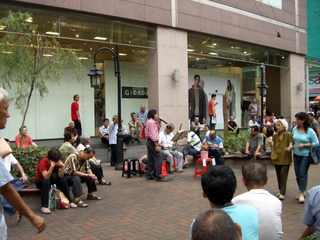
On a typical weekends, the open space surrounded by OG, old People's Park (as we call them), People's Park Complex and Majestic Building, is often filled full of human traffic. Older folks would sit on the concrete surrounding the trees and listen to the other older folks busking. What a wonderful afternoon to while the time away, listening to songs of yesteryears, something the grandchildren or even the children might not enjoy.

On some days, there could be two to three groups of buskers, some accompanied by musicians as in this case, where they play a assortment of musical instruments. Now, if only the story tellers, like those of yesteryears - the famous Cantonese Lei Dai Soh or Hokkien Ong Toh - were there too.

The cobblers carried on their work at the fringe, with their share of audience, some customers and some probably members of their respective chatgroups. To those diners along the row of Toh Kee, it was added entertainment. To the oldies, they might remember the old days when there were singers who would go from table to table to sing. That was in the very old open air People's Park.

If Republic Food Court would create their foodcourts with a touch of the old, maybe, such nostalgic times could be re-created for People's Park and Chinatown. We certainly can enjoy some operas being sung too.