Friday, November 10, 2006

Celebrating Guan Yin Tan at Tian Hock Keng

On 9 Nov 2006, which is the 19th of the 9th Lunar Month, at Tian Hock Keng, Xiang Lin Musical Association gave a Nan Yin and Li Yuan Xi performance, much to the delight of a dedicated audience. The average age of the group could well be the mid-70s, well, with some of us bringing the average lower. (^^) It was like yesteryears once more as the oldies - interestingly mostly men - sat, chat and enjoyed the show. And the performers, give a few older ones, the average age would be in mid-20s.

Well, we have hope that Nan Yin and Li Yuan Xi (literally translated as Pear Garden Opera .. the operas that were once the rave in the 1930s?) will be carried on to the next generation.

What better setting than at Tian Hock Keng, one of the oldest temples in Singapore, restored to its old glory .. bathed in warm light .. as the performers took the stage, which was the part of the courtyard just after the main doors. Tonight, the compere was a young lady. The man I was expecting was not there or could he be hidden in some masks as a performer? (^^)

The day, being the 19th of the 9th Lunar Moon, it was the third "Big Day" dedicated to Guan Yin, the Goddess of Mercy. The other days are 2M19 and 6M19. This musical association conducts this performance at the Tian Hock Keng three times a year.

In tonight's performance, Xiang Lin has also invited the experts from Quan Zhou, China, one who is a flautist and the other, a lady who was the expert drummer (percussionist). She has an interesting technique in controlling the drums, making various sounds with sticks, hands and her foot!

In the typical Nan Yin tempo and starting, we were treated to the first piece, followed by singing by two girls, said to have learnt only for 3 months. For me, it could take a lifetime. Learning the Nan Yin's Hokkien (minnan hua) is not easy. Lyrics were projected to a screen, and so we were able to enjoy the songs better following the words and understanding the meaning.

If I am not wrong, in the group was a Malay guy who played the "sa-mi-sen" (three strings?). The first time I saw him was at ACM where he played the guzheng.

The music piece and the singing piece dedicated to Guan Yin was a great piece singing about the three Big Days dedicated to Guan Yin. The lyrics were written by Ding Ma Chen and the music composed by Zuo Sheng Xiang, both members of the Association. The ladies took turn to sing each "Big Day" of Guan Yin. As is the tradition now, after this song, led by an elder lady, who I guess must be the patron of the Association, the senior members and the VIPs, with the audience facing towards Guan Yin who is at the rear Hall (the front hall being dedicated to Mazu) bowed three times.

The music piece and the singing piece dedicated to Guan Yin was a great piece singing about the three Big Days dedicated to Guan Yin. The lyrics were written by Ding Ma Chen and the music composed by Zuo Sheng Xiang, both members of the Association. The ladies, include Mdm Wu, took turn to sing each "Big Day" of Guan Yin.

As is the tradition now, after this song, led by this elder lady, who I guess must be the patron of the Association, the senior members and the VIPs, with the audience facing towards Guan Yin who is at the rear Hall (the front hall being dedicated to Mazu) bowed three times.

The second part of the show was more lively with the Li Yuan Xi. I thought this performance is much better than the present day Hokkien Opera, but well. Excerpts from Tan Sa Gor Niu (Chen San Wu Niang) were performed in three parts, each with different actresses. It was an opera about this man from Quan Zhou (Tan Sa - 3rd Tan) who met this lady in Chao Zhou (Gor Niu - 5th Lady) ... which left the old men wanting for more. (^^) Yes, we were literally "sucked" into the scene where Tan Sa was leaving, heartbroken and disappointed and was pulled back by the maid (the umbrella episode) who played the go-in-between for Gor Niu to express her real feelings so as to convince Tan Sa to stay.

I agreed readily that this was much better than the street \noperas. (^^)

And so, the show ended with a very high note for all of us panting for more .. what a pity that only the ah-laos can appreciate it better and this show should have been shown to more people. A showcase of one of our heritage.

Saturday, November 04, 2006

At the Barber

A couple of weeks ago, I was at this newly set up barbershop in People's Park. I went there to find one lady barber busy cutting and another one busy discussing with a customer. Oh, I thought to myself, a change of faces again. Unlike the old Fuzhou barbers where the same old faces (men) were there year in and year out, here the change is like every month. (^^)

From their accent, I gather that they must be mainland Chinese girls. This one was here only for a few months. She was flustered with this early morning customer who demanded money back for cutting his hair too short. "I thought he said that he wanted it short," she muttered to her associate. She was in a quandary if she should refund. The other was suggesting that she asked her boss. Finally, in the good new customer service of Singapore, a refund was made. I am not sure if it is from the till or from her wallet.

A lady popped her head in and asked in Hokkien, "Ka tampo esai bo?" Huh? The two girls looked at her in bewilderment. The other customer went to the rescue translating to Mandarin that she "wanted to cut a little, can or not". That lady wanted to know if the price would be less. Nope. Ah, the Chinese world in Singapore is changing. I couldn't help thinking that the "Speak Mandarin" campaign seems to work better for mainland Chinese working in Singapore. At least they have one putong hua (common language) to communicate with the local Chinese Singaporeans. (^^) In my halting Mandarin, I gave my instructions to the barber to cut my hair.

Letting her cut my hair (praying that she understood my requirements), I closed my eyes and drifted away. Away to my younger days when my Mum would bring me and my brother to a barbershop near to Grandma's place at Tanjong Pagar (where ST now stands). I hated to go to this barbershop because the barber would shave my face. I suppose I feared the shaving knife brandishing in front of my face, and each time inevitably, there were cuts. Those were the pre-AIDS days. Later, we managed to get our Mum to bring us to the Indian Barbershop opposite. At least they did not shave the face and they were friendlier. And yes, in an airconditioning room - a great thing in those days. I couldn't help wondering how was it that the Indian Radio seemed to have songs all day long, no matter when I went for my hair cut. Grandma opened a small kopi-tua, just across from the bus repair shop (Was it Tay Ko Yap?), and so, we had kopi after the having our hair cut. So, visit to Grandma and barbershop were part of our monthly routine and it meant that we could meet all the aunties. Grandma was strict and we had to call all of them when we saw them. Now, if we were to have lunch or dinner, it was to be the same, from Grandpa to Grandma, to first uncle .. right down to the last senior. The good thing for us boys was, we joined Grandpa and uncles for the meal first. The ladies came in second. For one, the table was not big. There was a joke in Hokkien about "Ta Paul Jia Toh, Cha Ball Chik Toh" (The male eat and the female clean).

Oh yes, and the Indian barbers did the trick on your head as if he wanted to twist your head and there was a "cluck" sound. Was fun having that done and being finished with some eau-di-cologne (Hokkien call it the Ko-long-chwee).

In the old days, female barbers are unheard of being in the main stream barber business. But of course, there were a few, two of which were famous at the "gao-lao" (9 storey) brick building (now it is gone) of the HDB flat next to Pickering St. I remembered the old men going there for their hair cut (we kids did not dare to venture into the barbershop and so we did not know if there were other activities) and some even bring their favourite barbers to Carpenter St for supper. In the 1970s, along the Carpentar St at night, there were two Teochew Muay (porridge) stalls serving great "hee-kau" (also known as Da Pan or Ikan Batang) muay and Pomfret muay. The stewed duck was also great. I was working then, and when I worked late, this was my favourite place to have my support. It later moved to Gor-Chan-Chiu-Ka (the old Esplanade) where it suffered a "slow death", overwhelmed by the steamboat stalls there.

"Hao le," said the lady barber, which woke me up. Without my specs, I could only have an outline of my hair. Looked good. Paying her, I went off. Only to discover that the cutting was a little off ... ah, a novice.

Tuesday, October 17, 2006

Wee Ma arrives for a visit to Po Chiak Keng

On Sunday, 15 Oct 06, the 24th of the 8th Lunar Month, Wee Ma, the grandma of Kai Chang Sheng Wang, the patron saint of Bao Che Gong 保赤宫 (Po Chia Keng), in the form of a statue, arrived in Singapore for a short visit, together with the 650 year old statue of Kai Zhang Sheng Wang 开漳圣王, also known in Hokkien as Sheng Ong.

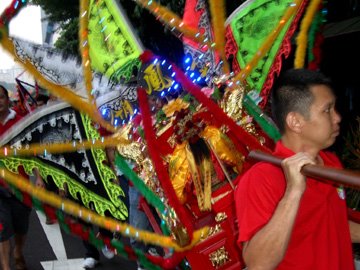
As in traditional Chinese style, a procession, led by lion and dragon dances and Kong-Kuan (cymbal and gong troupe), the elders of Po Chia Keng carrying the "fire" from the mother-temple in China, and three sedan chairs carrying Wee Ma and Sheng Ong, and a whole entourage of Po Chia Keng members, started from Bullockcartwater (Kreta Ayer) and walked through the heart of Chinatown.

With the lights and decorations commemorating the mid-Autumn festival still lit, it was like Disneyland parade come alive, ala orang cina (Chinese), with the parade. It was accidental attractions for many tourists, and local visitors to Chinatown too. Cameras and handphones with cameras were flashing non-stop. Many must have thanked their lucky stars for such a catch or shot.

Situated at Magazine Road, this is a 130 year old temple that has seen much of the development of Singapore. What was a tributary of the Singapore River (near to the Chwee Lang Tau) in front of the temple, what stands now is an electrical power distribution building. It is a temple dedicated to the ancestors of the Tan Clan (chen in Mandarin, and possibly, Chan in Cantonese and Chin in Hakka), with Sheng Ong as the patron Deity. The mother temple in China is in Zhang Zhou.

Tuesday, October 03, 2006

Bullockcartwater Talk?

I thought that fellow Chinatown residents - present and past, and even visitors might be interested in dropping in for a chat. Too bad, technology is not ready to serve tea. (^^)

Nevertheless, I have created an email forum. So, do drop in.


Google Groups
Subscribe to Bullockcart-water
Email:


Browse Archives at groups.google.com

Sunday, September 17, 2006

Chinatown Mid-Autumn Festival 2006 16 Sep - 15 Oct

It is the time again, albeit late by one month because this year, in the Chinese Lunar Calendar there are two 7th Months. This year, the Mid-Autumn, 15th of 8th Lunar Month, falls on 6 Oct 06. Chinatown, in its tradition, is going to mark the Mid-Autumn Festival with a string of activities. It is also the time when many locals, and perhaps, foreign residents, would be queuing up the old traditional moon-cake shops such as Da Zhong Guo (Dai Chong Kok in Cantonese) known to have served many generations the Chinese pastry delights, the moon cakes being one of the major ones.

The traditional moon cakes come baked with mostly lotus paste an salted eggs in them with a hard pastry crust. These are more Cantonese. The Teochews have their own mooncakes which are filled with yam paste and with flaky pastries. There are also the "snow-skin" types which are probably Cantonese. These days, one could find moon cake with durian flavoured fillings or Green Tea fillings.

With the moon cakes, the small yams would also be another food associated with Mid-Autumn Festival. These are steamed and eaten. And yes, the pomelos too.


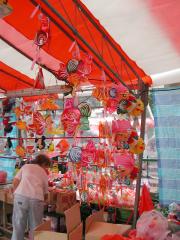
For the younger kids, the lanterns are a delight. What used to be the clear see-through paper pasted on bamboo sticks with a candle holders - and they are a fire hazard, with many children crying when their lantern caught fire first - and in various shapes such as the gold fish, these days, chances are the kids would want to have those in the forms of Hallo Kitty and with electronic control bulbs that cause them to flash.

Mooncakes and pomelos are also ideal gifts by the married children to their parents, or by the boyfriends to their prospective parents-in-law. Those moon cakes with more egg yolks, the merrier.

Copied from a poster from the organisers, are the broad programme information.

Chinatown Mid-Autumn Festival 2006
Official Light-up & Opening Ceremony

23 Sep 06 Sat
7.30pm
Along New Bridge Rd

Street Light-up
23 Sep - 15 Oct 06
7.00pm - 12.00mn (Sunday to Thursday)
7.00pm - 2.00am (Friday, Saturday and eve of Public Holiday)
New Bridge Rd, Eu Tong Sen St, South Bridge rd, Pagoda St, Smith St, Sago St, Temple St and Trengganu St

Mid-Autumn Festival Celebration & Mass Lantern Walk
6 Oct 06 Fri
7.30pm
Chinatown to Singapore River

Nightly Stage Shows
23 Sep - 6 Oct 06
8.00pm - 10.30pm
Kreta Ayer Square Stage

Festival Street Bazaar
16 Sep - 6 Oct 06
11.00am - 12.00mn (Sunday and weekdays)
11.00am - 2.00am (Friday, Saturday and eve of Public Holiday)
Venue: Pagoda St, Sago St, Temple St, and Trengganu St

Heritage Night Hunt
30 Sep 06 Sat
4.30pm - 9.30pm
Chinatown

Night of Lantern Riddles
29 & 30 Sep 06 (Fri and Sat)
7.30pm - 10.00pm
Kreta Ayer Square Stage

For more information call, +65 6222 3597

Ack: Poster by Kreta Ayer-Kim Seng Citizens' Consultative Committee

Saturday, September 16, 2006

Chinatown Wet Market No More?

The entire Chinatown Complex, consisting of the wet market, food court and sundry stalls, was barricaded for renovations. The bustling and lively part of Chinatown is now at a standstill, another ghostly reminder of the progress going through Bullockcartwater.

Decades ago (ca 1970s), just outside, on the streets, all the way from Sago St through Trengganu St to Pagoda Street, it was a maze of stalls in the morning, selling anything and everything that was edible. Ah, those early morning shows on the slitting of the great pythons or cutting of the giant turtles. These days, demands for the show and the meat have diminished so much that it would be a tough challenge for anyone selling them. Still on a bright morning, the streets were just alive with many marketing activities, the sellers shouting their wares, the buyers - housewives and restaurant chegs - hitting hard bargains. It would also be a breakfast and marketing outing for Mum and her kids. A great place for the old men to gather to yum cha (drink tea) and watched the housewives in their samfoos (traditional Chinese dress with tops and pants, getting rare these days) walking by.

And then, the market went underground to the basement of the Chinatown Complex. It was a great place, away from the glaring sun or the rain, but it was still as wet and dirty. The noises were contained with the space and vibrated many times. Slowly the people adapted to the new environment. Many had to look out for their favourite stalls. Chinatown was still the in-place to shop for fresh food. Chickens and ducks were still bought alive and be killed and defeathered if so desired. In the 80s, it was still the norm to even bring back a live chicken or two to slaughter only on the day, or before, of any festival days. That is now gone, given the increasing standards of public hygiene. Might as well, since the pandemic could well raise its ugly head. But the poor kids no longer have the chance to see a living chicken or duck, save at the zoo. Turkeys and Geese? (^^)

And now, another milestone has been marked with the renovation of the Chinatown Complex wet market. The temporary one is on the grounds of Outram Park.

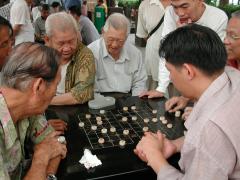
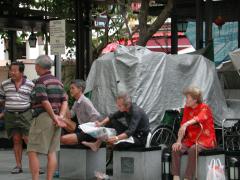
In the meantime, much of the peripheral activities of the marketplace continues. The old men gathered to play their favourite game of Chinese Chess. Two players per board and many observers and commentators. (^^) One was suggesting a move, but the player explained to him what would happened if he were to move as suggested. "Ah, I see," the commentator said. So, for a game that could last hours, many brains were kept busy. Others idled, reading newspapers, soaking in the atmosphere or perhaps, reminiscing what the place was.

Will this place be the same again when the wet market (or would it be dry?) returns? There will be changes, but hopefully, the same dynamic spirits of Chinatown, or Bullockcartwater remains.

Tuesday, September 05, 2006

Photographer of the Century - Mr. Yip Cheong-Fun

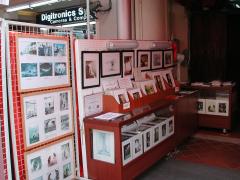
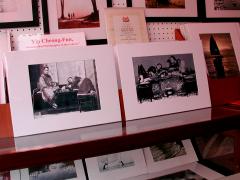
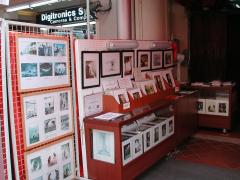
On 22 Aug 06, as I was walking with the Channel-8 cameraman, I shooting the interesting targets and he shooting me, I discovered a new stall. It might not be new and it has been quite a while since my last walk along Pagoda St, especially during high noon. There I came face to face with the picture of Mr. Yip Cheong-Fun and his wonderful photos, and Mr. Andrew Yip who was manning the stall, just outside the Chinatown Heritage Museum.

Here for sale were many great works of art by Mr. Yip Cheong-Fun. It reminded me of the young days when I would walk all the way from Chinatown to the then National Library - remember the brick building? - where they would have the Photographic Salon organised by the Singapore Photographic Society, that would come with a slide show, and then, back.

If you were a resident of Chinatown, you would find Mr. Yip Cheong-Fun's photos nostalgic, scenes that could only come back in flashes as your memory waves hit them. Ah, but now, perhaps, you could bring one home (buy I mean) to remind you, and possibly tell your grandchildren or grandnephews or nieces, about those days in this place call Niu Che Sui, more popularly known as Gnou Chair Shui or Gu Chia Chwee.

If you are not, or if you are a visitor, or if this is beyond your time, these are great pictures worth keeping and looking at the Chinatown heritage. Of course, Mr. Yip had also taken many pictures of different parts of Singapore.

Thanks to Mr. Andrew Yip's generosity, I have taken quite a number of pictures of the pictures, well, just to give you a glimpse. On sale were also the Asian Geo-magazine issue 4/2006 which has some reproductions of the pictures as well as small booklets (in English edition as well as Chinese edition) entitled "Singapore Chinatown in Pictures" by Andre W. Keye with pictures by Mr. Yip Cheong-Fun.And in case you do not know who Mr. Yip Cheong-Fun is, he has been an outstanding photographer in Singapore and has been elected "Outstanding Photographer of the Century" by the Photographic Society of New York, specialist in "seascapes". He was also the recipient of the Cultural Medallion of Singapore (1984).

Well, let his pictures convince you.If you need more information, you can reach Mr. Andrew Yip at andrewyip181@hotmail.com.

Recently, the Singapore Heritage Society with the National Library Board (NLB) staged an exhibition of Mr. Yip Cheong Fun's works.

Tuesday, August 01, 2006

Hungry Ghost Festival


The Hungry Ghost Festival is here again. Each year, for the entire 7th Lunar month, the traditional Chinese observe this month as the month dedicated to the wandering souls and the ancestors who have passed on. It is interesting to find out how this term "Hungry Ghost Festival" came about, but certainly, it tickles the mind.

This year, 25 Jul 2006 marks as the first day of the 7th Lunar Month. It is believed by the ancient Chinese that on this day, the ghosts could come up from the "below". And it is also believed that those who died young or in unusual circumstances could become wandering souls. Unless their relatives have arranged for the proper conducting of ritual to raise them up from such status, they would remain wandering all the time. And during this month, the traditional Chinese would offer their departed ancestors or relatives as well as the wandering souls with food and joss-papers (money for the nether world).

It used to be smoky days and nights as each Chinese dialect group offer its prayers on different days and in different ways. And residents of a neighbourhood might gather together to offer prayers to the wandering souls. It was very much a community event, but in modern Singapore, this is getting lesser.

Still, in Chinatown as in any HDB estate and even in shopping centres (if you look close enough) and offices, there could be make-shift altars for the residents (be they living or working) to offer their prayers. In the HDB estates, one could see the elders leading their young - children and grandchildren in praying with a joss-stick. Tradition lives and continues in this way.

The Hungry Ghost Festival is also an important local economic activity in many local companies' business charts. Those selling traditional Chinese praying paraphernalia would be busy stocking to meet the demands. Those in the food and fruits market will also be busy as a wide array of foods are offered, from cooked dishes to fresh fruits to canned food and dried food. Neighbourhoods organised mass prayers, with each family taking back a basket packed with various food after the prayer. Bigger supermarkets are also getting into the play offering ready packed baskets of goodies.

This year, there are two 7th Lunar Month in the Chinese Calendar. This has many in confusion as to whether the Hungry Ghost Festival will be 2-months long, meaning that the ghosts would have an extended stay. The general trend of thought is that ghosts do not understand second month and so, they will return as scheduled. (^^) The second 7th month starts from 24 Aug 2006 and the last day 29th of 7th Lunar Month will be on 21 Sep 2006.

Thursday, June 22, 2006

Sago Street Today

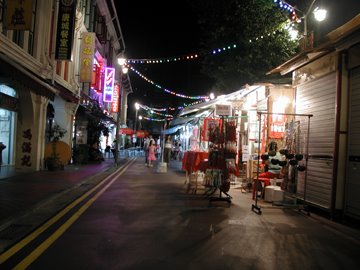
Sago Street today is a shade of what it was in the yesteryears. Only the remaining pre-war houses (as we call the shophouses) would know what happened over the years. Last Saturday night, I decided to look for some food in Chinatown and we walked and walked. We just couldn't find something that excites us.

My wife was reminiscing about the Trengganu St scene to my 12 year-old daughter. Yes, in the dating years, we used to smuggle out of her mother's watchful eyes to go to this yau-yi-ong-choy (re-processed dried cuttlefish with kangkong) stall that had kindergarten-size tables and chairs. There, for 50 cents we would enjoy a plate of dried cuttlefish or jellyfish with kangkong covered with red sauce and chilli, cooked to perfection by this old lady who probably was a perfectionist. Under her strict supervision were two women who helped to serve, whom until now we still could not figure out if one was the daughter and the other the daughter-in-law. She would scold them for a slight mistake .. and to us customers too if we reminded her one time too many. But, like kindergarten kids, we kept coming back. We could only relate.

We walked till the end of Sago St, which was at the junction of South Bridge Road. The population along the street got sparser as we walked towards the main road. The box-stalls stood neatly in a row. They were either shut or if open with the stallholder sitting looking bored. Behind these stall loomed the fast growing giant of a Buddhist Temple, which, hopefully in the near future would bring more life to Chinatown.

With hunger pangs, we decided just to sit on the last coffeeshop and ate what was available. It happened to be Hainanese Chicken Rice. It was a Saturday evening at 9pm, and the place was relatively quiet. Was it the World Cup (football?) Was it that the offerings were not attractive, to the locals nor the foreign tourists?

We decided to play tourist and peered into each box looking for something of interests. Indeed, there were many things of interests. But then, for a local, it might not be exciting enough for us to part with what we have in our wallet.

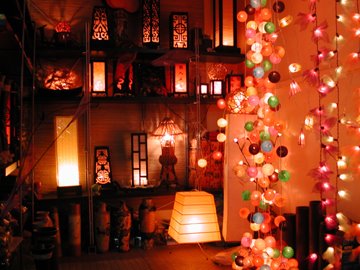
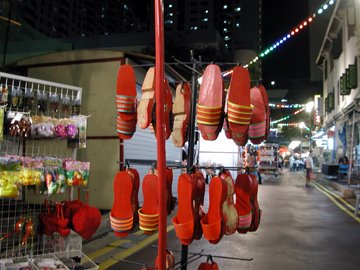
There was one that sold lights of all kinds. It gave a wonderful orangy glow .. that one could feel the warmth in a cold winter night. Alas, not in humid Singapore. Another was selling the typical local Chinese clogs - ones we wear in the old time kitchen, and these days, some may still use for the bath room. These do not look like those of the local market.

What caught our eyes was this stall with a guy happilying moulding a Laughing Buddha out of this wooden clay, looking at a picture of a Laughing Buddha for guidance. At S$5 a pack, it was reasonable enough for any parents to buy for their kids to play with. If they walk this way. Even though we were three, this guy stopped what he was doing and shared with us what he knew about the wooden clay. Ah, slowly but surely were sucked in, the interests in my art-inclined daughter growing. I went into the box to take a closer look at the finished products. Wow, models of the Chinese heritage could be seen, from Buddha to the Deities of the Hades to the Monkey Gods. When we decided to buy a pack just to try it out for fun, he got my daughter to learn how to make a hand with a quick 3-minute lesson to make sure that she would have the basic skills to do something when she gets home. For S$5, it was hard work, but he certainly got 5 very happy customers, who have already started the word-of-mouth campaign, and well, through blogging too. And of course, the curious passer-bys stopped to look. We left him to entertain a growing crowd.

As we moved back into the heart of Chinatown, at the cross-roads of Sago St, Trengannu St and Smith St, there was this strange stall that seemed to be out of place but yet getting the best patronage! A crowd of Europeans were having a stammtisch there enjoying beer from the nearby coffeeshop (ah, Weiss Bier) and his different sausages, starting from Bratwurst. Most locals would tah-pau (takeaway). The chef has changed his Chinese cap with a Football cap. Yes, it is Football World Cup time.

And so, in each tiny part of the Chinatown, which could be considered as Kreta Ayer part or the greater one that covers right to Singapore River and Telok Ayer St, there is a story waiting to be told.

Tuesday, June 06, 2006

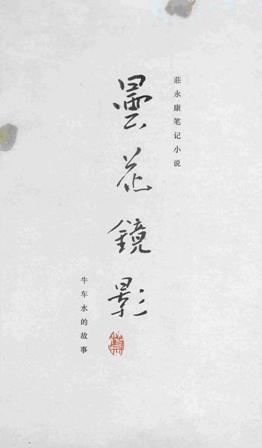
Blooms in a Glimpse: Story of Kreta Ayer “昙花镜影——牛车水的故事”


Blooms in a Glimpse: Story of Kreta Ayer
“昙花镜影——牛车水的故事


Book Launch: Saturday, 10 June 2006, 4.30 p.m.
Singapore Art Museum
Glass Museum
71 Bras Basah Road
Time 4.30pm – 6.30pm


With childhood memory drawn from Chinatown, coupled with images created by two Cultural Medallion recipients Yip Cheong Fun and Chua Ek Kay. Chong’s book reconstructs a memory landscape with an urgency to share with us the root-and-branch of a place that has shaped our past and define our presence.

以童年的记忆为经, 以见证南洋风雨的牛车水为纬,资深报人莊永康借童稚的灵犀之眼, 邀约叶畅芬的影像, 与蔡逸溪的水墨, 让似昙花, 像镜影的纯真岁月,忆往, 重构了生命的最初与有情的天地的款款唱和。

Guest of Honour:
Assoc Prof Kwok Kian Woon
National Heritage Board and Singapore Art Museum Board Member, Vice Dean, School of Humanities and Social Sciences, Nanyang Technological University

Speakers:
Mr Chong Wing Hong
, Journalist, Lianhe Zaobao
Mr Andrew Yip, Author of Chinatown - different exposures and Singapore Chinatown in pictures

Cultural Programme:
Cantonese Nanyin Performance

Nanyin (Namyum) is a strain of ballad sung in Kreta Ayer over the decades. It is very much a heritage shared by the Cantonese people in Singapore, Hong Kong and along the Pearl River in China. The song of Nan Shaoyi, Burning of Joss Paper, depicts a slice of life more than a hundred years ago, yet with traces of it still cherished by many Chinese of today. It is an integration of musical elements from the Tang and Yuan dynasties, Geyang accent and Minnan folk music.

南音是牛车水的一 缕乡音,散发着新加坡、香 港、珠江沿岸的广东人的共同情感。« 男烧衣»这支南音来自 清朝未年,里头描绘的生活习惯和人情世故到今天还是依稀可辨。它荟集了盛唐以来中原雅乐之精华,后来又吸引了元曲、戈阳腔的特长, 并与闽南的民间音乐融汇一体.

Witness the launching of this new and important publication!
Hosted by Singapore Art Museum

[Ack: Singapore Art Museum]