Tuesday, September 05, 2006

Photographer of the Century - Mr. Yip Cheong-Fun

On 22 Aug 06, as I was walking with the Channel-8 cameraman, I shooting the interesting targets and he shooting me, I discovered a new stall. It might not be new and it has been quite a while since my last walk along Pagoda St, especially during high noon. There I came face to face with the picture of Mr. Yip Cheong-Fun and his wonderful photos, and Mr. Andrew Yip who was manning the stall, just outside the Chinatown Heritage Museum.

Here for sale were many great works of art by Mr. Yip Cheong-Fun. It reminded me of the young days when I would walk all the way from Chinatown to the then National Library - remember the brick building? - where they would have the Photographic Salon organised by the Singapore Photographic Society, that would come with a slide show, and then, back.

If you were a resident of Chinatown, you would find Mr. Yip Cheong-Fun's photos nostalgic, scenes that could only come back in flashes as your memory waves hit them. Ah, but now, perhaps, you could bring one home (buy I mean) to remind you, and possibly tell your grandchildren or grandnephews or nieces, about those days in this place call Niu Che Sui, more popularly known as Gnou Chair Shui or Gu Chia Chwee.
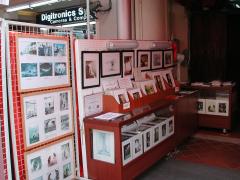
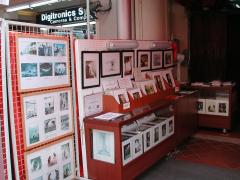
If you are not, or if you are a visitor, or if this is beyond your time, these are great pictures worth keeping and looking at the Chinatown heritage. Of course, Mr. Yip had also taken many pictures of different parts of Singapore.
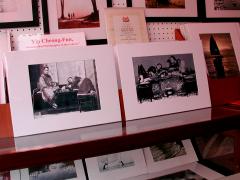
Thanks to Mr. Andrew Yip's generosity, I have taken quite a number of pictures of the pictures, well, just to give you a glimpse. On sale were also the Asian Geo-magazine issue 4/2006 which has some reproductions of the pictures as well as small booklets (in English edition as well as Chinese edition) entitled "Singapore Chinatown in Pictures" by Andre W. Keye with pictures by Mr. Yip Cheong-Fun.And in case you do not know who Mr. Yip Cheong-Fun is, he has been an outstanding photographer in Singapore and has been elected "Outstanding Photographer of the Century" by the Photographic Society of New York, specialist in "seascapes". He was also the recipient of the Cultural Medallion of Singapore (1984).

Well, let his pictures convince you.If you need more information, you can reach Mr. Andrew Yip at andrewyip181@hotmail.com.

Recently, the Singapore Heritage Society with the National Library Board (NLB) staged an exhibition of Mr. Yip Cheong Fun's works.

Tuesday, August 01, 2006

Hungry Ghost Festival


The Hungry Ghost Festival is here again. Each year, for the entire 7th Lunar month, the traditional Chinese observe this month as the month dedicated to the wandering souls and the ancestors who have passed on. It is interesting to find out how this term "Hungry Ghost Festival" came about, but certainly, it tickles the mind.

This year, 25 Jul 2006 marks as the first day of the 7th Lunar Month. It is believed by the ancient Chinese that on this day, the ghosts could come up from the "below". And it is also believed that those who died young or in unusual circumstances could become wandering souls. Unless their relatives have arranged for the proper conducting of ritual to raise them up from such status, they would remain wandering all the time. And during this month, the traditional Chinese would offer their departed ancestors or relatives as well as the wandering souls with food and joss-papers (money for the nether world).

It used to be smoky days and nights as each Chinese dialect group offer its prayers on different days and in different ways. And residents of a neighbourhood might gather together to offer prayers to the wandering souls. It was very much a community event, but in modern Singapore, this is getting lesser.

Still, in Chinatown as in any HDB estate and even in shopping centres (if you look close enough) and offices, there could be make-shift altars for the residents (be they living or working) to offer their prayers. In the HDB estates, one could see the elders leading their young - children and grandchildren in praying with a joss-stick. Tradition lives and continues in this way.

The Hungry Ghost Festival is also an important local economic activity in many local companies' business charts. Those selling traditional Chinese praying paraphernalia would be busy stocking to meet the demands. Those in the food and fruits market will also be busy as a wide array of foods are offered, from cooked dishes to fresh fruits to canned food and dried food. Neighbourhoods organised mass prayers, with each family taking back a basket packed with various food after the prayer. Bigger supermarkets are also getting into the play offering ready packed baskets of goodies.

This year, there are two 7th Lunar Month in the Chinese Calendar. This has many in confusion as to whether the Hungry Ghost Festival will be 2-months long, meaning that the ghosts would have an extended stay. The general trend of thought is that ghosts do not understand second month and so, they will return as scheduled. (^^) The second 7th month starts from 24 Aug 2006 and the last day 29th of 7th Lunar Month will be on 21 Sep 2006.

Thursday, June 22, 2006

Sago Street Today

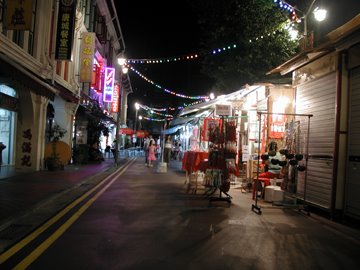
Sago Street today is a shade of what it was in the yesteryears. Only the remaining pre-war houses (as we call the shophouses) would know what happened over the years. Last Saturday night, I decided to look for some food in Chinatown and we walked and walked. We just couldn't find something that excites us.

My wife was reminiscing about the Trengganu St scene to my 12 year-old daughter. Yes, in the dating years, we used to smuggle out of her mother's watchful eyes to go to this yau-yi-ong-choy (re-processed dried cuttlefish with kangkong) stall that had kindergarten-size tables and chairs. There, for 50 cents we would enjoy a plate of dried cuttlefish or jellyfish with kangkong covered with red sauce and chilli, cooked to perfection by this old lady who probably was a perfectionist. Under her strict supervision were two women who helped to serve, whom until now we still could not figure out if one was the daughter and the other the daughter-in-law. She would scold them for a slight mistake .. and to us customers too if we reminded her one time too many. But, like kindergarten kids, we kept coming back. We could only relate.

We walked till the end of Sago St, which was at the junction of South Bridge Road. The population along the street got sparser as we walked towards the main road. The box-stalls stood neatly in a row. They were either shut or if open with the stallholder sitting looking bored. Behind these stall loomed the fast growing giant of a Buddhist Temple, which, hopefully in the near future would bring more life to Chinatown.

With hunger pangs, we decided just to sit on the last coffeeshop and ate what was available. It happened to be Hainanese Chicken Rice. It was a Saturday evening at 9pm, and the place was relatively quiet. Was it the World Cup (football?) Was it that the offerings were not attractive, to the locals nor the foreign tourists?

We decided to play tourist and peered into each box looking for something of interests. Indeed, there were many things of interests. But then, for a local, it might not be exciting enough for us to part with what we have in our wallet.

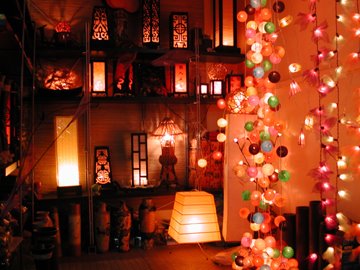
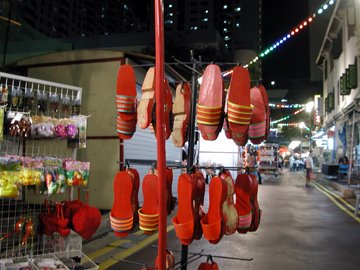
There was one that sold lights of all kinds. It gave a wonderful orangy glow .. that one could feel the warmth in a cold winter night. Alas, not in humid Singapore. Another was selling the typical local Chinese clogs - ones we wear in the old time kitchen, and these days, some may still use for the bath room. These do not look like those of the local market.

What caught our eyes was this stall with a guy happilying moulding a Laughing Buddha out of this wooden clay, looking at a picture of a Laughing Buddha for guidance. At S$5 a pack, it was reasonable enough for any parents to buy for their kids to play with. If they walk this way. Even though we were three, this guy stopped what he was doing and shared with us what he knew about the wooden clay. Ah, slowly but surely were sucked in, the interests in my art-inclined daughter growing. I went into the box to take a closer look at the finished products. Wow, models of the Chinese heritage could be seen, from Buddha to the Deities of the Hades to the Monkey Gods. When we decided to buy a pack just to try it out for fun, he got my daughter to learn how to make a hand with a quick 3-minute lesson to make sure that she would have the basic skills to do something when she gets home. For S$5, it was hard work, but he certainly got 5 very happy customers, who have already started the word-of-mouth campaign, and well, through blogging too. And of course, the curious passer-bys stopped to look. We left him to entertain a growing crowd.

As we moved back into the heart of Chinatown, at the cross-roads of Sago St, Trengannu St and Smith St, there was this strange stall that seemed to be out of place but yet getting the best patronage! A crowd of Europeans were having a stammtisch there enjoying beer from the nearby coffeeshop (ah, Weiss Bier) and his different sausages, starting from Bratwurst. Most locals would tah-pau (takeaway). The chef has changed his Chinese cap with a Football cap. Yes, it is Football World Cup time.

And so, in each tiny part of the Chinatown, which could be considered as Kreta Ayer part or the greater one that covers right to Singapore River and Telok Ayer St, there is a story waiting to be told.

Tuesday, June 06, 2006

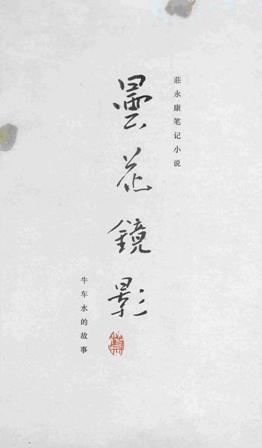
Blooms in a Glimpse: Story of Kreta Ayer “昙花镜影——牛车水的故事”


Blooms in a Glimpse: Story of Kreta Ayer
“昙花镜影——牛车水的故事


Book Launch: Saturday, 10 June 2006, 4.30 p.m.
Singapore Art Museum
Glass Museum
71 Bras Basah Road
Time 4.30pm – 6.30pm


With childhood memory drawn from Chinatown, coupled with images created by two Cultural Medallion recipients Yip Cheong Fun and Chua Ek Kay. Chong’s book reconstructs a memory landscape with an urgency to share with us the root-and-branch of a place that has shaped our past and define our presence.

以童年的记忆为经, 以见证南洋风雨的牛车水为纬,资深报人莊永康借童稚的灵犀之眼, 邀约叶畅芬的影像, 与蔡逸溪的水墨, 让似昙花, 像镜影的纯真岁月,忆往, 重构了生命的最初与有情的天地的款款唱和。

Guest of Honour:
Assoc Prof Kwok Kian Woon
National Heritage Board and Singapore Art Museum Board Member, Vice Dean, School of Humanities and Social Sciences, Nanyang Technological University

Speakers:
Mr Chong Wing Hong
, Journalist, Lianhe Zaobao
Mr Andrew Yip, Author of Chinatown - different exposures and Singapore Chinatown in pictures

Cultural Programme:
Cantonese Nanyin Performance

Nanyin (Namyum) is a strain of ballad sung in Kreta Ayer over the decades. It is very much a heritage shared by the Cantonese people in Singapore, Hong Kong and along the Pearl River in China. The song of Nan Shaoyi, Burning of Joss Paper, depicts a slice of life more than a hundred years ago, yet with traces of it still cherished by many Chinese of today. It is an integration of musical elements from the Tang and Yuan dynasties, Geyang accent and Minnan folk music.

南音是牛车水的一 缕乡音,散发着新加坡、香 港、珠江沿岸的广东人的共同情感。« 男烧衣»这支南音来自 清朝未年,里头描绘的生活习惯和人情世故到今天还是依稀可辨。它荟集了盛唐以来中原雅乐之精华,后来又吸引了元曲、戈阳腔的特长, 并与闽南的民间音乐融汇一体.

Witness the launching of this new and important publication!
Hosted by Singapore Art Museum

[Ack: Singapore Art Museum]

Saturday, May 20, 2006

The Grand Old Dame

To the residents, she is a regular sight. Sleeping on the car bonnets or underneath the cars. Chances are, these days, she sleeps under the cars, considering that she is now at an advanced age. If one is able to trace her family tree, gosh, how many generations she must have beget.

The worn out face peers at me as I greeted her each morning. Sometimes, she would be beneath my car, just next to the tyre. She would look at me sleepily and walked away to another car, and continued with her snooze. I am still wondering where she got food, staying on the third level of the car park.

She probably has outlived a dog which was also a resident in the block. While she belonged to an owner, she walked as if she owned the whole block. She would join us to take the lift, choosing the floor to get out, take a walk and wait for another lift down. The word life has taken its second meaning, literally. Bless her soul, she must have gone now as I have not seen her for a year.

Will this grand old dame still be around? Each morning looking out for her underneath one of the cars, I am assured that she lives out another peaceful day. I guess, her days are numbered, naturally.

Monday, April 10, 2006

Herbie is at it again!


Ah, the oldies but goodies might remember Herbie. For the youngies, maybe, you have another name? My old cells cannot recall. (^^) Yes, on this lovely Sunday afternoon when the carpark lots at Blk.33 off Park Crescent were quickly being filled up by the modern and flashy cars, there was one vintage. At least it was declared by the car, or the owner?

Blk.33 must be one of the best designed carparks in Singapore, but on this fateful day, 9 April 2006, the cars were crawling. I thought that only happens just before the Chinese New Year! Aha, I found out why quickly enough. Herbie decided to get fresh with this sweet young thing and so got close to it, oblivous to the embarrassed noises from the fellow four-wheelers. But it did respect the rule of the day, not more than 5 minutes. (^^)

But being typical Singaporean cars, they just passed by, took a quick look and went looking for a proper place. Tsk! Tsk! The cars must have been saying, doing it in public. (^^) Ah well, we should not be voyeurs, right? And so we went away.

How long did he stay there, I did not stay to find out. The next time I was there, he was gone. (^^)

Saturday, April 08, 2006

Cantonese Opera Singing Anyone?

Of all the local Chinese operas, I think Cantonese Opera is probably one of the most active and visible ones. Apart from the professional opera groups, there are a number of amateur ones and many are taking an interests in it.

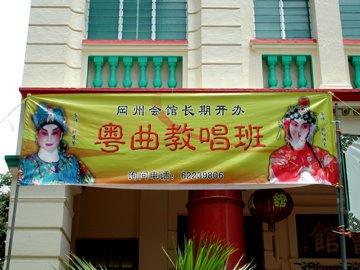
Inside Chinatown, the Kong Chao Wui Kun (Gang Zhou Hui Guan 岡州会馆) , Gang Zhou Association, which is probably older than its building which was built in 1924, is offering Cantonese Opera Singing lessons 粤曲教唱班. This Association has been amongst the pioneers in having a Cantonese Opera and a Lion and Dragon Dance troupe. Some of the artifacts of the Association are also on display in the Chinatown Heritage Museum.

So, if you are interested, call them at 62239806. The building is along New Bridge Road, opposite to Pearl Centre.

Sunday, March 19, 2006

Nan Yin 南音 at Tian Hock Keng

On Saturday night of 18 March, 2006, Tian Hock Keng (Guan Fu Gong 天福宫) opened its door to one of the rare concerts on Nan Yin 南音 - Southern Music. Once popular with the Emperor's Court from Tang Dynasty through Qing Dynasty, today, it is heartening to know that there are still groups of young people and old involved in practising and keeping this arts alive.
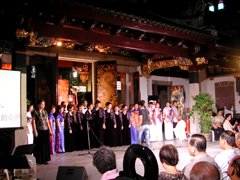
Organised by the Xiang Lin Music Society 湘灵音乐社, with the participation of the Fu Hai Monastery Choir 福海禅寺 and the support of Hokkien Huay Kuan, we got to listen to a very elegant and ancient music. Apart from the VIPs, the audience's median age must be 70! (^^) Ah, the music will remind them of their young days in the villages in and around Quan Zhou, China, where the Minnan Hua (Hokkien as known here) is spoken.

I think Tian Hock Keng is the appropriate place to perform such concerts as it also remind us of our ancestors who came to this temple upon touching the shores of Singapore. They brought along the cultural heritage to Singapore. Last night, some of the younger members, probably in the 12-16s, were also singing and playing in the Chinese Orchestra for Nan Yin. We know that Nan Yin will survive in Singapore. (^^)

Wednesday, March 08, 2006

A Life is just as Precious

In a dark cubicle of an equally dark pre-war house, somewhere in Kong Sai Kai (Keong Siak St) , some fifty years ago, a girl was born. She was born mute. And somewhere in Chinatown, another boy was also born. Mute.

Like a typical Chinese tale .. they were match-made. When this mute girl was growing up, her mother was concerned about her future. And so, she had long decided that she must get a husband for her. And so, these two mutes got married. Life was not easy but they got on. Husband was working on odd jobs. Wife worked as helper. In between, they had lovely kids, yes, they talk and are normal, thankfully.

If life was tough in Chinatown in the 60s to now, theirs would probably be more challenging. But each time when I met the mute lady, she was always happy and using her hands and whatever sounds she could make to communicate. She was a distant relative, probably linked all the way to this tiny village in China. And so, wherever we could, we would share something with her.

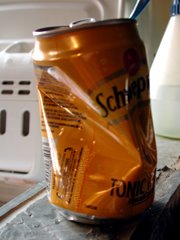
Unknownst to us, our Indonesian maid was also helping! We were wondering why she was keeping all the used drink cans in the house. Oh, she washed (to avoid the ants from making a mess) and saved them for the husband to sell!

And then, one morning, she waited and waited. In vain. She could not see him at the usual place. Then, we knew that he had passed on. When my wife met the wife, she was describing with her hands and sounds how she cried for days. (^^;

Now, each time I finish a can of drink, I think of these lives in our midst. A garbage could well mean a possible warm meal.

Saturday, March 04, 2006

Lor Mee Anyone?

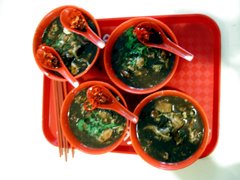
I suppose Lor Mee (or Lu Mian in Mandarin) must be a very Hokkien dish. It is one of those sticky gooey gravy over oily noodles (known as sic mee in Hokkien, meaning cooked noodles) complemented with chunks of fish meat (Ikan Merah fish?), sliced fatty pork and deepfried plain batter (like tempura), garnished with plenty of grated garlic, and if you like, at sliced chilli and a dash of black vinegar.

It is also interesting to see the stick gravy going watery, depending on the acidity (?) of the saliva. (^^)

In the old Boon Tat street, along a line of hawker stalls, there was once a famous Lor Mee Stall. It used to be one of my haunts when I worked around that area, well, not exactly near .. at Peck Seah St. For food, distance is not too far. once I travelled from Raleigh to Chapel Hill in North Carolina, USA, just for some good Indian food. (^^)

Now, at the Amoy St Food Centre, next to the famous old Sian Chor Keng (Xian Zu Gong) - temple more popular for Tua Pek Kong than its main Deity, Lu Dong Pin - each Sunday morning, from about 9am, one sees a long queue for the Lor Mee. It used to be the case of angry customers complaining when their orders were missed. These days, life is made simpler for the stallholder as the customers have to queue up to buy their noodles! One cannot appreciate the good customer service until now. (^^;

Each Sunday, parents bring their parents and their children to this place for breakfast. While the older folks relish on being able to taste and eat the same bowl of noodles that they had taken, maybe, some 60 years back, their 1-2 year old grandchildren have also been introduced to this dish. And so, the tradition of carrying on the taste and customs of how to each the Lor Mee is being transmitted.