Saturday, May 20, 2006

The Grand Old Dame

To the residents, she is a regular sight. Sleeping on the car bonnets or underneath the cars. Chances are, these days, she sleeps under the cars, considering that she is now at an advanced age. If one is able to trace her family tree, gosh, how many generations she must have beget.

The worn out face peers at me as I greeted her each morning. Sometimes, she would be beneath my car, just next to the tyre. She would look at me sleepily and walked away to another car, and continued with her snooze. I am still wondering where she got food, staying on the third level of the car park.

She probably has outlived a dog which was also a resident in the block. While she belonged to an owner, she walked as if she owned the whole block. She would join us to take the lift, choosing the floor to get out, take a walk and wait for another lift down. The word life has taken its second meaning, literally. Bless her soul, she must have gone now as I have not seen her for a year.

Will this grand old dame still be around? Each morning looking out for her underneath one of the cars, I am assured that she lives out another peaceful day. I guess, her days are numbered, naturally.

Monday, April 10, 2006

Herbie is at it again!


Ah, the oldies but goodies might remember Herbie. For the youngies, maybe, you have another name? My old cells cannot recall. (^^) Yes, on this lovely Sunday afternoon when the carpark lots at Blk.33 off Park Crescent were quickly being filled up by the modern and flashy cars, there was one vintage. At least it was declared by the car, or the owner?

Blk.33 must be one of the best designed carparks in Singapore, but on this fateful day, 9 April 2006, the cars were crawling. I thought that only happens just before the Chinese New Year! Aha, I found out why quickly enough. Herbie decided to get fresh with this sweet young thing and so got close to it, oblivous to the embarrassed noises from the fellow four-wheelers. But it did respect the rule of the day, not more than 5 minutes. (^^)

But being typical Singaporean cars, they just passed by, took a quick look and went looking for a proper place. Tsk! Tsk! The cars must have been saying, doing it in public. (^^) Ah well, we should not be voyeurs, right? And so we went away.

How long did he stay there, I did not stay to find out. The next time I was there, he was gone. (^^)

Saturday, April 08, 2006

Cantonese Opera Singing Anyone?

Of all the local Chinese operas, I think Cantonese Opera is probably one of the most active and visible ones. Apart from the professional opera groups, there are a number of amateur ones and many are taking an interests in it.

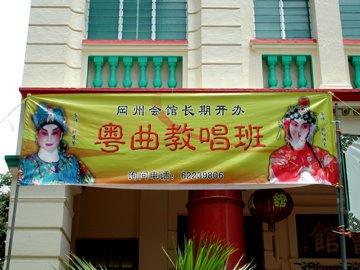
Inside Chinatown, the Kong Chao Wui Kun (Gang Zhou Hui Guan 岡州会馆) , Gang Zhou Association, which is probably older than its building which was built in 1924, is offering Cantonese Opera Singing lessons 粤曲教唱班. This Association has been amongst the pioneers in having a Cantonese Opera and a Lion and Dragon Dance troupe. Some of the artifacts of the Association are also on display in the Chinatown Heritage Museum.

So, if you are interested, call them at 62239806. The building is along New Bridge Road, opposite to Pearl Centre.

Sunday, March 19, 2006

Nan Yin 南音 at Tian Hock Keng

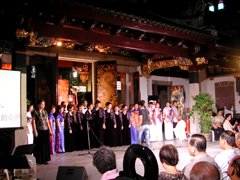
On Saturday night of 18 March, 2006, Tian Hock Keng (Guan Fu Gong 天福宫) opened its door to one of the rare concerts on Nan Yin 南音 - Southern Music. Once popular with the Emperor's Court from Tang Dynasty through Qing Dynasty, today, it is heartening to know that there are still groups of young people and old involved in practising and keeping this arts alive.

Organised by the Xiang Lin Music Society 湘灵音乐社, with the participation of the Fu Hai Monastery Choir 福海禅寺 and the support of Hokkien Huay Kuan, we got to listen to a very elegant and ancient music. Apart from the VIPs, the audience's median age must be 70! (^^) Ah, the music will remind them of their young days in the villages in and around Quan Zhou, China, where the Minnan Hua (Hokkien as known here) is spoken.

I think Tian Hock Keng is the appropriate place to perform such concerts as it also remind us of our ancestors who came to this temple upon touching the shores of Singapore. They brought along the cultural heritage to Singapore. Last night, some of the younger members, probably in the 12-16s, were also singing and playing in the Chinese Orchestra for Nan Yin. We know that Nan Yin will survive in Singapore. (^^)

Wednesday, March 08, 2006

A Life is just as Precious

In a dark cubicle of an equally dark pre-war house, somewhere in Kong Sai Kai (Keong Siak St) , some fifty years ago, a girl was born. She was born mute. And somewhere in Chinatown, another boy was also born. Mute.

Like a typical Chinese tale .. they were match-made. When this mute girl was growing up, her mother was concerned about her future. And so, she had long decided that she must get a husband for her. And so, these two mutes got married. Life was not easy but they got on. Husband was working on odd jobs. Wife worked as helper. In between, they had lovely kids, yes, they talk and are normal, thankfully.

If life was tough in Chinatown in the 60s to now, theirs would probably be more challenging. But each time when I met the mute lady, she was always happy and using her hands and whatever sounds she could make to communicate. She was a distant relative, probably linked all the way to this tiny village in China. And so, wherever we could, we would share something with her.

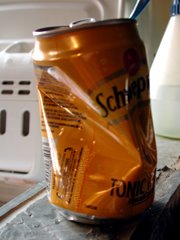
Unknownst to us, our Indonesian maid was also helping! We were wondering why she was keeping all the used drink cans in the house. Oh, she washed (to avoid the ants from making a mess) and saved them for the husband to sell!

And then, one morning, she waited and waited. In vain. She could not see him at the usual place. Then, we knew that he had passed on. When my wife met the wife, she was describing with her hands and sounds how she cried for days. (^^;

Now, each time I finish a can of drink, I think of these lives in our midst. A garbage could well mean a possible warm meal.

Saturday, March 04, 2006

Lor Mee Anyone?

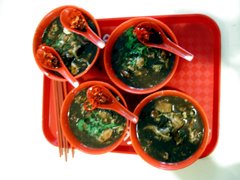
I suppose Lor Mee (or Lu Mian in Mandarin) must be a very Hokkien dish. It is one of those sticky gooey gravy over oily noodles (known as sic mee in Hokkien, meaning cooked noodles) complemented with chunks of fish meat (Ikan Merah fish?), sliced fatty pork and deepfried plain batter (like tempura), garnished with plenty of grated garlic, and if you like, at sliced chilli and a dash of black vinegar.

It is also interesting to see the stick gravy going watery, depending on the acidity (?) of the saliva. (^^)

In the old Boon Tat street, along a line of hawker stalls, there was once a famous Lor Mee Stall. It used to be one of my haunts when I worked around that area, well, not exactly near .. at Peck Seah St. For food, distance is not too far. once I travelled from Raleigh to Chapel Hill in North Carolina, USA, just for some good Indian food. (^^)

Now, at the Amoy St Food Centre, next to the famous old Sian Chor Keng (Xian Zu Gong) - temple more popular for Tua Pek Kong than its main Deity, Lu Dong Pin - each Sunday morning, from about 9am, one sees a long queue for the Lor Mee. It used to be the case of angry customers complaining when their orders were missed. These days, life is made simpler for the stallholder as the customers have to queue up to buy their noodles! One cannot appreciate the good customer service until now. (^^;

Each Sunday, parents bring their parents and their children to this place for breakfast. While the older folks relish on being able to taste and eat the same bowl of noodles that they had taken, maybe, some 60 years back, their 1-2 year old grandchildren have also been introduced to this dish. And so, the tradition of carrying on the taste and customs of how to each the Lor Mee is being transmitted.

Monday, February 27, 2006

A Sunday Morning at the Chinatown Food Centre

This could well be a typical Sunday mid-morning at the Chinatown Food Centre (FC). Well, I was there on 19 Feb 06 to have my favourite Vegetarian BeeHoon by the escalator nearer to the main market entrance.

Imagine that I have been eating at this Vegetarian BeeHoon stall long before the arrival of our kids, ate with the kids and now the kids are 13 & 11. This stall still has a queue every morning and the queue is much longer on the first and fifteenth of the Lunar Month.

On a Sunday morning at 11.30am, almost all the tables were taken up. Most of the people were in their 50s to 70s, a gathering of the retired folks. An interesting item on the table seemed to be beer! One man was seen taking a mixture from a bottle of Carlsberg and a bottle of Guiness Stout. And he was drinking it and eating fruits!

Across to the other side of the FC was a dim-sum stall, which used to house the Chwee-Kuey (Teochew Rice Cake), and there was a long queue, as it was in the past. I wonder why the Chwee-Kuey stall gave up.

Here is probably one place where Cantonese is still the main language spoken, and one could say the same for many Chinatowns around the world. For many of the older people, who probably do not stay in Chinatown, Sundays are days of gatherings with old friends or old neighbours and chats could have a wide range, from politics to the mundane things.

Monday, February 13, 2006

Chap Go Meh

To the various dialect groups of Chinese, the 15th day of the Chinese New Year could mean different things. But of course, all knows that it marks the end of the Chinese New Year celebration.

The age-old Wak Hai Cheng Beo at Philip St, a Teochew Temple which had since a long time been popular to Teochew, Hokkien and Cantonese, continues its traditional eve-of-chap-go-meh exchange of flags and lanterns. This goes on right through the 15th day. Gone are the days when one could see the devotees carrying flags and a bigger joss-stick sitting on the trishaws as they rode home. These days, they have even bigger joss-sticks to withstand the wind as they ride home in cars and maybe taxis.

To some Chinese families, it is a time for some tang-yuen, the familiar southern Chinese rice balls.

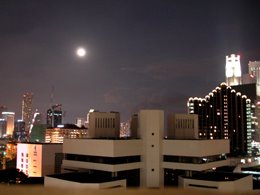
In Chinatown, it was the last bang for the Chinese New Year with another round of celebrations. Alas, I did not get to see it as I was somewhere else attending a temple dinner. But I managed to capture some scenes of the full moon (it is said that the moon is rounder on the 16th day of the lunar month) overlooking Chinatown.

Thursday, February 09, 2006

Chinese New Year in Chinatown

Over the years, Chinese New Year in Chinatown means shopping before the big day and Yu-Shang (pronounced in Cantonese for Yu-Sheng) after the new year. The highlights of the goodies for the Chinese New Year were mainly for the traditional Chinese cooking, such as dried mushrooms, the famous Yunnan Ham, all kinds of Chinese sausages of various shapes, colours, size and lengths, dried oysters, fatt-Choy (in Cantonese for Fa Cai) and yes, tidbits such as boiled peanuts, cashew nuts, melon seeds, and sweets. The attraction for this year must be the Mua-chi (like the Japanese Daifuku) from Taiwan.

Said to be originated by three or four local Restauranteurs, the idea of Lo-Hei (again, in Cantonese for raising prosperity) was rooted and now it is an in-thing for all to go for Lo-Hei within the 15 days of the Chinese New Year. This year, I saw people going for Lo-Hei even before the CNY! Some would prefer to do it on the 7th day of CNY, as it is said to be everyone's birthday. And yes, from the traditional Cantonese raw fish, these days, one could do Lo-Hei with practically anything, from Salmon to Abalone.

One interesting landmark of the new entrance to Chinatown must be the decorations at the New Bridge Road/Eu Tong Sen St junction with Upper Cross St. This is one scene that goes 360 degree that you must see. (^^)

http://www.singapore360.com/frame_main_blog.htm

Monday, February 06, 2006

Pai Ti Kong 拜天公

Today is the 9th day of the Lunar New Year. It is the birthday of the Jade Emperor, more popularly known to the Hokkien (Fujian) people as Ti Kong (Tian Gong in Mandarin). It is probably the single most important day for the Hokkien Taoists. As in the Chinese way of counting time, the first hour of the new day starts on the night before (in modern clock time) from 11pm. And so, the Hokkien would start their prayers from last night at 11pm, and well, depending on the throwing of the pua-puay (sheng-bei - the kidney shape wooden blocks that the Chinese Taoists use to communicate with the Deities or even the ancestors), the prayer could well end as late at 2am.

In the old days when I was living in a Peranakan house (our family rented a room) in Chinatown, it was a grand communal affair where all the tenants joined the landlady in offering the prayers. The main hall on the ground floor was arranged beautifully with all the praying paraphernalia, which included big red candles that were pushed into the sharp pointed brass candle holders (all polished for the Chinese New Year and this night), big joss papers known as Ti-Kong-Kim, most of them being folded into elaborate shapes, including those that looked like the ancient gold and silver ingots, and sugar canes.

A pair of sugar canes was and is still a must. According to stories heard, it was said once the Hokkien were being attacked (not sure if they were the mongols or bandits) and they went to hide in the sugar cane field. The sugar cane saved their lived. And so, when they came out alive, in gratitude the prayed to Ti Kong with the sugar canes, probably reminding them of how their lives were saved.

It was a night of grand offerings from roast pig to roast chicken and ducks, all kinds of Chinese kueh - like Huat Kueh and Kue-Nern-Ko (Egg cake pretty close to Castania), and yes, the Ti-Kong Pia (Cookies that the poor Hokkien made as a varied offering), fruits of all sorts, dried vegetarian dishes, and whatever the kitchen could produce. In our Peranakan House, it was a night of gathering as well, when all the tenants sat together, folded the Joss Papers and chatted. It was a night when children were allowed (almost forced to) stay up late to pray to Ti Kong.

The excitement came when the leader, in this case, the landlady, would seek approval to burn the joss papers. When this was granted, in unison, the occupants of the house would carry the joss papers, including the big and well decorated boxes and the sugar cane leaves chopped from the sugar cane, to form a bonfire. In the 1950s, it was also a time for the biggest amount of fire-crackers. Most of these fire crackers would have strung up to the bamboo sticks hung from the highest floor. In our house, the highest was third storey. It was a night when neighbouring houses would try to outdo each other in the fire-crackers too.

The next morning, with beady eyes, we would have to wade through the ankle deep "what's-left-over-of the firecrackers" - red papers - to walk to school. But we were also reminded of good and hearty makan awaiting for us when we returned home. This was one of the moments, we poor kids were waiting for.

As I do not have a picture of what I had described, I have borrowed this picture from Ronni Pinsler who has taken this Pai Ti Kong scene in Penang last night. It is almost similar, including the house. (^^)

Update: Wah, I did not know that as I wrote, someone in the west was doing the same! Monkey's narrations give me hope that tradition lives, albeit in smaller numbers. (^^;