Monday, February 06, 2006

Pai Ti Kong 拜天公

Today is the 9th day of the Lunar New Year. It is the birthday of the Jade Emperor, more popularly known to the Hokkien (Fujian) people as Ti Kong (Tian Gong in Mandarin). It is probably the single most important day for the Hokkien Taoists. As in the Chinese way of counting time, the first hour of the new day starts on the night before (in modern clock time) from 11pm. And so, the Hokkien would start their prayers from last night at 11pm, and well, depending on the throwing of the pua-puay (sheng-bei - the kidney shape wooden blocks that the Chinese Taoists use to communicate with the Deities or even the ancestors), the prayer could well end as late at 2am.

In the old days when I was living in a Peranakan house (our family rented a room) in Chinatown, it was a grand communal affair where all the tenants joined the landlady in offering the prayers. The main hall on the ground floor was arranged beautifully with all the praying paraphernalia, which included big red candles that were pushed into the sharp pointed brass candle holders (all polished for the Chinese New Year and this night), big joss papers known as Ti-Kong-Kim, most of them being folded into elaborate shapes, including those that looked like the ancient gold and silver ingots, and sugar canes.

A pair of sugar canes was and is still a must. According to stories heard, it was said once the Hokkien were being attacked (not sure if they were the mongols or bandits) and they went to hide in the sugar cane field. The sugar cane saved their lived. And so, when they came out alive, in gratitude the prayed to Ti Kong with the sugar canes, probably reminding them of how their lives were saved.

It was a night of grand offerings from roast pig to roast chicken and ducks, all kinds of Chinese kueh - like Huat Kueh and Kue-Nern-Ko (Egg cake pretty close to Castania), and yes, the Ti-Kong Pia (Cookies that the poor Hokkien made as a varied offering), fruits of all sorts, dried vegetarian dishes, and whatever the kitchen could produce. In our Peranakan House, it was a night of gathering as well, when all the tenants sat together, folded the Joss Papers and chatted. It was a night when children were allowed (almost forced to) stay up late to pray to Ti Kong.

The excitement came when the leader, in this case, the landlady, would seek approval to burn the joss papers. When this was granted, in unison, the occupants of the house would carry the joss papers, including the big and well decorated boxes and the sugar cane leaves chopped from the sugar cane, to form a bonfire. In the 1950s, it was also a time for the biggest amount of fire-crackers. Most of these fire crackers would have strung up to the bamboo sticks hung from the highest floor. In our house, the highest was third storey. It was a night when neighbouring houses would try to outdo each other in the fire-crackers too.

The next morning, with beady eyes, we would have to wade through the ankle deep "what's-left-over-of the firecrackers" - red papers - to walk to school. But we were also reminded of good and hearty makan awaiting for us when we returned home. This was one of the moments, we poor kids were waiting for.

As I do not have a picture of what I had described, I have borrowed this picture from Ronni Pinsler who has taken this Pai Ti Kong scene in Penang last night. It is almost similar, including the house. (^^)

Update: Wah, I did not know that as I wrote, someone in the west was doing the same! Monkey's narrations give me hope that tradition lives, albeit in smaller numbers. (^^;

Tuesday, January 24, 2006

A Trip to the Barber


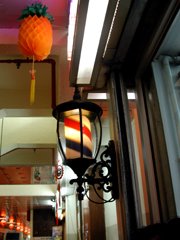
Last Sunday, I took a walk to People's Park Centre basement, to my old Barber shop. You see, the new one at People's Park Complex was no more there. Businesses seem to come and go so fast these days. So, after two flings with the new barbers, I went back to the old.

It was the last Sunday before the Chinese New Year. As with Chinese traditions, the guys should go for their haircut before the New Year. So, as if it was a calling from within I joined the crowd. Gone are the days when if you have long hair you might be served last. (^^)

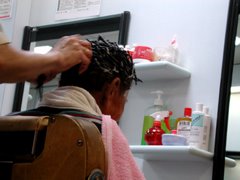
The barber chairs were all occupied. All the barbers were busy. Outside, on the benches were two guys - in their fifties, I think - with the towel all wrapped up on their heads. Ah, having a cold "perm". Another three were having their hair swept backwards, like the Rock-n-Roll dancers in Harajuku, Japan on a Sunday afternoon. Yes, they were having their hair tinted black.

The barbers of the old have their business evolved too, providing "perming" as well as dying. Digging of the ears is now a thing of the past. The electric shavers (or rather hair cutters) have replaced the traditional mechanical ones. Razor blades for shaving are now fitted with use and throw blades. AIDS have changed the ways shaving tools are used.

This barber shop - called Good World - has been around for quite a while. It is the modern barber shop of the old, but not of the new generation type. No, no lady barbers. An interesting thing about this barber shop is that the barbers all speak Hock Chew (Fuzhou) - I think. With the customers, they speak Hokkien or Mandarin. It was a surprise to me when I went this Sunday and a guy (new face) greeted and conversed with me in English. Changing Times. (^^)

Nothing like going to the same old place, doze off and have one's hair trimmed, amidst the chatters in Hock Chew, the comparisons of 4-D results and even some tall tales from some customers to the barbers. (^^)

Friday, January 20, 2006

A Good Soul Deserves Another

Last night, as I was picking up my mail from my mailbox on the groundfloor, there was a funeral wake. It was normal and I did not pay much attention until one lady, whom we met often in the lift, told me that the person died alone.

This man who had just passed away lived alone in the "senior citizen flat" along Upper Cross St. From what I understand from the people at the Wake, he was under social welfare. Inspite of all the hardship, he helped to deliver food and things to the other elderly people in the block, the people who are not able to move easily. He was an important connector in this community of elderly people.

He died alone without any relatives (at least at the Wake, no one was aware). The neighbours in the "community" took it upon themselves (with some volunteers like this lady and her husband who are living in my block, which across from that block) to give him a decent burial. They even arranged for Buddhist funeral rituals to be conducted.

At the Wake, the elderly neighbours who could walk were there to help out, such as folding the necessary joss-papers and burning candles/joss sticks. They tried collecting "white gold" (contributions to a funeral is known as white gold in Chinese) from the community. There was one donor who happened to be at the block to give ang-pows away to the senior citizen (these are the low profile philanthropists), who upon hearing of this case, gave S$1000 contribution. The community spirit is still alive.

Tuesday, January 17, 2006

Temple Facing The Sea 福德祠望海大伯公


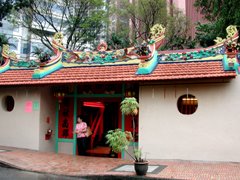
It was said that way before Raffles arrived in Singapore in 1819, at this place where Palmer Road is now at, there was a thriving community. This could have been a thriving port, called Tanjong Malan, now known as Tanjong Pagar (Pagar meaning Kelongs or building on stilts in the sea used for trapping fish). And thus, it was only natural for the Chinese to first offer thanks to their Deities upon coming on shore. In this little place was a Chinese Temple dedicated to Da Bo Gong 大伯公 (more popularly known as Tua Pek Kong in Hokkien, and Fu Tat Chi (Fu De Ce) 福德祠 to the Cantonese and Hakka). As the temple was facing the sea (then), it was then known as the Da Bo Gong Temple facing the sea 福德祠望海大伯公.

This temple is probably the only "practising" Hakka temple in Singapore. For its more than a hundred and eighty years (considering 1819 as the starting point), this temple must have seen much. How its view of the sea was now blocked by containers when it could have been sending lapping waves on its steps. The bustling port activities. The different people living together - an early cosmopolitan town. There was also a famous kramat just across from the temple.

But much of the described scenes are oral history. What was it really like? Thanks to the Ying Fo Fui Kun (a HakkaClan) which administers the temple and NUS, an archaeological team has started doing some digs around the temple to understand better what life was like then. I hope that the dig will reveal more about life around the temple and the location then.

Thursday, January 12, 2006

Chinatown Cat

Thanks to the encouragement of cat_aunty I am sharing a pix or two of this Chinatown Cat. One wonders since when did the cats come to Singapore (^^). But for longtime residents of Chinatown, they must have seen generations after generations of these free and easy cats. These cats are fiercely independent but are tame enough to take up your offer of food.

And if they like you, well, they will declare that you are their property. How? By brushing their bodies against your legs. Oh, they love a scratch on their head and would sit perfectly still, a little purr here and there, as you scratch its head.

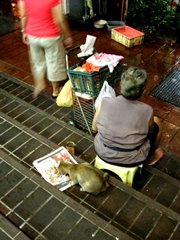
On this crowded and noisy night in Chinatown as it lighted up for the Chinese New Year shopping, this cat was contented to have its dinner on a newspaper, thanks to its sponsor. Despite the movement of the people and the rain, it just ate on. What would its life be in Chinatown. (^^)

Sunday, January 08, 2006

Chinatown Lights Up

Officially speaking, that is. It was "ren-shan-ren-hai" (people mountain people sea) from People's Park Complex to Sago Lane. It was almost like the old days when there were only shoppers and the stalls. Last night, the crowd was created in part, with the show and the small walking space for the people who flocked to Chinatown to watch, amongst many things fireworks.

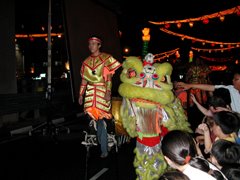
There were more onlookers than shoppers, but certainly some would be "hooked" to buy something they fancied. The show by the Sichuan Operatic Troupe at the open stage next to the Chinatown Food Centre/Market must be the crowd stealer, with its modern dance and the ever interesting mask-changing performance.

For the crowd lined along the barricades, the highlight must be the dragon, lions and stilt walkers. The crowd, especially, the children just love to touch the fur of the lions. One young kid was so entranced by the giant (on stilt) that he allowed him to carry him.

Yes, Chinese New Year preparations for the household are underway. Chinatown will relive its old days, albeit a little differently.

Chinese New Year Shopping

Chinese New Year is probably one of the number of Chinese festivities where cooking traditional Chinese food is important. And so, shopping for traditional Chinese cooking ingredients is one of the main activities in the weeks before Chinese New Year. For this year, Chinese New Year falls on the 29th January, 2006.

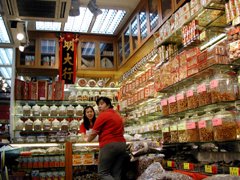
Many shops in Chinatown are already stocking all the goodies, from ingredients for food dishes to desserts to tidbits (traditional Chinese sweets and bites like melon seeds and ground nuts) to the all important fruit, the Mandarin Orange.

At Upper Cross St, there is this shop, Ming Tai [Ming Da] that sells all kinds of traditional Chinese cooking ingredients, from various grades of dried scallops to wax duck and sausages. It also dispenses Chinese herbs - for medicine as well as for tonic soups. And for those who wants to prepare special dishes like "Buddha Jumps Over the Wall", you can also find most of the ingredients here.

The shopowners speak English, Mandarin, Cantonese, Hokkien and probably more languages and dialects.

[Note: Disclaimer, I have no commercial interests in this shop (^^)]

Saturday, December 31, 2005

Chinatown prepares for the New Year of the Dog

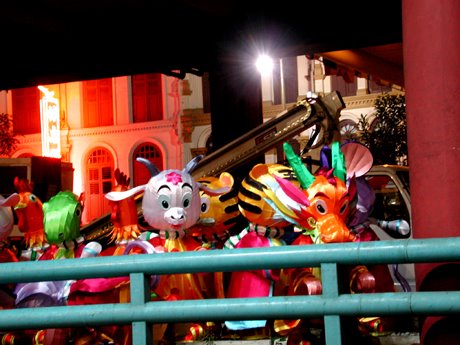
Christmas has come and gone. The new year is only hours away. And now Chinatown is preparing for the Chinese New Year of the Dog, which falls on 29 January 2006. Many interestings props were already awaiting in various "hideouts" waiting to be put up. Now, they are in the process of putting up.

A few weeks before Chinese New Year is probably the only time of the year when the place will be crowded as people from all over Singapore will flock here to buy the traditional stuff to prepare for the Chinese New Year (CNY). Others will come to soak in the atmosphere. In the old days, the very young would venture into the crowd with their parents risking suffocation as it was really shoulder to shoulder. These days, the crowd is as thick. But then, in those days, it could be the only time for the family to buy new clothes and some tidbits for the CNY. Ah, Singapore has come a long way.

Soon, traditional yummy food - maybe only for the older people? - like Chinese sausages, waxed ducks and meat, Yunnan Ham (that one uses a normal saw to saw it), and Shitake mushrooms will be on full display.

Tuesday, December 06, 2005

Sausages - An Austrian Challenge


Right in the heart of the Chinatown that most people know, is a small roadside stall, the new ones that were set up along Trengganu St (on the side of Sago St.) Apart from the traditional and not so traditional stalls selling all kinds of things, is a stall that stands out. Inside this stall is an ang-mo. A jovial and outgoing person, this ang-mo (Hokkien for red hair, meaning caucasians) greets anyone and everyone who passes by his stall.

Erich must be his name as his name card is written as "Erich's Wuerstel Stand" with the slogan "Quality Grilled Sausages - Austrian Style". And the address? Chinatown Night Market Singapore F&B 3 Trengganu Street.

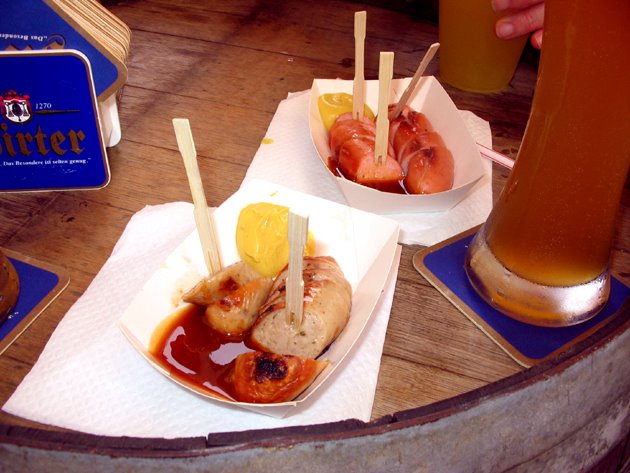
On that evening when I was in Chinatown with my Aussie friends, we thought it was a good idea to have Austrian sausages right in the heard of Chinatown. What a Stammtisch too! We had Bockwuerst and Bratwuerst with sauce and mustard. Oh, sie waren gut geschmeckt! Ah, in Singlish? Shiok! Sedap!

And what could have been better when we were enjoying the sausages and chatting with Erich, when the Crazy Horse girls walked down the road with the saucy Chinese blouses and tight samfoo pants. We did not know where they came from until we heard from Erich. And yes, he knows what's going on in Chinatown!

Erich certainly adds life to Chinatown! Judging by the number of news-magazine articles pasted all over his stall, his must be the most popular one in town.

Want to get another kick out if this? His name card has this declaration, "The Last Sausage Kiosk Before the Equator". Can anyone dispute this? (^^)