Tonight, 11 Sep 10, Chinatown in Singapore welcomes Autumn with a lights-up and grand performance as we prepare for the Mid-Autumn Festival - Zhong Qiu Jie.
What was missing were the delightful clear-glass lanterns that would have been of fishes and even aeroplanes (considered as modern then). Tonight it was modern technologies in full display with dance modernised with modern beat. Something that is atuned with the younger Singaporeans.
While the older people sat back, or rather stood, to watch the performance, it must be the performers who enjoyed and probably appreciate the Mid-Autumn festival of current times.
With full grandeur, performance after performance graced the stage and carried on to perform on the streets to the people who came from afar to watch. It was an event where Singaporeans, working foreigners and tourists came together to enjoy.
Wait, it was not just the younger people who performed with their energetic leaps and dance, the other slightly older group from Sokka Association was also there - 36 of them I heard, performing the fusion line dance!
The young parents and the grandparents must have been the ones busy trying to carry their children/grandchildren over their shoulder to get a glimpse of the actions. An introduction to the culture of Singapore. Just the beginning.
Saturday, September 11, 2010


Hakka Songs Event @ Hong Lim Green
On 10 Sep 10, the Hakka community in Singapore and Malaysia came together to share a night of singing at the Hong Lim Green. Thanks to modern day Karaoke system and disks, there were plenty of songs from which the participants could use to sing and perform.
To the delight of the grandchildren who called out to their grannies as they walked to the stage to sing their favourite Hakka songs. There must have been some three to four generations of Hakkas present at this event. And there must be more than 200 of them as they sat, listen and cheered the performers on.
And from Johore came four members dressed in kabayas.
With the popular Taiwan soap opera on the TV, this Hokkien song also has a Hakka version.
To the delight of the grandchildren who called out to their grannies as they walked to the stage to sing their favourite Hakka songs. There must have been some three to four generations of Hakkas present at this event. And there must be more than 200 of them as they sat, listen and cheered the performers on.
And from Johore came four members dressed in kabayas.
With the popular Taiwan soap opera on the TV, this Hokkien song also has a Hakka version.
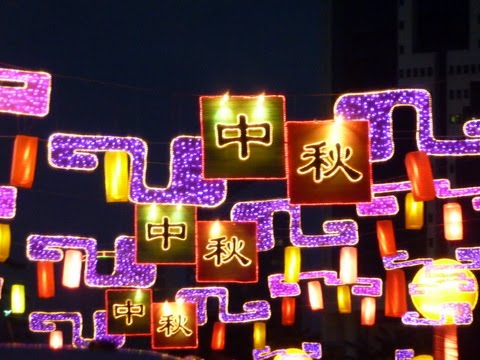
Mid-Autumn Festival comes to Chiinatown
As Chinatown feted the Good Brothers with grand offerings and sending off, the scene changes very quickly. 8 September 2010 is the first day of the 8th Lunar Month. The 15th of the 8th Moon (as described in Chinese) is the day dedicated to the full moon in the cool Autumn Night. In Singapore, the cool Autumn night might be missing (but who knows as cool to the Singaporeans could just be a drop of one or two degrees) but the celebrations will be colourful and loud. And almost hot!
As we await for the lights-up on 11 September, hours away, here is a sneak preview of what it is like this year.

As we await for the lights-up on 11 September, hours away, here is a sneak preview of what it is like this year.
Tuesday, August 31, 2010
Ghost Festival in Chinatown - Zhong Yuan Jie 中元节
Chinatown used to have many activities during the 7th Month or what is known to the English speaking world as Ghost Festival. And it would happen at various spots in Chinatown. Chinatown is known to most Singaporeans, and probably the world, to be from Sago Street to Temple Street, where the streets are interlinked by Trengganu St. These days, the ghost festival activities are somewhat concentrated in the still available free space next to the Tooth Relic Temple. But then, the activities are getting bigger and when there is a getai (variety show) on the street, then it would be jam packed.

I went to the Kreta Ayer Square (next to Chinatown Complex, which houses the wet market, small shops and a food court) where there is a stage and a free space. On the opposite end are the "dum" and chess tables which seem to be forever occupied no matter what time I was there. A favourite gathering place of the older men who exercise their brain over the strategy games.
This year, apart from the exhibition on Taoism, organised by the Youth Group of the Taoist Federation (the exhibition was enlarged compared to the last year), there was also a talk show conducted by Master Leong from HongKong who spoke in Cantonese and translated by Wei Yi, the General Secretary of the Youth Group. It was a very interesting presentation and if only more people were there. Many of the older people even stood right to the end to follow the explanation followed by short demonstrations by the Taoist Priests. Suddenly it seemed somewhat clearer to me as I listened to the explanation and then, the demonstration. I wish there are such narrations that could be put on slides that could be placed next to the event when the Taoist Priests are performing the rituals. Our command of the language, be it Cantonese, Hokkien, Mandarin or any dialect in which the priests are conducting are not enough to comprehend, not to mention understanding the intentions and objectives of the rituals. It was a good start. If the video taken of the event could be put into youtube, more people could learn. (^^)
While this was going on, another group of Taoist Priests were walking along the streets. I traced them to the tentage nearby where they were conducting the Zhong Yuan Jie. I was to learn later on that under this tentage, over two weeks, there were actually two Zhong Yuan Jie being conducted. On the first night I was there, it was organised by the occupants of the Chinatown Complex - probably from the wet market stallholders to the Food Court stallholders.

In the following week when I was there again, it was organised by the Chinatown Business Association. In conjunction with the Zhong Yuan Jie 中元节, Chinatown Business Association also works with Singapore Tourist Board to offer tours for tourists and Singaporeans to better understand Zhong Yuan Jie and getting to visit various interesting parts of Chinatown, led by two very knowledgeable Heritage Guides, Diana and Charlotte. On one tour, the participants even got to join in the grand dinner to experience a typical Zhong Yuan Jie dinner that comes with auctions.

14th evening of the 7th month is said to be the day when Cantonese would make their offerings to the "Good Brothers", a polite term used for the wandering souls. For the Hokkien, it would be 15th as well as the 1st and last day of the 7th month, when they would be receiving them with offerings and sending off with offerings as well. The 7th month is a reminder to the Chinese about their ancestors. Many would make offerings at home to their ancestors. For many who these days have the ancestor tablets in clan associations or temples, families would make a trip there. On the 15th day, Taoists would pay respect to the "Earth Official" known as Di Guan 地官.
Sunday, August 08, 2010
Chinatown Hungry Ghost Festival 2010
The Ghost Festival will start from 10 Aug 10 (the first day of the 7th Lunar Month). As residents and businesses of Chinatown prepares to make offerings during this month, the Chinatown Business Association is also sharing some of its activities with visitors. Read more from the poster below or at the Chinatown Business Association at http://www.chinatown.org.sg
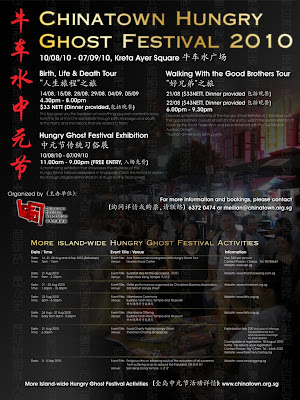
Hungry Ghost Festival Cultural Exhibition (No admission charges)
ack: Chinatown Business Association

Hungry Ghost Festival Cultural Exhibition (No admission charges)
Date | : | 10 Aug to 7 Sep |
Venue | : | Kreta Ayer Square (Sago Street) |
Time | : | 10am to 10pm, daily |
Fees | : | Free Entry |
Staged in partnership with the Taoist Federation (Singapore), this month-long exhibition is an indept look at the mysteries of the Hungry Ghost Festival as it is celebrated in Singapore. What is the origin of the festival, what are its do's and don't's, and the significance of its rituals and offerings? Catch the festival in action too through staged demonstrations of rituals by the Federation's priests.
Hungry Ghost Festival Walking Tour
Birth, Life & Death in Chinatown
(All about Chinese Beliefs, Myths and Taboos)
(All about Chinese Beliefs, Myths and Taboos)
Date | : | 14, 15, 28, 29 of Aug & 4, 5 of Sep |
Time | : | 4.30pm - 8pm (dinner provided) |
Fees | : | $33 per person |
Registration | : |
This tour gives you the lowdown on everything you ever wanted to know about Chinese beliefs, myths and taboos. Our guide will walk you through Chinatown to see Chinese beliefs as they are lived, through birth, marriage and death. Consult the Almanac and get your fortune told. Find out what lies behind ‘Dead Man’s Street’ and watch real-life demonstration rituals performed by the Taoist Federation. We’ll answer some burning questions too, like why it’s not safe to point at the moon, when it’s perfectly alright to not wash your hair and of course, how to live the great prosperous life!
Walking With the Good Brothers
(THE Hungry Ghost Festival Walk)
(THE Hungry Ghost Festival Walk)
Date | : | 21 Aug (Sat) and 22 Aug (Sun) |
Time | : | 6pm - 9.30pm (dinner provided) |
Fees | : | 21 Aug: $33 per person 22 Aug: $43 per person |
Registration | : |
Enter into the world of deities, spirits and beliefs of the Hungry Ghost Festival. Our guide will take participants through a mystical evening of the Hungry Ghost festivities in Chinatown. Find out which deity acts as the festival’s ‘policeman’, what secrets lie in the ‘Fa Cai Ang Bao’ (prosperous red packet), watch the rituals and be immersed in the loud and electrifying action of the Ge Tai and Auction Dinner*. Walk with the ‘good brothers’ (a euphemism for the spirits) as they walk the earth once more.
* Auction dinner is on 22 Aug only.
* Auction dinner is on 22 Aug only.
Saturday, July 31, 2010
Food Festival in Chinatown
On 24 July 2010, there was a Cantonese Food Festival in Kreta Ayer Square, as part of the bigger Singapore Food Festival. A modest setup it did get a crowd going for their favourite food. The most popular queue was the roast meat, as one would expect.

Alas, I was looking forward to the lesser-filling food that one could take as Tim Sum (Dim Sum) for breakfast or anytime (it is said that in Asia, notably in Singapore? we eat only one meal, one long meal that is). And so, after looking at the displays of the stalls and peering into what was being bought (There was a Ramli Burger too! A rare sight in Singapore other than at the KTM Tanjong Pagar Railway Station), we decided to go to the food centre to check out for my favourites.

Since we were in the mood, we decided to take the Chee-Cheong-Fun (literally names as Pig Intestine as it looks like one but actually it is rice flour roll) and Wu Tau Koh (Yam Cake) with the typical chilli and Tim-jeong (sauce). I preferred the dark red sauce that seems to be less popular these days. And I tried the Chow-mei-fun (fried Beehoon or vermicelli) (I wanted the chow mien - fried noodles - but it was sold out - well, they replenished it later) and then, the Tao-Chung (bean dumpling) with custard sugar, my childhood favourite. Somehow, the taste was never the same, compared to the young days when we had it. Most of these food these days are factory-produced and not home-cooked.

My favourite stall in the Chinatown Complex food centre is still the Vegetarian BeeHoon, which I have been taking for decades. Other than the stall owners, I have seen how many hands had taken over the wok. Now, it is in the hands of the mainland Chinese. Ordering the beehoon has also been changed from Cantonese to Mandarin, unless the locals are around. (^^) In many Chinatowns around the world, Cantonese is the franca lingua. In Singapore, it might be diminishing .. fast.

I hope in the next Cantonese Food Fest, more typical Cantonese dishes, from the humble home-cooked ones to the banquet, could be on show, and of course, for tasting and purchase too. Maybe, we can ask the Grandma to share their recipes too. How about a cookbook by the Cantonese Ah Mah and Ah Por.

Alas, I was looking forward to the lesser-filling food that one could take as Tim Sum (Dim Sum) for breakfast or anytime (it is said that in Asia, notably in Singapore? we eat only one meal, one long meal that is). And so, after looking at the displays of the stalls and peering into what was being bought (There was a Ramli Burger too! A rare sight in Singapore other than at the KTM Tanjong Pagar Railway Station), we decided to go to the food centre to check out for my favourites.

Since we were in the mood, we decided to take the Chee-Cheong-Fun (literally names as Pig Intestine as it looks like one but actually it is rice flour roll) and Wu Tau Koh (Yam Cake) with the typical chilli and Tim-jeong (sauce). I preferred the dark red sauce that seems to be less popular these days. And I tried the Chow-mei-fun (fried Beehoon or vermicelli) (I wanted the chow mien - fried noodles - but it was sold out - well, they replenished it later) and then, the Tao-Chung (bean dumpling) with custard sugar, my childhood favourite. Somehow, the taste was never the same, compared to the young days when we had it. Most of these food these days are factory-produced and not home-cooked.

My favourite stall in the Chinatown Complex food centre is still the Vegetarian BeeHoon, which I have been taking for decades. Other than the stall owners, I have seen how many hands had taken over the wok. Now, it is in the hands of the mainland Chinese. Ordering the beehoon has also been changed from Cantonese to Mandarin, unless the locals are around. (^^) In many Chinatowns around the world, Cantonese is the franca lingua. In Singapore, it might be diminishing .. fast.

I hope in the next Cantonese Food Fest, more typical Cantonese dishes, from the humble home-cooked ones to the banquet, could be on show, and of course, for tasting and purchase too. Maybe, we can ask the Grandma to share their recipes too. How about a cookbook by the Cantonese Ah Mah and Ah Por.
Tuesday, July 20, 2010
Singapore Food Festival: Chinatown offers Cantonese food on 24-25 July 2010
In this year's Singapore Food Festival, Chinatown is going to throw up the best Canto food that you can find in Singapore. At least the traditional ones. It would be fun checking out what's in store. So, if you are a foodie, a Canto food diehard, bookmark the dates - 24 & 25 July, 2010.


Cantonese Cuisine Food Expo
Enter the world of Cantonese Cuisine, as you explore and rediscover the many
reasons why Singaporeans love Cantonese Food so deeply!
Date: 24th & 25th July 2010, Saturday & Sunday
Time: 11.00 am to 9.00pm
Venue: Kreta Ayer Square
Fee: Free Entry
Family’s Cantonese Recipe Cooking Competition
Chinatown invites all food-loving families to take part in this year’s inaugural Cantonese Recipe Cooking Competition.
Whip up any Cantonese dish in the given 45mins to impress our chef judges!
The winning family can win up to the 1st prize of $1000 worth of Cash and Hampers!
Experience and enjoy the fun-filled, adrenaline pumping cooking competition and be crowned the
King of Family Recipe Cooking Competition in this year’s Singapore Food Festival!
Date: 24th July 2010, Saturday
Time: 12.00pm to 2.30pm
Venue: Kreta Ayer Square
Registration Fee : $10
Registration: chinatown@eventions.com.sg
Singapore’s LONGEST ‘Chee Cheong Fun’ Record
150 Chefs from Society of Chinese Cuisine Chefs (Singapore) will gather at Chinatown to challenge this amazing feat for charity!
The targeted 80m long Chee Cheong Fun will write history as it gets recorded in the Singapore Book of Records!
The completed Chee Cheong Fun will be pan-fried immediately on site to be sold at a nominal price to the public in efforts to raise funds for charity.
Date: 25th July 2010, Sunday
Time: 3.00 pm
Venue: Kreta Ayer Square
Fee : Free Entry
For more details:
6474 7909 or chinatown@eventions.com.sg
Website: www.chinatown.org.sg
Enter the world of Cantonese Cuisine, as you explore and rediscover the many
reasons why Singaporeans love Cantonese Food so deeply!
Date: 24th & 25th July 2010, Saturday & Sunday
Time: 11.00 am to 9.00pm
Venue: Kreta Ayer Square
Fee: Free Entry
Family’s Cantonese Recipe Cooking Competition
Chinatown invites all food-loving families to take part in this year’s inaugural Cantonese Recipe Cooking Competition.
Whip up any Cantonese dish in the given 45mins to impress our chef judges!
The winning family can win up to the 1st prize of $1000 worth of Cash and Hampers!
Experience and enjoy the fun-filled, adrenaline pumping cooking competition and be crowned the
King of Family Recipe Cooking Competition in this year’s Singapore Food Festival!
Date: 24th July 2010, Saturday
Time: 12.00pm to 2.30pm
Venue: Kreta Ayer Square
Registration Fee : $10
Registration: chinatown@eventions.com.sg
Singapore’s LONGEST ‘Chee Cheong Fun’ Record
150 Chefs from Society of Chinese Cuisine Chefs (Singapore) will gather at Chinatown to challenge this amazing feat for charity!
The targeted 80m long Chee Cheong Fun will write history as it gets recorded in the Singapore Book of Records!
The completed Chee Cheong Fun will be pan-fried immediately on site to be sold at a nominal price to the public in efforts to raise funds for charity.
Date: 25th July 2010, Sunday
Time: 3.00 pm
Venue: Kreta Ayer Square
Fee : Free Entry
For more details:
6474 7909 or chinatown@eventions.com.sg
Website: www.chinatown.org.sg
ack: CBA
Saturday, July 10, 2010
Lor Mai Kai
Last weekend, with wife and daughter, we decided to retrace one of our favourite food in Gau Che Shui (Bullockcartwater in Cantonese). Alas, the original stalls were no longer there. But new generations stalls or restaurants have taken their place, albeit with cleaner facilities and even air-conditioning, but alas, somehow not with the same taste. At least for this old man.

Along Smith Street, at the corner of the shophouse with the lane, there used to be a very busy tim-sum stall with its for-kei (waiters) shouting orders from all over the lane. Menus were long strips of coloured papers with beautifully calligraphed dishes (one has to understand Chinese and how Chinese food is named, not necessarily directly related to the contents of the dish) pasted in a slanted form on the walls at the lane and in the shop.
To compensate the dirtiness of the environment (which was oblivious to us), when we had a place to sit down, the for-kei would come along with a towel over his shoulder and a kettle of boiling water in one hand and a small enamel basin containing chopsticks and tea cups. He would place them on the table and pour the boiling water into the small basin (size of a soup bowl). With the steam coming out of the sprout as the water went into the basin, one could be sure the germs will be dead in no time. Chinese tea was taken for granted. Then, at least at this place, we were not sophisticated enough to have a selection of tea. I remember when I first went to HongKong in 1976, the waiter and I were shocked about the selections of Chinese Tea. The waiter must have thought me a dumb, and I was dumbfounded with such a wide selection of tea! When he first asked me "Oi yum mi ye cha", my answer was "zhong kok cha". I have learnt since then.

Ah and so when we went to this restaurant the last weekend, we were wiser and indeed, they asked what tea we would want. In the old days in Singapore, probably the Poh-Lei and Lok-Poh would be the popular Cantonese tea. These days, Huong-Pin (Xiang Pian) is also popular. We had Poh-Lei. We had quite an assortment of Har-Gau (Prawn Dumplings), Hor Yip Fun (Lotus Leaf Glutinous Rice), Chee Cheong Fun (Rice Rolls) with prawns and Char Siew (grilled pork strips), and Wu Tao Koh (Yam Cake). And of course my favourite Lor Mai Kai (glutinous rice with chicken).

In my childhood days - 1960s - with my friend, we would try to save up to 30 cents before we would then venture into the heart of Chinatown, yes, to this lane to have a plate of Lor Mai Kai. With hot steaming tea and just one Lor Mai Kai, we would savour every grain, and enjoy the din of the for-kei shouting out the orders in codes. I always remember that for "7", they would call "lei-pai", meaning Sunday, but in reality seven. In this way, it was easier for the backend to hear clearly versus the word "chak", the Cantonese for seven.
When it comes to identifying the customer, the for-kei can be very creative and certainly colourful in their descriptions.
In those days, it was business like and very brisk. The moment you leave the table, someone would come up to clean up almost immediately, and someone would take over the place. And the next cycle of business began. I moan when I think of the current hawker centers these days. There was this old lady waitress serving up last week. It was pure down to earth Cantonese warmth as she spoke between Mandarin and Cantonese (because we preferred to speak Cantonese .. imagine ordering Lor Mai Kai in any language other than Cantonese!) advising us of the dishes to pick and serving us. Ah, the granny warmth! Next table had three young children (3 years old) and she went to advise and help to put a sweater for them lest they caught the chill from the drafts of the air-conditioning. Something that we did not encounter in the old days and found it so refreshing that it is there today.

Could anyone recommend the best Lor Mai Kai in Singapore? It would certainly no longer be 30 cents. (^^)

Along Smith Street, at the corner of the shophouse with the lane, there used to be a very busy tim-sum stall with its for-kei (waiters) shouting orders from all over the lane. Menus were long strips of coloured papers with beautifully calligraphed dishes (one has to understand Chinese and how Chinese food is named, not necessarily directly related to the contents of the dish) pasted in a slanted form on the walls at the lane and in the shop.
To compensate the dirtiness of the environment (which was oblivious to us), when we had a place to sit down, the for-kei would come along with a towel over his shoulder and a kettle of boiling water in one hand and a small enamel basin containing chopsticks and tea cups. He would place them on the table and pour the boiling water into the small basin (size of a soup bowl). With the steam coming out of the sprout as the water went into the basin, one could be sure the germs will be dead in no time. Chinese tea was taken for granted. Then, at least at this place, we were not sophisticated enough to have a selection of tea. I remember when I first went to HongKong in 1976, the waiter and I were shocked about the selections of Chinese Tea. The waiter must have thought me a dumb, and I was dumbfounded with such a wide selection of tea! When he first asked me "Oi yum mi ye cha", my answer was "zhong kok cha". I have learnt since then.

Ah and so when we went to this restaurant the last weekend, we were wiser and indeed, they asked what tea we would want. In the old days in Singapore, probably the Poh-Lei and Lok-Poh would be the popular Cantonese tea. These days, Huong-Pin (Xiang Pian) is also popular. We had Poh-Lei. We had quite an assortment of Har-Gau (Prawn Dumplings), Hor Yip Fun (Lotus Leaf Glutinous Rice), Chee Cheong Fun (Rice Rolls) with prawns and Char Siew (grilled pork strips), and Wu Tao Koh (Yam Cake). And of course my favourite Lor Mai Kai (glutinous rice with chicken).

In my childhood days - 1960s - with my friend, we would try to save up to 30 cents before we would then venture into the heart of Chinatown, yes, to this lane to have a plate of Lor Mai Kai. With hot steaming tea and just one Lor Mai Kai, we would savour every grain, and enjoy the din of the for-kei shouting out the orders in codes. I always remember that for "7", they would call "lei-pai", meaning Sunday, but in reality seven. In this way, it was easier for the backend to hear clearly versus the word "chak", the Cantonese for seven.
When it comes to identifying the customer, the for-kei can be very creative and certainly colourful in their descriptions.
In those days, it was business like and very brisk. The moment you leave the table, someone would come up to clean up almost immediately, and someone would take over the place. And the next cycle of business began. I moan when I think of the current hawker centers these days. There was this old lady waitress serving up last week. It was pure down to earth Cantonese warmth as she spoke between Mandarin and Cantonese (because we preferred to speak Cantonese .. imagine ordering Lor Mai Kai in any language other than Cantonese!) advising us of the dishes to pick and serving us. Ah, the granny warmth! Next table had three young children (3 years old) and she went to advise and help to put a sweater for them lest they caught the chill from the drafts of the air-conditioning. Something that we did not encounter in the old days and found it so refreshing that it is there today.

Could anyone recommend the best Lor Mai Kai in Singapore? It would certainly no longer be 30 cents. (^^)
Sunday, July 04, 2010
Historian Painter Marcus Lim & the Chinatown Connection
Ever heard of historians? Plenty. Ever heard of Historian Painter? Huh? Got such person meh? Ah, as Marcus Lim would passionately and patiently explain to you. "ya got!". A historian writes about history, a historian painter paints about history. Ask Marcus about history, and he will paint you a picture!

Said to be the only Historian Painter in Singapore, or for that matter, in Asia, Marcus looks set to strike out a new path. He is already recognised by the Asian Geographic.

copyright: Marcus Lim
Somehow, our paths crossed (how, I am still wondering) and of course, I asked him if he or his relatives were once residents of Chinatown, the inner or the greater. Indeed he has. And chances are most Chinese in Singapore would have the Chinatown connection.
" I guess my main connection with Chinatown would be with my granduncle and his family who used to live around Chin Swee Road area. I can still remember the smells of sea-salt beaten boats, stinking river and mouldy wood, the faded peeling paints on the 5-foot way buildings. My granduncle stayed on the third floor, and so whenever we go visit him we had to climb dangerously up the creaky old wooden staircase, that felt like giving way whenever my little foot climbed the stairs. It was nerve-recking but exciting; I dared not climb back down when I was about to go home.
The juxtaposition of old and new buildings in that area is etched in my mind; seeing the buildings nearby being demolished was had my memory branded.
Let's not forget the people from traditional trades. The affable old man who used to hawk the big-head paper masks. The soy sauce seller who goes around with his rattan bag with bottles of 头抽...that strong sweet smell of the freshly made soy sauce mixed with the rattan smell creates an interesting combination.
These are the little affinity that tied me to Chinatown."
And what has our Historian Painter captured from Chinatown. Like most artists, he did also roam the streets of Chinatown. He tried to capture the essence of Chinatown with a historical perspective. One day down the road, when photos fade, his paintings will be around to tell our descendants more about the Chinatown we know.

copyright: Marcus Lim
I hope that he will continue to capture the life of Chinatown, absorbing the atmosphere and the way of life, before they also become history. Hopefully, if he could recapture from the memories of the old folks of Chinatown, we would have further depth into the history of Chinatown Singapore.
Saturday, June 12, 2010
My favourite Chicken Rice
While Singaporeans and visitors to Singapore would know about the famous Singapore Hainanese Chicken Rice, I kindda miss the Cantonese Chicken Rice. I am not sure if there is a similar Cantonese Chicken Rice, but I know long long ago (not that long really), at the corner of Smith Street and Trengganu St (where the Sex Shop is now?) was a bustling stall selling the "steamed" or "boiled" Chicken Rice. And the stall only appeared in the evening, probably from 5pm.
Those were the days when the Art-Deco flats were still there, just across from where the stall was, by the side of the road. There would be queues to buy the Chicken Rice. And there were tables, many of them, laid out on the street, as what you would see on the other side of Smith St (now called the Food St).
It was the time when we poor young folks were dating and looking for some more "luxurious" for dinner. Ah a chicken rice dinner with two chicken wings (sometimes, the stall would not sell us, apparently being one of the popular items), soup, two plates of rice, with the Cantonese chilli sauce and maybe Kai-Lard (I cannot remember if they had - it is mustard, somehow that went well with Cantonese steamed or boiled chicken) - we were happy. And these days, that girlfriend turned wife often laments that she missed the Kai-Lard.
And yes, the "spare parts" (innards) which were just great to chew on - crunchy. Gizzards & Liver and yes, the almost transparent intestines. I wonder what happened to these intestines. One can no longer find them, not even in the market to bring home to cook up a great meal!
It is interesting that while on the streets, the Chicken Rice stall was flourishing with long queues of diners. When the Chinatown Food Centre came up and all the wonderful street hawkers had to move indoors, it started losing its customers. Would it be fengshui (it was located in a rather good position, next to the escalator)? or just customers getting more impatient or distracted by more stalls within a same area? Or a drop in customer service because the stall now had no tables of its own?
Ah, I still long for that chicken and its wonderful chilli sauce. Anyone knows if the stall still exists?
Those were the days when the Art-Deco flats were still there, just across from where the stall was, by the side of the road. There would be queues to buy the Chicken Rice. And there were tables, many of them, laid out on the street, as what you would see on the other side of Smith St (now called the Food St).
It was the time when we poor young folks were dating and looking for some more "luxurious" for dinner. Ah a chicken rice dinner with two chicken wings (sometimes, the stall would not sell us, apparently being one of the popular items), soup, two plates of rice, with the Cantonese chilli sauce and maybe Kai-Lard (I cannot remember if they had - it is mustard, somehow that went well with Cantonese steamed or boiled chicken) - we were happy. And these days, that girlfriend turned wife often laments that she missed the Kai-Lard.
And yes, the "spare parts" (innards) which were just great to chew on - crunchy. Gizzards & Liver and yes, the almost transparent intestines. I wonder what happened to these intestines. One can no longer find them, not even in the market to bring home to cook up a great meal!
It is interesting that while on the streets, the Chicken Rice stall was flourishing with long queues of diners. When the Chinatown Food Centre came up and all the wonderful street hawkers had to move indoors, it started losing its customers. Would it be fengshui (it was located in a rather good position, next to the escalator)? or just customers getting more impatient or distracted by more stalls within a same area? Or a drop in customer service because the stall now had no tables of its own?
Ah, I still long for that chicken and its wonderful chilli sauce. Anyone knows if the stall still exists?
Subscribe to:
Posts (Atom)