While Singaporeans and visitors to Singapore would know about the famous Singapore Hainanese Chicken Rice, I kindda miss the Cantonese Chicken Rice. I am not sure if there is a similar Cantonese Chicken Rice, but I know long long ago (not that long really), at the corner of Smith Street and Trengganu St (where the Sex Shop is now?) was a bustling stall selling the "steamed" or "boiled" Chicken Rice. And the stall only appeared in the evening, probably from 5pm.
Those were the days when the Art-Deco flats were still there, just across from where the stall was, by the side of the road. There would be queues to buy the Chicken Rice. And there were tables, many of them, laid out on the street, as what you would see on the other side of Smith St (now called the Food St).
It was the time when we poor young folks were dating and looking for some more "luxurious" for dinner. Ah a chicken rice dinner with two chicken wings (sometimes, the stall would not sell us, apparently being one of the popular items), soup, two plates of rice, with the Cantonese chilli sauce and maybe Kai-Lard (I cannot remember if they had - it is mustard, somehow that went well with Cantonese steamed or boiled chicken) - we were happy. And these days, that girlfriend turned wife often laments that she missed the Kai-Lard.
And yes, the "spare parts" (innards) which were just great to chew on - crunchy. Gizzards & Liver and yes, the almost transparent intestines. I wonder what happened to these intestines. One can no longer find them, not even in the market to bring home to cook up a great meal!
It is interesting that while on the streets, the Chicken Rice stall was flourishing with long queues of diners. When the Chinatown Food Centre came up and all the wonderful street hawkers had to move indoors, it started losing its customers. Would it be fengshui (it was located in a rather good position, next to the escalator)? or just customers getting more impatient or distracted by more stalls within a same area? Or a drop in customer service because the stall now had no tables of its own?
Ah, I still long for that chicken and its wonderful chilli sauce. Anyone knows if the stall still exists?
Saturday, June 12, 2010


Monday, May 03, 2010
Thian Hock Keng celebrates its 170th Anniversary
170 years ago, a small temple was built at the coast so that the freshly arrived could thank Mazu for their survival over the treacherous seas. Mazu 妈祖 was their Goddess of the Seas and the guide to their new land of hope (to earn money to bring back to Tng-Sua - Tang Shan).
As the number of immigrants increased, the need for more help for them grew. It was not just worship to Mazu but also help for the newly arrived to find a place to stay and jobs to look for. It was a community centre, the earliest to the current day community clubs.
170 years on, as the later generations of these forefathers, many of whom stayed on in this tiny island, we saw a rich heritage of Thian Hock Keng 天福宫, the temple that had a very small and humble beginning. We marvel at a piece of the ancient Chinese architecture brought all the way from China, so that we descendants could appreciate the beauty of the culture and traditions of the Chinese. That link that was forged 170 years ago, continues till this day, with many of the descendants going back to China to provide expertise in business and organisation, and increase more two-way trade.

And so on 2 May 10, Thian Hock Keng celebrated its 170th Anniversary with the launch of a book on the history of the temple (couldn't be a better timing) and an exhibition on its history too. For many of us old enough, we could recognise some of the old artifacts of the temple. The Acting Minister for Information, Communications and the Arts, RADM(NS) Lui Tuck Yew was the Guest of Honour.
In the Guest Book at the Exhibition, RADM(NS) Liu Tuck Yew thanked the Singapore Hokkien Huay Kuan for its sterling efforts in preserving this precious temple which is so much a part of our early history.

The who's who in the Chinese community in Singapore were present to witness the launch of the book: Nan Hai Ming Zhu Tian Fu Gong 南海明珠天福宫 and the opening of the exhibition at the neighbouring complex, Chong Wen Ge 崇文阁. The exhibition is from 2 May 10 to 9 May 10. For those who have been to Thian Hock Keng with their grandma or grandpa, you might be able to spot a thing or two at the exhibition.
In the evening, there was a concert by Deng Zhi Hao 邓志浩 from Taiwan. No one could better share the philosophy and outlook of a typical Chinese life than he did through his songs and interactions with the audience. In the almost 2 hour non-stop concert, he brought his audience through laughter and tears, sharing the sorrows, love and joys of typical Chinese families and their relationships. He even shared stories about Mazu's life and her unconditional response to people in danger. The characteristic from which we also worship Mazu for.
A great job by the organising committee of this event from Singapore Hokkien Huay Kuan and the Thian Hock Keng Management Committee. Keep it up! Maybe, we could still invite Deng Zhi Hao back in 10 or 15 years time (when he is 70) to sing for us. (^^)
As the number of immigrants increased, the need for more help for them grew. It was not just worship to Mazu but also help for the newly arrived to find a place to stay and jobs to look for. It was a community centre, the earliest to the current day community clubs.
170 years on, as the later generations of these forefathers, many of whom stayed on in this tiny island, we saw a rich heritage of Thian Hock Keng 天福宫, the temple that had a very small and humble beginning. We marvel at a piece of the ancient Chinese architecture brought all the way from China, so that we descendants could appreciate the beauty of the culture and traditions of the Chinese. That link that was forged 170 years ago, continues till this day, with many of the descendants going back to China to provide expertise in business and organisation, and increase more two-way trade.

And so on 2 May 10, Thian Hock Keng celebrated its 170th Anniversary with the launch of a book on the history of the temple (couldn't be a better timing) and an exhibition on its history too. For many of us old enough, we could recognise some of the old artifacts of the temple. The Acting Minister for Information, Communications and the Arts, RADM(NS) Lui Tuck Yew was the Guest of Honour.
In the Guest Book at the Exhibition, RADM(NS) Liu Tuck Yew thanked the Singapore Hokkien Huay Kuan for its sterling efforts in preserving this precious temple which is so much a part of our early history.

The who's who in the Chinese community in Singapore were present to witness the launch of the book: Nan Hai Ming Zhu Tian Fu Gong 南海明珠天福宫 and the opening of the exhibition at the neighbouring complex, Chong Wen Ge 崇文阁. The exhibition is from 2 May 10 to 9 May 10. For those who have been to Thian Hock Keng with their grandma or grandpa, you might be able to spot a thing or two at the exhibition.
In the evening, there was a concert by Deng Zhi Hao 邓志浩 from Taiwan. No one could better share the philosophy and outlook of a typical Chinese life than he did through his songs and interactions with the audience. In the almost 2 hour non-stop concert, he brought his audience through laughter and tears, sharing the sorrows, love and joys of typical Chinese families and their relationships. He even shared stories about Mazu's life and her unconditional response to people in danger. The characteristic from which we also worship Mazu for.
A great job by the organising committee of this event from Singapore Hokkien Huay Kuan and the Thian Hock Keng Management Committee. Keep it up! Maybe, we could still invite Deng Zhi Hao back in 10 or 15 years time (when he is 70) to sing for us. (^^)
Thursday, April 29, 2010
Catching Bus is no fun
A few Saturdays ago, I took a bus (I have not taken one in months) and had a great view sitting on the upper deck and watching the streets as if I were a tourist. A tourist indeed, I was.
I could not help reminiscing the days when everyday was a struggle chasing after the bus. It was in my secondary school days when I had only 30 cents to 50 cents to take me to school, had my recess and back. Bus fare was inexpensive (when we look back) at 5 cents on way. But catching that bus was not easy. 7am in the morning was too late.
Each morning, it was a prayer hoping that the bus would stop at the bus stop just near to the end of Bukit Pasoh Rd with New Bridge Road. There was only one bus, No.4 (Hock Lee Bus). Almost inevitably, it would not stop. So, our best bet then was that the traffic light went red at the New Bridge Road/Cantonment Road junction. It would have been already jammed back, but getting to school on time was important. Or it would be detention class. And so, lugged with a heavy bag that seemed to fly, a few of us would be dashing to the slowing bus, oblivious to the other cars coming along. And then, it would be Tarzan and the Bus as we clung for life as the bus did it right angle turn. The bus conductor would be shouting away but no body mind. Often, one might hear him shouting "Ou Way Wu Kiu Arh?" (Are the ghosts at the back?), trying to get the passengers to move to the back so that we poor souls could get a better foothold.
With the rushing wind brushing against our face as the bus moved, it was quite thrilling. We were too young (maybe) and too worried about going to school on time to worry about the dangers. Years later when I saw such scenes in India, I could realise the dangers, but it was also nostalgic at the same time. (^^)
Those were the days when there would be Bus Inspectors who would appear (out of no where) to check out if we had bought enough fare. There were many tricks for those who did not, especially when they were sitting. They would pretend to be sleeping. Some might not have even bought the tickets! It was a skill for the Bus Inspector to be able to squeeze through the crowded bus to check the tickets. And as soon as he was done, he would glide off the bus as the bus came to a stop. Wow, he looked cool sliding off the bus. And of course, many a times, we did the same too since we were just standing by the bus steps.
There were days when I thought I would tighten my stomach and catch the bus a different way. In this case, I would cross to the opposite side of the road to catch the bus to the terminus as North Canal Road. There was the infamous smelly public toilet there that I wondered how the bus workers could tolerate. But then, that was probably the only public convenience there. Catching a bus to the terminus would cost be 5 cents and following it back to school, which was now twice the distance would mean 10 cents.
There were better days when my uncle would be working in the afternoon shift at the then Singapore Harbour Board (one of the prerequisites of Harbour Board workers was that he must be able to ride a bicycle because he has to go from wharf to wharf to carry the bales of rubber sheets or sacks of rice or flour. And so, with a lot of dented shins and knees, I would brave the same rushing bus to cycle to school at Kim Seng Road. Closes brushes came by the dozens each week, but it was a less stressful way to go to school.
Ah, those were the days my friend.
PS: Anyone has a photo of the Hock Lee Bus ticket to share?
I could not help reminiscing the days when everyday was a struggle chasing after the bus. It was in my secondary school days when I had only 30 cents to 50 cents to take me to school, had my recess and back. Bus fare was inexpensive (when we look back) at 5 cents on way. But catching that bus was not easy. 7am in the morning was too late.
Each morning, it was a prayer hoping that the bus would stop at the bus stop just near to the end of Bukit Pasoh Rd with New Bridge Road. There was only one bus, No.4 (Hock Lee Bus). Almost inevitably, it would not stop. So, our best bet then was that the traffic light went red at the New Bridge Road/Cantonment Road junction. It would have been already jammed back, but getting to school on time was important. Or it would be detention class. And so, lugged with a heavy bag that seemed to fly, a few of us would be dashing to the slowing bus, oblivious to the other cars coming along. And then, it would be Tarzan and the Bus as we clung for life as the bus did it right angle turn. The bus conductor would be shouting away but no body mind. Often, one might hear him shouting "Ou Way Wu Kiu Arh?" (Are the ghosts at the back?), trying to get the passengers to move to the back so that we poor souls could get a better foothold.
With the rushing wind brushing against our face as the bus moved, it was quite thrilling. We were too young (maybe) and too worried about going to school on time to worry about the dangers. Years later when I saw such scenes in India, I could realise the dangers, but it was also nostalgic at the same time. (^^)
Those were the days when there would be Bus Inspectors who would appear (out of no where) to check out if we had bought enough fare. There were many tricks for those who did not, especially when they were sitting. They would pretend to be sleeping. Some might not have even bought the tickets! It was a skill for the Bus Inspector to be able to squeeze through the crowded bus to check the tickets. And as soon as he was done, he would glide off the bus as the bus came to a stop. Wow, he looked cool sliding off the bus. And of course, many a times, we did the same too since we were just standing by the bus steps.
There were days when I thought I would tighten my stomach and catch the bus a different way. In this case, I would cross to the opposite side of the road to catch the bus to the terminus as North Canal Road. There was the infamous smelly public toilet there that I wondered how the bus workers could tolerate. But then, that was probably the only public convenience there. Catching a bus to the terminus would cost be 5 cents and following it back to school, which was now twice the distance would mean 10 cents.
There were better days when my uncle would be working in the afternoon shift at the then Singapore Harbour Board (one of the prerequisites of Harbour Board workers was that he must be able to ride a bicycle because he has to go from wharf to wharf to carry the bales of rubber sheets or sacks of rice or flour. And so, with a lot of dented shins and knees, I would brave the same rushing bus to cycle to school at Kim Seng Road. Closes brushes came by the dozens each week, but it was a less stressful way to go to school.
Ah, those were the days my friend.
PS: Anyone has a photo of the Hock Lee Bus ticket to share?
Monday, April 12, 2010
Sri Mariamman Temple Consecration Ceremony on 11 Apr 2010
I managed to walk past the Sri Mariamman Temple tonight, after the consecration. I could hear the prayers still going on. There was still a large crowd of devotees inside the temple.

The lights at the temple shows the beautifully repainted temple, back to its original splendour.
Chinatown boasts of two old places of worship, and Sri Mariamman is one of them.
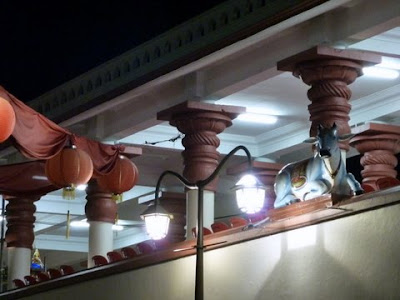

The lights at the temple shows the beautifully repainted temple, back to its original splendour.
Chinatown boasts of two old places of worship, and Sri Mariamman is one of them.

Sunday, April 11, 2010
Die & Dye
Long ago, at this corner of Kreta Ayer Rd and New Bridge Road, facing the Oriental Theatre across Kreta Ayer Rd, was a small shop. It's specialty was to dye any clothing to black.
It was a time when black was not the fashionable dress or clothing as most Asians, if not, Chinese, considered it as one of mourning. Indeed this was the shop that dyed clothing of any colour to black for those in mourning.
In the old days, when someone in the family died, all were expected to wear black. For some, like the children of the deceased, wearing back might be expected for a longer period of time. Mourning period could last (or is expected to last) for 3 years. It is unlikely that anyone had black clothing in those days. And so, if there was such a bereavement in the family, getting some clothing to be dyed black was one of the priorities.
It could well be the beginning of the fast service that one expects of any funeral activities today. In those days, one could expect to get the black clothing, perhaps in two days after sending in.
And so, in this little hut, there seemed to be constant activity as clothing was sent in to dye to black. The proximity of Sago Lane (known to the Chinese as Sei Yan Kai - dead people street) could be a reason for the brisk business.
These days, black is a fashion. So, there could be ample supplies at home. If not, the nearest shopping centres could yield abundant black clothing, in various styles and design.
We have yet to see the mourners coming with black lipsticks or eye shadows (^^). Makeup was a no-no then, when in mourning. Nor watching wayangs or movies. But with TV these days, no one observes such rules.
It was a time when black was not the fashionable dress or clothing as most Asians, if not, Chinese, considered it as one of mourning. Indeed this was the shop that dyed clothing of any colour to black for those in mourning.
In the old days, when someone in the family died, all were expected to wear black. For some, like the children of the deceased, wearing back might be expected for a longer period of time. Mourning period could last (or is expected to last) for 3 years. It is unlikely that anyone had black clothing in those days. And so, if there was such a bereavement in the family, getting some clothing to be dyed black was one of the priorities.
It could well be the beginning of the fast service that one expects of any funeral activities today. In those days, one could expect to get the black clothing, perhaps in two days after sending in.
And so, in this little hut, there seemed to be constant activity as clothing was sent in to dye to black. The proximity of Sago Lane (known to the Chinese as Sei Yan Kai - dead people street) could be a reason for the brisk business.
These days, black is a fashion. So, there could be ample supplies at home. If not, the nearest shopping centres could yield abundant black clothing, in various styles and design.
We have yet to see the mourners coming with black lipsticks or eye shadows (^^). Makeup was a no-no then, when in mourning. Nor watching wayangs or movies. But with TV these days, no one observes such rules.
Saturday, April 03, 2010
Qing Ming Festival 清明节
5 April is Qing Ming Day, 104 days from Winter Solstice (read more on wikipedia). In Singapore, this is one month that all Chinese remember their ancestors. With changing times, different people will remember their departed in various ways. Some would go to the temples where they place the tablets of their ancestors and pay their respects. There are still many who would go to the cemeteries where their departed relatives are buried. For those who were cremated, the descendants and relatives might go to the government, temple or even private company run columbaria where the ash niches are kept.

Traditionally, for the Taoists, they would bring along the favourite food of their departed (in this case, mainly for their departed parents or grandparents, or in some cases, siblings or children) to offer to them. In the old days, extend families would organise to get a lorry (truck) to load all the necessary praying paraphernalia and food for each departed relative and to go from tomb to tomb. Traffic jam, during the weekends, would not be in the city, but in the cemeteries.
I remember those days when my late maternal grandma would organise such trips. For us kids, it was fun. First we got to sit in a lorry (the type with wooden structures) and get to meet all the aunties, uncles and cousins. And there would be plenty of food to eat, after the offerings. We would be going to different places in Bukit Brown area (the wider area known as Kopi Sua - Coffee Hill to us. It is said that once, there was an attempt to plant coffee here) and Peck Shan Ting (in Cantonese, what is Bishan now). My mum's late adopted father was buried without any tombstone during the Japanese occupation, and in each Qing Ming she would have to depend on the landmarks, such as trees or other tombstones to locate this small mound.
And a few times, I followed by late Mother-in-law to the Qing Ming outing with the Zhong Shan Association (a dialect group from Zhong Shan in GuangDong). They have one area in Peck Shan Ting where all the Zhong Shan people were buried and there was one common one of the Association. Here, the members paid respect to the common ancestors of the Zhong Shan people. The fellow members would sponsor many roast pigs and after the prayers, we would be sitting in groups to have a picnic with freshly cut roast pork with buns. The best roast pork to me!
There are some Chinese customs in that for the long dead, offerings of respect could be made within 10 days from Qing Ming (known as Cheng Beng in Hokkien) Day, before and after. For those who just passed away, there seems to be some particular rules about the day for prayer.

Apart from the 7th Month (known as the Hungry Ghost Festival to many), Qing Ming is another month where the Joss-shops are very busy offering praying paraphernalia of many kind. The focus now is on the people who have departed. In the past, it could be simple papers with printings of clothings. With modernization, creativity and innovations, the paper offerings have evolved. There are almost real paper models of shirts, blouse, samfoo, and shoes of all kinds. This year, I spotted bras or could they be bikinis? For the more technically inclined, there are handphones, computers and these days, notebooks. I-phone lookalikes could be on its way. With I-Phone applications, well, maybe, there could be less burning. (^^)
For those who have enjoyed life, there are cans of beer and stout and now, cognac and wine.

In Chinatown, there are two shops which probably have been doing such a business for a long time. One is at Banda St and the other at Smith Street. They are also favourite haunts of tourists, led by the tour guides to show them about life after life for Singapore Chinese.


Traditionally, for the Taoists, they would bring along the favourite food of their departed (in this case, mainly for their departed parents or grandparents, or in some cases, siblings or children) to offer to them. In the old days, extend families would organise to get a lorry (truck) to load all the necessary praying paraphernalia and food for each departed relative and to go from tomb to tomb. Traffic jam, during the weekends, would not be in the city, but in the cemeteries.
I remember those days when my late maternal grandma would organise such trips. For us kids, it was fun. First we got to sit in a lorry (the type with wooden structures) and get to meet all the aunties, uncles and cousins. And there would be plenty of food to eat, after the offerings. We would be going to different places in Bukit Brown area (the wider area known as Kopi Sua - Coffee Hill to us. It is said that once, there was an attempt to plant coffee here) and Peck Shan Ting (in Cantonese, what is Bishan now). My mum's late adopted father was buried without any tombstone during the Japanese occupation, and in each Qing Ming she would have to depend on the landmarks, such as trees or other tombstones to locate this small mound.
And a few times, I followed by late Mother-in-law to the Qing Ming outing with the Zhong Shan Association (a dialect group from Zhong Shan in GuangDong). They have one area in Peck Shan Ting where all the Zhong Shan people were buried and there was one common one of the Association. Here, the members paid respect to the common ancestors of the Zhong Shan people. The fellow members would sponsor many roast pigs and after the prayers, we would be sitting in groups to have a picnic with freshly cut roast pork with buns. The best roast pork to me!
There are some Chinese customs in that for the long dead, offerings of respect could be made within 10 days from Qing Ming (known as Cheng Beng in Hokkien) Day, before and after. For those who just passed away, there seems to be some particular rules about the day for prayer.

Apart from the 7th Month (known as the Hungry Ghost Festival to many), Qing Ming is another month where the Joss-shops are very busy offering praying paraphernalia of many kind. The focus now is on the people who have departed. In the past, it could be simple papers with printings of clothings. With modernization, creativity and innovations, the paper offerings have evolved. There are almost real paper models of shirts, blouse, samfoo, and shoes of all kinds. This year, I spotted bras or could they be bikinis? For the more technically inclined, there are handphones, computers and these days, notebooks. I-phone lookalikes could be on its way. With I-Phone applications, well, maybe, there could be less burning. (^^)
For those who have enjoyed life, there are cans of beer and stout and now, cognac and wine.

In Chinatown, there are two shops which probably have been doing such a business for a long time. One is at Banda St and the other at Smith Street. They are also favourite haunts of tourists, led by the tour guides to show them about life after life for Singapore Chinese.


Monday, March 29, 2010
The Kitchen God has returned and the Tee-Kueh already hardened
The favourite story with the sending off of the Kitchen God on the 24th day of the 12th Lunar Month was the offering of the Tee-Kueh 甜糕 (Hokkien) or Nian Gao 年糕 (Mandarin) to sweeten his mouth or got his mouth stuck with the sticky Nian Gao that he would not say much. The kitchen used to be the place of gossips, quarrels and scoldings (if you can imagine the communal kitchens in the old houses in Chinatown).

In the good old days, when the Nian Gao is made through natural process, after a week, it is as hard as a rock. In tropical Singapore, sometimes, it got mouldy. But it did not matter as you might see Grandma washing the hardened Nian Gao and putting it in the sun. It should not be put to waste.
And so, it was time to use a chopper to slice the Nian Gao into thin square slabs. I loved to just chew on those slabs of Nian Gao. Sometimes, it is still a little moist on the inside.

Grandma would make a dough from some flour, water and perhaps, an egg or two. Whipped them into a sticky mixture, somewhat more dilute as your would see the stalls selling the Pisang Goreng (banana fritters), Grandma then would dip the sliced Nian Gao into the dough mix, making sure that it is covered and then into the kuali (wok) of boiling oil. Ah, the aroma .. but one must be careful not to eat it after it has been taken out of the kuali, hot and nice. That is sure to get scalded lips and probably stucked teeth.

Once it cools down a little, with Chinese Tea or even Kopi-O (black coffee), the fried Nian Gao fritters make good tea. For hungry kids like us .. this was heaven-sent! Ah, we had them because of the Kitchen God!

In the good old days, when the Nian Gao is made through natural process, after a week, it is as hard as a rock. In tropical Singapore, sometimes, it got mouldy. But it did not matter as you might see Grandma washing the hardened Nian Gao and putting it in the sun. It should not be put to waste.
And so, it was time to use a chopper to slice the Nian Gao into thin square slabs. I loved to just chew on those slabs of Nian Gao. Sometimes, it is still a little moist on the inside.

Grandma would make a dough from some flour, water and perhaps, an egg or two. Whipped them into a sticky mixture, somewhat more dilute as your would see the stalls selling the Pisang Goreng (banana fritters), Grandma then would dip the sliced Nian Gao into the dough mix, making sure that it is covered and then into the kuali (wok) of boiling oil. Ah, the aroma .. but one must be careful not to eat it after it has been taken out of the kuali, hot and nice. That is sure to get scalded lips and probably stucked teeth.

Once it cools down a little, with Chinese Tea or even Kopi-O (black coffee), the fried Nian Gao fritters make good tea. For hungry kids like us .. this was heaven-sent! Ah, we had them because of the Kitchen God!
Tuesday, February 16, 2010
Chinese New Year also means rest and relax
If you wander around, especially in Chinatown and in many shopping centres as well, you will find many closed, even on the third day of the Chinese New Year! Since the past decades, the number of days closed for the Chinese New Year (acronym CNY) for the shops has been reduced. In the old days, one could close the shop for as long as nine days. Especially for the Hokkien, they might open their shops after the prayer to the Jade Emperor (more popularly known to the local Hokkiens as Pai Ti Gong or Bai Tian Gong in Mandarin), which happens on the 8th night of the Chinese New Year. For many, they might open the shop on the second of the CNY or a suitable date (which could be advised from the Almanac) for a couple of hours to indicate that the shop has been opened, and then it was closed again.

For many of such family owned businesses, they hardly take any day off in the year and so, the long period off during CNY was the only time off for them.
I remember the days when my late Mother-in-Law used to run a shop at the "old" People's Park selling cloth. She worked every day, Saturday and Sunday included. So, the only days off was just before the Chinese New Year and a few days into the CNY. In the good old days, many people still bought cloth to sew their own clothes or send to the tailor to make. Ready made clothing was not so popular for the ladies. Many of the cloth available were for the making of samfoo (literally translated from Cantonese as blouse and pants). Of course, some of the materials could be made into "modern" and more westernised style blouses or dresses. I used to get some cloth to make shirts too.
There was also the black cloth, in various designs (black of course) and of different make. In the old days, when one reaches 50, it was time to wear black pants and probably blouse (of the samfoo cut) in shades of blue. My Mum was starting to wear less bright coloured clothes when she passed 30! And then, the world changed. Everyone began to wear brighter colours. That must have been an indication to the shops selling cloth, much of which were from Japan.
Some of you might have heard of Japanese cloth brand like Toray. But to the customers, they were not really interested in the brand as in the quality of the cloth, would it stick in the sweaty Singapore, was it reasonably priced. Buying cloth in the old People's Park could be both an adventure and a nightmare if you are not good at bargaining. And you could even risk being scolded if the shop was making its first sale for the day to you and despite giving you the best price, you walked away. Business people could be really superstitious and a first successful sale could mean more successful sales! (^^)
Ah, but I was no salesman and did not understand the intricacies of bargaining and why prices were always offered high. You see the wholesalers would only sell the cloth in sets, meaning if a pattern comes in five colours, the retailers have the buy all five. But one would be lucky if two of the five colours sell. So, the shops have to make up for the other three which could not be sold or sold below cost. Some people got good deals out of the bargain, others don't.
My task was to help to close the shop with the old planks, making sure they are fitted to one another vertically (they are numbered) before finally fitting the door post, and door. These days, one pull of the shutter is good enough.

Come towards the last week or two before the Chinese New Year, sales would have diminished and no one could be able to buy the cloth and got them made in time for the New Year. It was time to do the annual clean up. On a good morning (usually weekends so that we would be around) we would be carrying out the rolls and rolls (or bales) of cloth out of the tiny shop. I often marvel at how much could be put into the tiny shops. Then, it was time to clean the wall, the railings, the fans and yes, perhaps, add a new coat of paint.
Talking out the cloth and dismantling the setup, of which the rolls of cloth were placed such that there would be no cloth avalanche, was easy. Putting them back was a challenge. Ah, new the boss of the shops knew precisely how and where the cloth should be put. It had to be and was important to be able to know where to get specific cloth than a customer might ask for.
After a long day, the job was done and the shop closed, for the next week or two. It was the end of an ardous day and a cleaned shop with new Chinese characters indicating prosperity was ready to greet the new year when it was reopened again.

For many of such family owned businesses, they hardly take any day off in the year and so, the long period off during CNY was the only time off for them.
I remember the days when my late Mother-in-Law used to run a shop at the "old" People's Park selling cloth. She worked every day, Saturday and Sunday included. So, the only days off was just before the Chinese New Year and a few days into the CNY. In the good old days, many people still bought cloth to sew their own clothes or send to the tailor to make. Ready made clothing was not so popular for the ladies. Many of the cloth available were for the making of samfoo (literally translated from Cantonese as blouse and pants). Of course, some of the materials could be made into "modern" and more westernised style blouses or dresses. I used to get some cloth to make shirts too.
There was also the black cloth, in various designs (black of course) and of different make. In the old days, when one reaches 50, it was time to wear black pants and probably blouse (of the samfoo cut) in shades of blue. My Mum was starting to wear less bright coloured clothes when she passed 30! And then, the world changed. Everyone began to wear brighter colours. That must have been an indication to the shops selling cloth, much of which were from Japan.
Some of you might have heard of Japanese cloth brand like Toray. But to the customers, they were not really interested in the brand as in the quality of the cloth, would it stick in the sweaty Singapore, was it reasonably priced. Buying cloth in the old People's Park could be both an adventure and a nightmare if you are not good at bargaining. And you could even risk being scolded if the shop was making its first sale for the day to you and despite giving you the best price, you walked away. Business people could be really superstitious and a first successful sale could mean more successful sales! (^^)
Ah, but I was no salesman and did not understand the intricacies of bargaining and why prices were always offered high. You see the wholesalers would only sell the cloth in sets, meaning if a pattern comes in five colours, the retailers have the buy all five. But one would be lucky if two of the five colours sell. So, the shops have to make up for the other three which could not be sold or sold below cost. Some people got good deals out of the bargain, others don't.
My task was to help to close the shop with the old planks, making sure they are fitted to one another vertically (they are numbered) before finally fitting the door post, and door. These days, one pull of the shutter is good enough.

Come towards the last week or two before the Chinese New Year, sales would have diminished and no one could be able to buy the cloth and got them made in time for the New Year. It was time to do the annual clean up. On a good morning (usually weekends so that we would be around) we would be carrying out the rolls and rolls (or bales) of cloth out of the tiny shop. I often marvel at how much could be put into the tiny shops. Then, it was time to clean the wall, the railings, the fans and yes, perhaps, add a new coat of paint.
Talking out the cloth and dismantling the setup, of which the rolls of cloth were placed such that there would be no cloth avalanche, was easy. Putting them back was a challenge. Ah, new the boss of the shops knew precisely how and where the cloth should be put. It had to be and was important to be able to know where to get specific cloth than a customer might ask for.
After a long day, the job was done and the shop closed, for the next week or two. It was the end of an ardous day and a cleaned shop with new Chinese characters indicating prosperity was ready to greet the new year when it was reopened again.
Sunday, February 14, 2010
Temples in Chinatown Welcome the Year of the Tiger
As with each Chinese New Year eve, the Chinese temples in Singapore await to welcome the New Year. And so is this year. As the heart of Chinatown was filled with lights, music and fun, in the other parts of the greater Chinatown, temples were filled with devotees who went to offer their first joss sticks to the Deities.

Smokes of the joss sticks and the continuous calls of the temple assistants for the devotees to the Deities informing them of their wishes for good health, peace and prosperity brought back wonderful memories. The one memory that was permanently etched in my mind was arriving in Thian Hock Keng at the stroke of twelve midnight in a trishaw to offer our prayers to Ma Chor Po (Mazu - Goddess of the Sea). It was a teary night as the fumes hit the eyes. But that added to the memory too.

But last night at Thian Hock Keng, it was a different sight. There seemed to be a bigger mix of age group. Interestingly, there were less of the more senior citizens. There were more children. Led by three Buddhist monks, many of the devotees joined in the chanting of the sutras. A few were outside watching the Marionette Theatre. A caucasian family was also there to soak in the event. The prayers ended at midnight with the beating of the giant drum and bell.
The temple then exploded with the fire crackers, alas, the electronic version but the noises were getting more like the real thing. The Cai Sheng Ye (Deity of Wealth) came in with the dragons and the lions. The devotees went after them with their cameras or handphone cameras. Some went after the Cai Sheng Ye for his sweets. To the Chinese, sweet is important. Everyone looks towards a "sweet" life, compared the the "bitter" life experienced by many of their ancestors. And of course, the typical Hokkien phrase is "Jia Tee Tee, Si Hao Si" (literally meaning if you take something sweet, you will get a son!)

I did a lightning visits to the other temples in Chinatown, covering Wak Hai Cheng Beo (Yue Hai Qing Miao) which is a temple often frequented by the Cantonese and Teochews (Thian Hock Keng is frequented by the Hokkiens, but these days, the dialect lines are blurred) and Fook Tet Soo Khek Temple (the only Hakka Da Bo Gong Temple in Singapore, as I understand).

Tradition is alive! In greeting a new year, going to the temples as our ancestors had done over the millennium, we continue with the tradition. And the latest Hokkien exclaimation: HUAT AH! Prosperity to all!

Smokes of the joss sticks and the continuous calls of the temple assistants for the devotees to the Deities informing them of their wishes for good health, peace and prosperity brought back wonderful memories. The one memory that was permanently etched in my mind was arriving in Thian Hock Keng at the stroke of twelve midnight in a trishaw to offer our prayers to Ma Chor Po (Mazu - Goddess of the Sea). It was a teary night as the fumes hit the eyes. But that added to the memory too.

But last night at Thian Hock Keng, it was a different sight. There seemed to be a bigger mix of age group. Interestingly, there were less of the more senior citizens. There were more children. Led by three Buddhist monks, many of the devotees joined in the chanting of the sutras. A few were outside watching the Marionette Theatre. A caucasian family was also there to soak in the event. The prayers ended at midnight with the beating of the giant drum and bell.
The temple then exploded with the fire crackers, alas, the electronic version but the noises were getting more like the real thing. The Cai Sheng Ye (Deity of Wealth) came in with the dragons and the lions. The devotees went after them with their cameras or handphone cameras. Some went after the Cai Sheng Ye for his sweets. To the Chinese, sweet is important. Everyone looks towards a "sweet" life, compared the the "bitter" life experienced by many of their ancestors. And of course, the typical Hokkien phrase is "Jia Tee Tee, Si Hao Si" (literally meaning if you take something sweet, you will get a son!)

I did a lightning visits to the other temples in Chinatown, covering Wak Hai Cheng Beo (Yue Hai Qing Miao) which is a temple often frequented by the Cantonese and Teochews (Thian Hock Keng is frequented by the Hokkiens, but these days, the dialect lines are blurred) and Fook Tet Soo Khek Temple (the only Hakka Da Bo Gong Temple in Singapore, as I understand).

Tradition is alive! In greeting a new year, going to the temples as our ancestors had done over the millennium, we continue with the tradition. And the latest Hokkien exclaimation: HUAT AH! Prosperity to all!
Thursday, February 11, 2010
The Chinatown Secret
Being old but young at heart, I thought I could try out a little fun with barcodes. I am still trying to explore ways to make this fun for anyone - residents, local & foreign tourists. Let our handphone (well, not all of them) do some work for us .. and tell us more about it. It could be a place, a thing or even a message!
 So, anyone wants to share with me what's locked inside this? And better still, share with me (and us) your brainwave about how this box of black and white could make a tour of Chinatown more interesting. (^^)

Subscribe to:
Posts (Atom)