ack: thanks to the alert from Kelvin
Tuesday, January 26, 2010
Singapore through the eyes of a British serviceman
I think. Interesting to see some old sights and sounds. You might hear some familiar ways of descriptions on life in old Singapore. Can you spot any familiar sights?


Sunday, January 24, 2010
Chinese New Year Tours by Geraldene Lowe

EMAIL TO Geraldene @ Geraldenestours@hotmail.com to book the tour as she is out of town until 29 Jan 2010.
31 Jan - SUNDAY
- START 10am corner Everton Road & Neil Rd- Everton Park is a block of HDB flats -there are seats up the steps behind Bus Stop. This is near Baba House Museum - there is parking behind the HDB block - enter via Everton Rd. However the tour ends in heart of Chinatown - so could taxi back!
Cost of Tour $40 (half for kids) payable on day of tour - includes drink & cookies and sample delicacies along the way. Ends about 1pm - could have lunch in Chinatown -Chinese handmade noodles, best Thai food in S'pore, or explore Chinatown Market & take Taxi or MRT home!
(minimum 10 persons to operate) On day of Tour Tel: 81551390
07 FEB - SUNDAY
- START 10am corner Everton & Neil Rd same tour as above.
05 FEB FRIDAY &
12 FEB FRIDAY
- Same Tour repeated BUT START 9.30am same corner as Listed above. Tour lasts approx 3 hours
13 FEB- SATURDAY
- START 9.30am corner Everton Rd & Neil Road. THis is CNY Eve so extra bustling with last minute frenzy! Best to take MRT!
(Disclaimer: No Commercial Interests)
Photo Ack: Charlotte
Saturday, January 23, 2010
Singapore Chinatown Lights Up
It was Ren Shan Ren Hai 人山人海 (People Mountain People Sea) as many Singaporeans flocked to Chinatown to await the light up. Waiting with patience, the people lined up the entire New Bridge Road and Eu Tong Sen St from Upper Cross St to Kreta Ayer St.

Save those nearer to the Peoples' Park Complex who could see the ceremony on the screen, the rest had to wait patiently "in the dark". Only invited guests could get to see the main stage where the main event was held. And when the DJ led in the counting from 10, many who were sitting on the kerb (ah, on normal days one would risk being run over by sitting on the kerbside) stood up, cranking their necks to look for action. When it hit zero, the entire streets lit up with Chun 春 floating all above us. Somewhere above the Peoples' Park Complex, the sound of fire crackers came, followed by rain of fine red paper, the remants of the fire crackers. For some reason, a breeze was blowing bringing the snow of red dust onto us. Ah, perhaps, that was indication of good luck to be brought by the Tiger.

While thousands waited patiently for the show, hundreds were enjoying the popular Si Chuan Huo Guo 四川火锅 - fiery steam boat from Szechuan. A new shop selling porridge was seen offering competition to the established one by the corner of Keong Saik Rd and New Bridge Road. Into Smith St, more people walked, attracted by the calls of the stallholders to try out their fair. From the famous Cantonese waxed goods - sausages, waxed ducks, Wong Fa Yi 黄花鱼 (Huang Hua Yu), Yunnan Ham - to melon seeds to golden pumpkins, bottle gourds 葫芦 (hu lu) to Japanese dried mushrooms. There was even a queue at Wurstand for the german sausages served by the Austrian chef, dress in red, but of course.

Outside the Chinatown Complex, oblivious to the din, a few crowds were focussing on the intense game of 'Dum" (draughts). On the other end, a young band was belting out the popular Chinese New Year songs. And further up Spring St, where the huge tentage was set up for the Chinese New Year mart, the crowd was less. The two auctioneers (they sounded like Taiwan or Mainland Chinese) were calling out for bids for the numerous good luck collectibles. Plants are part of Chinese New Year decorations, with many helping to usher in a good year, like the specially arranged Guan Yin Bamboo, aptly called Bu Bu Gao Sheng 步步高生.

At the South Bridge Road end, probably because most of the goldsmith shops used to be here, the decorations has the upsidedown Fu 福 (prosperity) hanging across the road. The Chinese love to think that an upsidedown Fu means that Prosperity has arrived, instead of the other sound. I often wondered if someone had made a mistake and got a saving grace coming up with this story. (^^)

If the crowd tonight continues for the next two weeks, it will spell well for the Chinatown economy and certainly for the economy of Singapore! (^^)
Sunday, January 17, 2010
Chinese New Year is around the corner
Chinese New Year is barely a month away, and although there are more shopping centres and shops all over Singapore, there is nothing like a touch of the Chinese New Year festive atmosphere in the Chinatown. Chinese New Year this year falls on 14 Feb 2010. Light up of the decorations in Chinatown will happen next week, 23 Jan 2010. While this adds to the gaiety of Chinatown, many local visitors to Chinatown have other objectives in mind.

I did a quick recce this evening to measure the "barometer" of the atmosphere. The crowd was certainly there but not to the huge surge yet. Cars were waiting bumper to bumper for the nearest carpark at Chinatown Complex. It is a Sunday and many of the mainland Chinese were also gathered in the small but growing eateries that cater to the northern Chinese cuisines.
The place is certainly getting redder with all the things related to Chinese New Year, ranging from angpow (red packets in Hokkien) to lanterns to all kinds of decorations for the home. New stuff Tigers to greet the year of the Tiger were there, and some lion dance toys became tiger dance toys.

At the huge tentage, setup each year specifically for pre-Chinese New Year sales, along South Bridge Road facing the Maxwell Food Centre, the early-bird vendors were calling for business. At two diagonal corners, the interesting sales by auction were already in progress. Calling prices started as small as one Singapore dollar!

The all important kamquats and greenery were in place. This year's specialty seems to be this particular cactus plant (which the Chinese believe could ward away negative entities) with a flower-like part on top of it. They did not look like parts of the same plant. The popular Guanyin bamboos now come in arranged in the shape of a boat.

I could only spot one stall offering couplets, with the hand written Chinese calligraphy. What happened to the "Dui-Lian" 对联 (the longer couplets) that was the tradition for the Chinese to paste on both sides of the doorway? Ah, with most people living in HDB (housing development board) flats, there's hardly any space at the doorway to paste these couplets. In the old days, the letter writers, who wrote letters for the Chinese migrant workers or immigrants to be sent back to China, would also write these Dui-Lian. And there would be single characters being written on a diagonal paper, with words such as "Man" 满, meaning full on the important rice jars. Of course, there is the all popular "Fu" 福, meaning prosperity, which many would paste it upsidedown, where one could read as Fu Dao, which has similar sounding as Prosperity having arrived. Ever since the old days, and still is so with many mainland Chinese and Singapore Chinese, many are still on the journey to become prosperous. These days, there's more hope for material prosperity than the all encompassing belief of prosperity which includes a big happy family.
Would there be more people going to buy the traditional Chinese clothes to wear during Chinese New Year? For sure, the parents would buy the cute samfoos or qipao for their little kids. Ah, what about the adults? Ladies are more apt to wear the beautiful Chinese clothings and perhaps, men would also go for the traditional Chinese shirts with the cloth knotted fasteners. We will see. Ah, but what about the youngsters? Would red be the trend or black, much to the horrors of the grannies. But these days, many of the grannies are the baby-boomers who might not be very particular. Still, won't it be fun to paint the town red?

Time to stock up the Chinese delicacies and sweets for family reunions and for visiting guests. The typical kueh-chi 瓜子 (melon seeds) and groundnuts have yet to make their appearance. The waxed ducks, Yunnan Ham and Chinese sausages in various sizes are already available, but I could only spot one stall at the traditional spot, outside CK Departmental Store of Chinatown Complex.
Along the main New Bridge Road, a small queue was already formed getting the first batch of the famed Lim Chee Guan bak-kwa 肉乾 (BBQ sweet meat).

Monday, January 11, 2010
Diaspora of Amoy Street
Many of the offspring of the earlier Chinese in Singapore might have a relation (parents, aunts, uncles, grandparents, grandaunts & granduncles, or well, in-laws and their ancestors) in Chinatown. And for the Hokkien, many could come from Amoy St, which is just the street from Telok Ayer St, probably the waterfront then, where the early Chinese workers and migrants would land.

I have started a facebook group from which I hope to gather photographs of old Amoy St and stories of the people who once upon a time lived at Amoy St. So, if you have, please share with me.
You can reach me at bullockcartwater@gmail.com

Xian Chor Keng (temple) @ beginning of Amoy St
You can reach me at bullockcartwater@gmail.com
Saturday, January 09, 2010
A Giant in the Neighbourhood
I was walking along Craig Rd, reminiscing my childhood days when I looked up at the row of houses that were opposite to where I lived, and low behold, it was like a giant has stepped into the neighbourhood. There towering behind the row of two storey houses was that huge and mammoth monolith called The Pinnacle. It was impressive and reminded me of the first time when I watched the "Kong Long" movie at Oriental Cinema, one of the very new movies that I went with the family, especially with my late father, who worked in Johor Baru then.
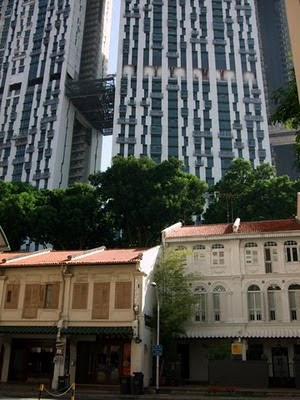
Ah, but before the Pinnacle came, there were two blocks of ten-storey flats. They were probably the most expensive rental flats then, at S$96 (if my memory serves me well) compared to the others, say in Queenstown that was at S$66.
We thought that we could give it a try, since it would be a far better place than the small rooms shared with a number of families in one of the houses along Craig Rd. At Craig Rd, we learnt tolerance and compromises. Going to the bathroom, one has to look for empty timeslot. The bucket system toilet was always challenging for us kids. There was no light inside the toilet and so, it was with a candle if we wanted to go in the night. The smell did not help. Not did the cockroaches which seemed to be everywhere. The landlady was very strict. It was lights out by 11pm. And so for us kids, there was the spitoon (which has more than its stated use) and the kerosene lamp so that we could sleep with a little light. Catfights or cat mating on the roof above us (we were on the top floor, being the third floor) added to our wild imaginations. It was a challenge going to bed early as the family would be at the second floor where we had our little dining table.
Imagine a toilet with bathroom of our very own and a bigger space (albeit at a higher cost), it was heaven to us. Even if we have to gather a bigger family to stay together, it was still worth the effort, if for anything, a better toilet. (^^)
And so, I spent the later part of my primary school and secondary days at Cantonment Road. Slowly, we lost contact with the "kampung" friends of Craig Road, where we had enjoyed our early childhood.
I could remember the small palm trees planted between the carpark in front of our flat (behind us were the flats of the Police Cantonment) and Cantonment Rd. I saw they grew, taller and taller. If there is one restaurant that was part of the two Cantonment Rd flat history, it must be Hillman Restaurant. Famed for its claypot dishes, it later became famous and popular with Japanese tourists and expatriates that at one time, almost the entire occupancy in a night could be Japanese. Ah, to the Japanese, it would be the famous "Paper Chicken Rice" and Sharkfin omelette wrapped in lettice (DIY). Now, the restaurant has shifted to Kitchener Road. For us then, it was fried ee-meen.
My uncle was staying with us and working in the then Harbour Board. In those days, one must be able to ride a bicycle to be able to work in the harbour. It was the only cheapest way to travel to the harbour and from wharf to wharf. He worked in shifts, morning or afternoon. When he worked in the afternoon shift, I would cycle to school. And if he worked in the morning, it would be afternoon escapade for me and my Sikh classmate after a good hot Punjabi tea (this is tea boiled with powdered milk) and chapati at his house. Sometimes, he sneaked out of the house when his mother was sleeping. (^^) And we explored Singapore on two bikes without maps but based on our hunch to return back in time for dinner. We were in secondary two then.
There were always open air movie in the Police Cantonment behind the flat or even as far as another one at the end of the old Tanjong Pagar Road. With my neighbour, we would try to sneak into the Cantonment to watch the movie, which often would be in Malay. Ah Potiananak or the Oily Man, frightening stuff. Because the screen was a big makeshift cloth, we could watch on the opposite side as well.
Mother had to go to work to earn additional income to pay for the rent and feed the hungry kids. There was no pocket money for us save when we went to school, and it would be 15 cents, 10 cents for return on the Hock Lee Bus and 5 cents for recess. If I ride the bike, I would save 10 cents. So, when Mum went to work, being the eldest, it was my duty to go to the wet market, which by then I knew where to get what at the cheapest. Budget was S$10 for two families for a week. So, it would be chicken hearts, kangkong, Ikan Kuning, cockles, pre-steamed Ikan Kembong, tau gay (bean sprouts) and tau-kwa (bean curd). And then, I had to cook. Learning a few skills from my aunt, I could fry the Ikan Kuning marinated in tamarind or the chicken hearts with sesami oil, dark soya sauce and sliced old ginger. Cooking rice was using the palm to measure the amount of water enough to have the rice cooked without being too soggy or uncooked.
In between, we could still have our fun. It was a no-no to go swimming. The parents were always fearful of us kids drowning. The fact that Mum did not know how to swim made it worse. And so, with a neighbour who hid the swimming trunks for us, we would sneak off to the Yan Kit Swimming pool when we saved enough money to pay for the entrance fee. There we learnt on our own how to swim, not without many mouthful of chlorinated water. It was not only the dangers of the water. There was also the dangers of kids coming up to us to ask us "what did we play" (in Hokkien - Li chi toh si mi). That was like a password check to know which gang we belonged to. We had to be careful to say that we don't play. And it would be small kids coming up to challenge us. Ah, the dangerous days.

The new Pinnacle seems to make such childhood memories so far away. But it does remind us that we have come a long way. Living on the 7th storey was high then. Imagine 50th storey! But like in the past, the cost might still be a little above the head. (^^)

Ah, but before the Pinnacle came, there were two blocks of ten-storey flats. They were probably the most expensive rental flats then, at S$96 (if my memory serves me well) compared to the others, say in Queenstown that was at S$66.
We thought that we could give it a try, since it would be a far better place than the small rooms shared with a number of families in one of the houses along Craig Rd. At Craig Rd, we learnt tolerance and compromises. Going to the bathroom, one has to look for empty timeslot. The bucket system toilet was always challenging for us kids. There was no light inside the toilet and so, it was with a candle if we wanted to go in the night. The smell did not help. Not did the cockroaches which seemed to be everywhere. The landlady was very strict. It was lights out by 11pm. And so for us kids, there was the spitoon (which has more than its stated use) and the kerosene lamp so that we could sleep with a little light. Catfights or cat mating on the roof above us (we were on the top floor, being the third floor) added to our wild imaginations. It was a challenge going to bed early as the family would be at the second floor where we had our little dining table.
Imagine a toilet with bathroom of our very own and a bigger space (albeit at a higher cost), it was heaven to us. Even if we have to gather a bigger family to stay together, it was still worth the effort, if for anything, a better toilet. (^^)
And so, I spent the later part of my primary school and secondary days at Cantonment Road. Slowly, we lost contact with the "kampung" friends of Craig Road, where we had enjoyed our early childhood.
I could remember the small palm trees planted between the carpark in front of our flat (behind us were the flats of the Police Cantonment) and Cantonment Rd. I saw they grew, taller and taller. If there is one restaurant that was part of the two Cantonment Rd flat history, it must be Hillman Restaurant. Famed for its claypot dishes, it later became famous and popular with Japanese tourists and expatriates that at one time, almost the entire occupancy in a night could be Japanese. Ah, to the Japanese, it would be the famous "Paper Chicken Rice" and Sharkfin omelette wrapped in lettice (DIY). Now, the restaurant has shifted to Kitchener Road. For us then, it was fried ee-meen.
My uncle was staying with us and working in the then Harbour Board. In those days, one must be able to ride a bicycle to be able to work in the harbour. It was the only cheapest way to travel to the harbour and from wharf to wharf. He worked in shifts, morning or afternoon. When he worked in the afternoon shift, I would cycle to school. And if he worked in the morning, it would be afternoon escapade for me and my Sikh classmate after a good hot Punjabi tea (this is tea boiled with powdered milk) and chapati at his house. Sometimes, he sneaked out of the house when his mother was sleeping. (^^) And we explored Singapore on two bikes without maps but based on our hunch to return back in time for dinner. We were in secondary two then.
There were always open air movie in the Police Cantonment behind the flat or even as far as another one at the end of the old Tanjong Pagar Road. With my neighbour, we would try to sneak into the Cantonment to watch the movie, which often would be in Malay. Ah Potiananak or the Oily Man, frightening stuff. Because the screen was a big makeshift cloth, we could watch on the opposite side as well.
Mother had to go to work to earn additional income to pay for the rent and feed the hungry kids. There was no pocket money for us save when we went to school, and it would be 15 cents, 10 cents for return on the Hock Lee Bus and 5 cents for recess. If I ride the bike, I would save 10 cents. So, when Mum went to work, being the eldest, it was my duty to go to the wet market, which by then I knew where to get what at the cheapest. Budget was S$10 for two families for a week. So, it would be chicken hearts, kangkong, Ikan Kuning, cockles, pre-steamed Ikan Kembong, tau gay (bean sprouts) and tau-kwa (bean curd). And then, I had to cook. Learning a few skills from my aunt, I could fry the Ikan Kuning marinated in tamarind or the chicken hearts with sesami oil, dark soya sauce and sliced old ginger. Cooking rice was using the palm to measure the amount of water enough to have the rice cooked without being too soggy or uncooked.
In between, we could still have our fun. It was a no-no to go swimming. The parents were always fearful of us kids drowning. The fact that Mum did not know how to swim made it worse. And so, with a neighbour who hid the swimming trunks for us, we would sneak off to the Yan Kit Swimming pool when we saved enough money to pay for the entrance fee. There we learnt on our own how to swim, not without many mouthful of chlorinated water. It was not only the dangers of the water. There was also the dangers of kids coming up to us to ask us "what did we play" (in Hokkien - Li chi toh si mi). That was like a password check to know which gang we belonged to. We had to be careful to say that we don't play. And it would be small kids coming up to challenge us. Ah, the dangerous days.

The new Pinnacle seems to make such childhood memories so far away. But it does remind us that we have come a long way. Living on the 7th storey was high then. Imagine 50th storey! But like in the past, the cost might still be a little above the head. (^^)
Monday, January 04, 2010
At the Barber's
It was New Year eve. For some reasons, I felt that I must go for my haircut. Just like in the old days, one must have his hair cut before the Chinese New Year. And so, I strolled to the S$10 barbershop in Chinatown.
This is one of the modern Japanese styled unisex quick-cut barbershop. Unlike the old days when the ladies would go to their hairdressing saloon and the men to the barbershop with white (almost-dentist-chair lookalike) adjustable chairs. Most hairdressing saloons seemed to have the hairdressers speaking in Cantonese and chances are the Chinese Barbers might be Hock Chew (Fuzhou). While the hairdressing saloons are still around, perhaps less, the barbershops seem to go to the way of the dinosaurs. Ah, there is still one in a lane in Chinatown with its regular clientele.
If one was told of the barbershop with lady barbers, one might raise one's eyebrow as to what were the services offered. There used to be two popular ones in Chinatown. They are now extinct.
Now in this barbershop, men and women waited for their turns, to be cut by men or women. The customers could choose their barbers or cutters.
A barbershop is also an interesting place to sit and watch and although each customer is to be dealt with in 10 minutes, there was still much to watch and hear as the queue was quite long. Ah, one, probably newly qualified senior citizen, was enjoying a haircut by this lady barber (his regular by the way they talk). In a way, he was entertaining her with tales of his adventures overseas, with polite responses. What a way to relieve stress, I thought to myself as I was trying to concentrate on a book I brought along to read. Reading an English book and eavesdropping Mandarin conversations.
I wondered to myself too, what if this barber has her own blog. Won't t be fun to read about her clients. (^^)
Sat next to me was an elderly couple as well. They were conversing in Cantonese. From the look (or rather hearing them speaking) of it, the lady, who was to have her hair cut, was rather nervous. It must have been her first time. The brave husband was assuring her that he has already chosen the lady barber and at least she could speak Mandarin. He has to assure her many times. I did not stay to watch what happened as I was ahead of them.
A rather elder lady was struggling with the money eating machine. She could not get the machine to take her ten dollars. A young guy who had earlier given up his place for the old couple offered his help. After a few tries, the machine decided that it liked the ten dollars and swallowed it, spitting out the ticket. He then offered to write for her which barber she might want to have. Like me, she opted for anyone. Ah, she's adventurous, not knowing if she was going to encounter a non Mandarin or dialect speaker.
The only scene I missed was that of the old barbershops where they had pulley systems with lights (almost like dentist clinic again) and all the tools for the cleaning of the ears.
It was a delightful new year eve at the barber's.
This is one of the modern Japanese styled unisex quick-cut barbershop. Unlike the old days when the ladies would go to their hairdressing saloon and the men to the barbershop with white (almost-dentist-chair lookalike) adjustable chairs. Most hairdressing saloons seemed to have the hairdressers speaking in Cantonese and chances are the Chinese Barbers might be Hock Chew (Fuzhou). While the hairdressing saloons are still around, perhaps less, the barbershops seem to go to the way of the dinosaurs. Ah, there is still one in a lane in Chinatown with its regular clientele.
If one was told of the barbershop with lady barbers, one might raise one's eyebrow as to what were the services offered. There used to be two popular ones in Chinatown. They are now extinct.
Now in this barbershop, men and women waited for their turns, to be cut by men or women. The customers could choose their barbers or cutters.
A barbershop is also an interesting place to sit and watch and although each customer is to be dealt with in 10 minutes, there was still much to watch and hear as the queue was quite long. Ah, one, probably newly qualified senior citizen, was enjoying a haircut by this lady barber (his regular by the way they talk). In a way, he was entertaining her with tales of his adventures overseas, with polite responses. What a way to relieve stress, I thought to myself as I was trying to concentrate on a book I brought along to read. Reading an English book and eavesdropping Mandarin conversations.
I wondered to myself too, what if this barber has her own blog. Won't t be fun to read about her clients. (^^)
Sat next to me was an elderly couple as well. They were conversing in Cantonese. From the look (or rather hearing them speaking) of it, the lady, who was to have her hair cut, was rather nervous. It must have been her first time. The brave husband was assuring her that he has already chosen the lady barber and at least she could speak Mandarin. He has to assure her many times. I did not stay to watch what happened as I was ahead of them.
A rather elder lady was struggling with the money eating machine. She could not get the machine to take her ten dollars. A young guy who had earlier given up his place for the old couple offered his help. After a few tries, the machine decided that it liked the ten dollars and swallowed it, spitting out the ticket. He then offered to write for her which barber she might want to have. Like me, she opted for anyone. Ah, she's adventurous, not knowing if she was going to encounter a non Mandarin or dialect speaker.
The only scene I missed was that of the old barbershops where they had pulley systems with lights (almost like dentist clinic again) and all the tools for the cleaning of the ears.
It was a delightful new year eve at the barber's.
Tuesday, December 22, 2009
Wet Market
Ask anyone about Wet Market, and different people will give you different responses. To the young, you might see shudders and the involuntary move to cover the nose with the hand. Maybe, and hopefully not all. When I was young, not ready for school yet, I loved going to the wet market with my mother.
In those days, a wet market is a natural evolution where the sellers congregated and the buyers converged. Chances are it might be a few streets or lanes. Those were the days when anyone could get a cart and hawk. It was a day to earn a living than staying unemployed.
In my pre-primary school days, I lived in this downtown place called Turn-Tiam-Hung, meaning Pawnshop lane in Hokkien. I was and still puzzled as I could only count, at best two pawnshops. But the official road name is Craig Rd. Nearer towards Tanjong Pagar Rd, there was a lane. This lane marked the entrance to the wet market from Craig Rd side. It was connected to Narcis St at the other end of the lane.
A trip to the wet market was going to end up with black feet upon return. The thin "Japanese flipflops" were no help. Some ladies were better prepared by using on the clogs - these clogs could be seen in the kitchens of the then houses of many households, and then relegated to the bathrooms in the HDB flats and probably are moving towards extinction.
My task then was to help by carrying the market basket. Talk about the "green" days. No, there were hardly any plastic or paper bags. Besides most things were going to be wet. There were so many kind of market baskets, some soft and some hard made from cane. Some ladies would hang the baskets on their lower arm to carry. Most of the Chinese ladies in those days wore samfoos (two piece dress) to market.
Walking into the lane, there was a noodle stall selling prawn noodles and lor-mee (if I remember correctly) on my left. I was always eyeing this stall for a bowl of noodles, but it was a luxury. So, it was so near yet so far. Moving into the lane, there were the usual stalls, and there were the occasional stalls that appeared once in a while. Most of the stallholders knew the people doing the marketing there. It was the nearest for those living in that vicinity. The next one will be the bigger one at Smith St/Trengganu St enclave.
"Any pork today," the butcher would call out to my mum in Hokkien. "Hor guy chia bak, ka chia eh hor," my mum would ask the butcher. (Give me the lean meat, leaner ones) The butcher would try to get mum to buy more. "How about the liver, it is good and fresh. Ah, the hoon-chng (powdered intestines) is good." It depends on how much money Mum had in her tiny wallet. (^^)
It was not just meat alone that she had to buy. There was fish to buy. Ah, I learnt how to select the sliced sting-ray. "Smell it," instructed mum, "see if there's any urine smell." Apparently, if the fishmonger cuts the fish wrongly, the smell from the innards would permeate into the meat. I never really tried to find out. Ah, sting-ray fried with kiam-chye (salted vegetable) was and is still my favourite. Here, the leafy part of the kiam chye is better.
With a small budget, we had to get the cheapest and freshest fish. I think that's where the "Chi ka Pi" (fresh and chip) came from. (^^) Ikan Kambong, Ikan Selar and Ikan Kuning were amongst the cheapest. I kati of Ikan Kuning was 30 cents. Ah the cockles were even cheaper, 5 cents per kati.
Chicken seemed to be rather expensive and most were sold live. One could ask for it to be slaughtered and defeathered. Before big days like the Chinese New Year, mum would buy one or two chickens, and one duck, to bring back home, live, fatten them before slaughtering them on New Year eve. So, chickens were luxury then, only to be eaten during big days such as New Year, Hungry Ghost Festivals, and Anniversaries of the Death of ancestors. As children, we looked forward to these days, oblivious to the fact that Mum might be worrying where to get the extra money to buy them. Living in a multi-household house did not help because the kids were going to see what their neighbours ate.
So, instead of chicken, we would be looking for the frozen chicken hearts shipped from Australia. They were cheap and when fried with sesami oil, ginger and dark soya sauce, would make a good meal. Ah, I know where I got my cholesterol. (^^)
The cooked seafood was another source of relatively cheap food. The fish were apparently caught, put on trays and steamed before being brought to the market to be sold. We called them "Sic Hi" (cooked fish). The steamed tiny sotongs (squids) were a delight and so were the boiled prawns (that were much smaller than they are these days).
Marketing in those days was based on what's available. Mum never had any shopping list. She could not write and so, it was all committed to memory if she needed to buy anything specific like soya sauce. For fresh food, it was what was available and cheap. (^^)
When I was in Primary 6, I started going to the same wet market to buy and cook. Mum had to go and work to bring in additional income. Costs were increasing. The familiar faces in the market helped in that they would not overcharge me. There was no fixed price and unless one could read the Chinese weighing scale, one would not know if one was overcharged. There were many horror stories about how one could manipulate the scale.
I love to visit wet market, even if I am not buying anything. The range of things on sale is just big, and sometimes, exotic. I also do this when I go overseas. Wet markets are a lure for me.
In those days, a wet market is a natural evolution where the sellers congregated and the buyers converged. Chances are it might be a few streets or lanes. Those were the days when anyone could get a cart and hawk. It was a day to earn a living than staying unemployed.
In my pre-primary school days, I lived in this downtown place called Turn-Tiam-Hung, meaning Pawnshop lane in Hokkien. I was and still puzzled as I could only count, at best two pawnshops. But the official road name is Craig Rd. Nearer towards Tanjong Pagar Rd, there was a lane. This lane marked the entrance to the wet market from Craig Rd side. It was connected to Narcis St at the other end of the lane.
A trip to the wet market was going to end up with black feet upon return. The thin "Japanese flipflops" were no help. Some ladies were better prepared by using on the clogs - these clogs could be seen in the kitchens of the then houses of many households, and then relegated to the bathrooms in the HDB flats and probably are moving towards extinction.
My task then was to help by carrying the market basket. Talk about the "green" days. No, there were hardly any plastic or paper bags. Besides most things were going to be wet. There were so many kind of market baskets, some soft and some hard made from cane. Some ladies would hang the baskets on their lower arm to carry. Most of the Chinese ladies in those days wore samfoos (two piece dress) to market.
Walking into the lane, there was a noodle stall selling prawn noodles and lor-mee (if I remember correctly) on my left. I was always eyeing this stall for a bowl of noodles, but it was a luxury. So, it was so near yet so far. Moving into the lane, there were the usual stalls, and there were the occasional stalls that appeared once in a while. Most of the stallholders knew the people doing the marketing there. It was the nearest for those living in that vicinity. The next one will be the bigger one at Smith St/Trengganu St enclave.
"Any pork today," the butcher would call out to my mum in Hokkien. "Hor guy chia bak, ka chia eh hor," my mum would ask the butcher. (Give me the lean meat, leaner ones) The butcher would try to get mum to buy more. "How about the liver, it is good and fresh. Ah, the hoon-chng (powdered intestines) is good." It depends on how much money Mum had in her tiny wallet. (^^)
It was not just meat alone that she had to buy. There was fish to buy. Ah, I learnt how to select the sliced sting-ray. "Smell it," instructed mum, "see if there's any urine smell." Apparently, if the fishmonger cuts the fish wrongly, the smell from the innards would permeate into the meat. I never really tried to find out. Ah, sting-ray fried with kiam-chye (salted vegetable) was and is still my favourite. Here, the leafy part of the kiam chye is better.
With a small budget, we had to get the cheapest and freshest fish. I think that's where the "Chi ka Pi" (fresh and chip) came from. (^^) Ikan Kambong, Ikan Selar and Ikan Kuning were amongst the cheapest. I kati of Ikan Kuning was 30 cents. Ah the cockles were even cheaper, 5 cents per kati.
Chicken seemed to be rather expensive and most were sold live. One could ask for it to be slaughtered and defeathered. Before big days like the Chinese New Year, mum would buy one or two chickens, and one duck, to bring back home, live, fatten them before slaughtering them on New Year eve. So, chickens were luxury then, only to be eaten during big days such as New Year, Hungry Ghost Festivals, and Anniversaries of the Death of ancestors. As children, we looked forward to these days, oblivious to the fact that Mum might be worrying where to get the extra money to buy them. Living in a multi-household house did not help because the kids were going to see what their neighbours ate.
So, instead of chicken, we would be looking for the frozen chicken hearts shipped from Australia. They were cheap and when fried with sesami oil, ginger and dark soya sauce, would make a good meal. Ah, I know where I got my cholesterol. (^^)
The cooked seafood was another source of relatively cheap food. The fish were apparently caught, put on trays and steamed before being brought to the market to be sold. We called them "Sic Hi" (cooked fish). The steamed tiny sotongs (squids) were a delight and so were the boiled prawns (that were much smaller than they are these days).
Marketing in those days was based on what's available. Mum never had any shopping list. She could not write and so, it was all committed to memory if she needed to buy anything specific like soya sauce. For fresh food, it was what was available and cheap. (^^)
When I was in Primary 6, I started going to the same wet market to buy and cook. Mum had to go and work to bring in additional income. Costs were increasing. The familiar faces in the market helped in that they would not overcharge me. There was no fixed price and unless one could read the Chinese weighing scale, one would not know if one was overcharged. There were many horror stories about how one could manipulate the scale.
I love to visit wet market, even if I am not buying anything. The range of things on sale is just big, and sometimes, exotic. I also do this when I go overseas. Wet markets are a lure for me.
Thursday, December 17, 2009
A death in the neighbourhood
I was picking up my mail from the mailbox at the common mailbox area, at the same time, staring at a huge canvas advertisement on the one-stop funeral service. Then, I saw a neighbour, supposedly talking with the funeral services manager. She walked towards me and told me that her husband had just passed away. Oh, I was taken aback and could only murmured, "when?". "Oh, he went to the toilet at midnight and went back to sleep. But this morning when I tried to wake him up at 5am for his breakfast, he was already no more."
To us neighbours, we will missed seeing him at the lift landing, where he would stand there to take a smoke. There are many elderly folks in my block of flats who were resettled from the Teochew part of Chinatown during the days of rapid urban renewal, in the late 70s. Ah, they were quite young then.
To the neighbours who moved from their old neighbourhood, it was still "kampung spirit" when they moved to this vertical village. It is not like running down the street but up or down the stairs. To the others, like me, who moved in from elsewhere, it took a while, perhaps, a long while to get to know the neighbours.
We did not really communicate with the neighbourhood in the block for years (save the immediate neighbours), till when the children came. Ah, according to a BBC survey, to be able to talk with strangers, the easiest way is to walk a dog. I suppose in our neighbourhood, a baby would open up communications. I too would always tease the baby in the lift, and without fail, the mother or grandma would coach it to call "Uncle". The neighbours in the lift would comment how big my kids have grown .. and soon, we smile and greet and make small talk.
Death to the Chinese is a little different because not all would want to get involved unless necessarily, probably from their beliefs. But for those who know the family or the deceased, paying the last respect is something that one would want to do. And so, we went to "chor yeah" (Cantonese for sitting in the night, meaning attending a funeral wake) to pay our respect to the deceased and to lend moral support to the wife and son. The neighbours were also there, and it was an opportune time to sit and chat as well.
Through death, perhaps, the community bond was strengthened, a little, as we expressed our concerns and support to the bereaved family.
To us neighbours, we will missed seeing him at the lift landing, where he would stand there to take a smoke. There are many elderly folks in my block of flats who were resettled from the Teochew part of Chinatown during the days of rapid urban renewal, in the late 70s. Ah, they were quite young then.
To the neighbours who moved from their old neighbourhood, it was still "kampung spirit" when they moved to this vertical village. It is not like running down the street but up or down the stairs. To the others, like me, who moved in from elsewhere, it took a while, perhaps, a long while to get to know the neighbours.
We did not really communicate with the neighbourhood in the block for years (save the immediate neighbours), till when the children came. Ah, according to a BBC survey, to be able to talk with strangers, the easiest way is to walk a dog. I suppose in our neighbourhood, a baby would open up communications. I too would always tease the baby in the lift, and without fail, the mother or grandma would coach it to call "Uncle". The neighbours in the lift would comment how big my kids have grown .. and soon, we smile and greet and make small talk.
Death to the Chinese is a little different because not all would want to get involved unless necessarily, probably from their beliefs. But for those who know the family or the deceased, paying the last respect is something that one would want to do. And so, we went to "chor yeah" (Cantonese for sitting in the night, meaning attending a funeral wake) to pay our respect to the deceased and to lend moral support to the wife and son. The neighbours were also there, and it was an opportune time to sit and chat as well.
Through death, perhaps, the community bond was strengthened, a little, as we expressed our concerns and support to the bereaved family.
Sunday, November 22, 2009
Hakka Food Fest
In conjunction with its 80th Anniversary, the Nanyang Khek Community Guild organised a street food fest just outside its Guild house at 20 Peck Seah St on Sunday, 22 Nov 09.

When I arrived at 1pm, almost all the spread of wonderful Hakka food were taken up. As the fest started at 10am, one can expect the delicious dishes prepared by various member organisations and members of the Guild to be taken up. I could only ogle at the posters showing the delicious dishes.

I got what is second best, a cookbook that was also produced by the Guild, with a simple title, Hakka Cook Book. Published in Chinese and English, the 120-page book has many Hakka dishes, some better known and others, perhaps, only known to the Hakkas. Many of the dishes have accompanying narrations about the dish, be it its origin or who it is for, like ladies in confinement.

According to the book, of some 3.3 million Hakkas in South East Asia, Singapore has 200,000. And its Hakka food stands out in the local Chinese cuisines. Many would have heard or tasted the famous Abacus Beads, amongst many famous dishes, we well as the Lei Cha, mistakenly translated as Thunder Tea rice. (^^)

There will also be a Hakka Night on 14 & 15 Dec 09, with performers from MeiZhou, China.


When I arrived at 1pm, almost all the spread of wonderful Hakka food were taken up. As the fest started at 10am, one can expect the delicious dishes prepared by various member organisations and members of the Guild to be taken up. I could only ogle at the posters showing the delicious dishes.
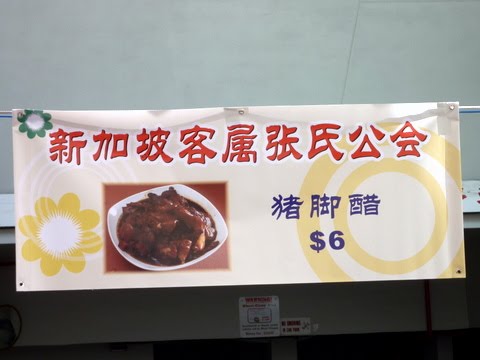
I got what is second best, a cookbook that was also produced by the Guild, with a simple title, Hakka Cook Book. Published in Chinese and English, the 120-page book has many Hakka dishes, some better known and others, perhaps, only known to the Hakkas. Many of the dishes have accompanying narrations about the dish, be it its origin or who it is for, like ladies in confinement.

According to the book, of some 3.3 million Hakkas in South East Asia, Singapore has 200,000. And its Hakka food stands out in the local Chinese cuisines. Many would have heard or tasted the famous Abacus Beads, amongst many famous dishes, we well as the Lei Cha, mistakenly translated as Thunder Tea rice. (^^)

There will also be a Hakka Night on 14 & 15 Dec 09, with performers from MeiZhou, China.

Subscribe to:
Posts (Atom)