Friday, August 28, 2009

Movie: A Month of Hungry Ghosts

We know the words "Hungry Ghost Festival" pretty well in Singapore. We know that there will be offerings - by the roadsides, outside the homes, with the communities, prayers & rituals, residental & business community dinners & auctions, and of course the ubiquitous GeTai. But do we really know what Hungry Ghost Festival or Zhong Yuan Jie is all about?


If you don't and want to know more, note these two dates

- Saturday 29 Aug 09 @ 7pm
- Sunday 30 Aug 09 @ 7pm

at a tentage next to Spring St, off South Bridge Road (going into Neil Rd), Chinatown, made possible with Sinema Mobile

I just came back from a sneak preview. We wanted the 'operator' to continue with the show as we were just warming up. It is primarily in English.


Bring along your children who will learn a thing or two about the Chinese culture. Bring along your Grandpa and Grandma who will be able to share more details with you, and perhaps, later with us? (^^)


There will be a "Meet the Director" session after the movie, where you can get to know more about how this movie was made.

Wednesday, August 12, 2009

Chinatown 7th Month (Hungry Ghost) Festival

Right in the heart of Chinatown, there will be a Hungry Ghost Festival from 29 Aug 09 to 1 Sep 09. As part of this year's festival, there will be two tours organised for tourists and local to better understand how Hungry Ghost Festival is observed in Singapore.


A traditional festival from China, from popular beliefs, the Hungry Ghost Festival is one where literally all hell breaks lose as the gates of hell will open to let out the 'hungry ghosts' to earth during the seventh lunar month, usually between August and September. To appease the wandering spirits the Chinese will offer prayers to the deceased, burn joss sticks, paper money and offer food. There will even be entertainment for the spirits during the festival. It is common to see street wayang (Chinese Opera) or getai (mini concerts) performances being held during this period. Generally held at night, it is believed that these loud affairs attract and entertain the spirits. After the celebrations are over, the ghosts will return back to where they come from after a month of 'merry-making'.

The Chinatown Business Association is also arranging for a movie entitled "A Month of Hungry Ghost" produced by Ms Genevieve Woo and directed by Mr. Tony Kern on 29 Aug 09 and 30 Aug 09. This will be held at the GeTai stage.

On both evenings, the programme is:

7.30pm: Viewing of the Hungry Ghost Exhibition
8.00pm: Screening of the Movie
9.30pm: Meet the Director

The Chinatown Business Association is also organising a guided tour on two days, 31 Aug and 1 Sept, to unravel the mysteries behind this "bizarre" festival.

Chinatown Hungry Ghost Festival Tour
31 Aug 09 (Mon) & 1 Sept 09 (Tue)
6.30 pm – 10pm

This is an in-depth guided tour of the Hungry Ghost Festival in Chinatown where one could get to:
: Watch the rituals
: Learn about the practices
: Experience a 7th month auction
: Catch the 'Ge Tai' in action

Tour itinerary on 31 August (Mon), Price at $30
- Buddha Tooth Relic Temple & Museum
- Hungry Ghost Festival Site
- Prayer Walk
- Dinner at Food Street
- Ge Tai

Tour itinerary on 1 September (Tues), Price at $50
- Buddha Tooth Relic Temple & Museum
- Hungry Ghost Festival Site
- Funeral Paraphernalia
- Ge Tai
- Dinner at Festival Site & Viewing of Auction


Tour Capacity
Minimum - 1 pax
Maximum - 50 pax

How to Book?
Contact the Chinatown Business Association (Jennifer or Jonel)
- Tel: 63720478
- Email: jennifer@chinatown.org.sg or jonel@chinatown.org.sg
- Book by: 26 Aug 09

In conjunction with the Singapore Tourist Board's 2009 reasons to enjoy Singapore promotion, if you can give a password when booking, you get a 50% discount off the ticket price! Watch out for more tips if you cannot find the password. Like Newspaper ad on 20 Aug 2009 (^^)

Meeting Point
Main entrance of Buddha Tooth Relic Temple (facing South Bridge Road).
Registration opens at 5.30pm and closes at 6.15pm.

Ack: Pictures from Chinatown Business Association

Saturday, July 18, 2009

Were you in St. Mathew Kindergarten before?


With a new whitewash, this quiet building stood along Neil Road, directly facing Everton Road at the T-junction. Once upon a time, this hall must have been resonating with the giggling, singing and even shouting of the kids as they responded to their teachers' questions or encouragement. During its hey days, St. Matthew Kindergarten, probably one of the better known kindergartens of that time, was popular with the residents of Chinatown.

Although it was situated on the "outskirt" of Chinatown, it was not too far away. Known to the Cantonese as Seng Mah Tai, I assumed that it must have been a school for those who could afford. My family could not afford and by the time I knew about the kindergarten, I was already in primary school.

I had one opportunity to visit the kindergarten during its open house and I was already in Primary one. I was already out of place as I joined the kids in doing colouring. That was in 1960.

I am sure, many of the Chinatown residents (kids then), when they pass this now quiet building, they must have good memories of their childhood days. They would probably be telling their grandchildren about their days as tiny tots. Most, if not all, would be been in the baby-boomer generation.

Thursday, July 09, 2009

Singapore's 44th National Day

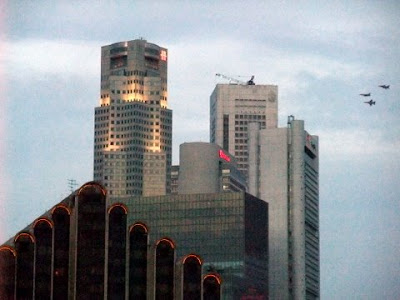
It is the time of the year when we, the residents of Chinatown get to see first hand, the rehearsal for Singapore's National Day celebrations. Looking at the skies, that is. Year after year, we never fail to be excited by the chut chut sounds of the helicopters as they fly overhead with the giant Singapore flag (the biggest in Singapore?) fluttering above us. And sure enough, looking at the distance, the jets would be flying past. While the helicopters seem to be consistent in their flight path, it is not so with the jets over the years. They must have been flying different formations.


Looking at the flag and helicopter moved towards the parade site, I could not help reminiscing the young days when I too was a participant in the Boy Scout contingent in the parade held in the Padang then. In one National Day parade, it was pouring dogs and cats and I could remember shivering in the rain as water gushed over our heads through our drenched uniforms. Ah, but we stood still (trying not to shive too much), proud to be part of another milestone in our tiny nation.


Just as it might be now, then, the parade was held in the morning. This meant, for most of us gathering at a place the night before so that we could assemble together in the shortest time. The then Sands House (Scouts HQ)'s Aw Boon Haw Hall was the place where rows and rows of Scouts would lay down to sleep under the spinning ceiling fans. We probably did not have much sleep as it took us a while to settle down. There were no sleeping bags then (it was still a luxury item for most of us) and so, we tried to cover with what we had, trying to shield from the increasingly cold draft from the fan. 5am, we were up, and by 5.30am, it was breakfast of bread, hard boiled eggs and drink. And the buses were waiting for us.

We assembled at Nicoll Highway and marched down to the Padang from there. Scouts were not known for good marchers but we practised hard (in the earlier times at the then Raffles Institution field) and weren't we proud when we saw our contingent in the Singapore dollar note!

The birth of modern Singapore was not a painless one. It made us all the more aware of the need for us not only to survive but to thrive. But even in the midst of a smallest achievement, we must not forget our past. Like the rings of a tree trunk or the layers of the soil, I think the events are also reflected in the history of our Chinatown. Let's look for the signs.

Monday, July 06, 2009

People's Park takes a new role


Long ago, some people might feel uncomfortable with words such as "People's .." for fear of being associated with communism. But interestingly, in Singapore's Chinatown, the People's Park did not seem to really elicit any fear. It could be because then, it was more known by its Chinese name than its English. People's Park Complex was known as Zhen Zhu Fang 珍珠坊 which could be translated as Pearl Place.

I took a walk through People's Park Complex last weekend, and to my surprise, the place was crowded, very crowded. There was a bigger variety of mainland Chinese there. Many were tough, brown and brawn, speaking in numerous dialects and possible Mandarin in heavy accents. I gather that they must be in the construction industry here. Singapore has seen a surge in Chinese construction contractors in the local building industry. People's Park Complex now has many Remittance Centres allowing the mainland Chinese to send back money to their home, just as Lucky Plaza is to the Filipinos. The lonely POSB ATM at one end saw a constant long queue as the workers waited patiently for their turn to withdraw money, probably to hop down a few steps to the remittance centre. Hmm, under IN2015, perhaps, they could do it at one place with the remittance centre working with POSB for direct transfer. Just a thought. It could be a nightmare for the IT security.

By the entrance to the Overseas Emporium - once upon a time, this Chinese emporium is one of many where all local Chinese flocked to get cheap Chinese goods, and unknown to many, the English editions on Socialism and Commission, good enough to get one to sleep - was a crowd looking at two topless young men showing no pain as they had their back drilled (tattooed).

People's Park has seen a resurgence of crowds and hopefully customers.

I could remember long long ago when the People's Park Complex was probably the biggest departmental store in Singapore. That must be in the late 60s. I remembered joining the curious crowds walking through the empty corridors in the newly finished complex. The place smell new.

There was an "open air" coffeehouse where I first brought my German visitors to for their breakfast. That was another story on culture shock .. just how the eggs are to be prepared and coffee without sugar. That was in 1978.

People's Park continued to evolve. Being small shops selling almost identical ware, it was tough business. Restaurants came and went. I remember having vegetarian dinner at the Kingsland Restaurant at one corner of the complex. The luggage shops seem to be able to sustain their lives there. Then the shops selling the "smelly" medicated oil, said to be good for treatment of the muscles came in. The place "stinks" probably chasing away the non Asian foreigners. But it must have added to the flavour of the Asianness there.

Recently, a sex shop opened. That opens up a new dimension to this multi-faceted complex. The People's Park Complex continues to evolve.

Wednesday, July 01, 2009

A journey of the Southern Sounds

On Sunday, 28 June 2009, the Ee Hoe Hean Club with Siong Leng Musical Association (which is just up the hill along the same road) co-sponsored a talk on the journey of the southern sounds - Nan Yin 南音. It is about a music that is more than a thousand years old, and how it travelled from the times of Tang Dynasty to the modern era, about how it manages to remain on course through time and rapid changes, and how it travelled out of China to all corners of the world.

Nan Yin lyrics still maintain the words of the ancient times. The early source of the Hokkien (Minnan) language/dialect, it is a pride of the Hokkiens in Singapore. Interestingly, the interests on this music and song have transcended all dialect groups and even interests people from all over the world.

The elders worry about the Nan Yin becoming extinct. In Quanzhou where it has its base, reports indicate that it is still very strong and thriving well. One could enjoy a performance at any night. One could find many singing the Nan Yin at home, in communities or with friends. In Singapore, there are a number of Nan Yin groups.

Of these groups, Siong Leng Musical Association has been one of the most active in bringing the music and songs to the young, through schools and performances. Each year as it performs in Thian Hock Keng at Telok Ayer St, the courtyard would be filled with the elderly audience waiting in expectations, and even humming along. In recent times, more and more younger ones could be found, some of whom attended out of curiosity, but ended getting stuck with it, a feeling of the residue echoing of the melodies resonating in one's mind, as describe by Ms Zou Lu, one of the two presenters at Ee Hoe Hean Club.

That Siong Leng Musical Association comes this far, with foresight of innovations and creating new songs, one man was instrumental in this, the late Mr. Teng Mah Seng, the previous President of the Association. He has written more than 300 pieces of songs, many of which have now been played in China and other places. He was instrumental in organising ASEAN gathering of Nan Yin groups to perform in Singapore. He led the group to win prices in the Edinburgh Festival.

Ack: Siong Leng Musical Association

At this talk, Mr. Han Shan Yuan, a veteran journalist, also shared his experience both as an interviewer of Mr. Teng and as a friend. Mr Teng did not start his writing of Nan Yin songs till when he was 61 years old when a Nan Yin performance at his mother's funeral wake triggered him. His passion for the music and songs was so great that even when he was diagnosed with cancer, he asked the Almighty to let him have more time so that he could do more. He was a man in a hurry. Said to be a man of little schooling when he came to Singapore to work, many were amazed by the lyrics that he wrote, beautifully composed in classical Chinese.

Mr. Teng must be very proud that today, the descendants of Siong Leng Musical Association continues to perform his songs and music. He has left behind a very important legacy to the Singaporeans, and to the Nan Yin lovers in the world!

A new and young group performs for us the legacy of Mr. Teng.


Ack: Siong Leng Musical Association, Ms Zou Lu, Mr. Han Shan Yuan

Saturday, June 06, 2009

Sri Mariamman Temple undergoes renovation


The iconic Hindu Temple in Chinatown, Sri Mariamman Temple, is undergoing another renovation and restoration. It was some time back when they have the entire temple complex's statues restored and repainted.

If my understanding is correct, a freshly restored Sri Mariamman Temple will make its debut on 11 Apr 2010.


Looking from a different angle, I could see that the statues have already been given a clean coating, awaiting the patching and eventually, the vibrant colour.


Probably the oldest Hindu Temple in Singapore, it has seen evolutions in Chinatown through the years. The temple itself has also seen changes and development within the temple complex.


Tuesday, June 02, 2009

Sei Yan Kai 死人街 (Sago Lane) - the lane of the dead

Asked the older people about Sei Yan Kai (in Cantonese), chances are they will know, and may cringe from memories of this place. It was a place of gloom, because there were funeral wakes practically every day (since the funeral parlours were here) and there were also people just waiting, waiting for their day.

I could not remember much as I did not go through that lane often. Not one that any mother would want her kid to along to. The old folks were also "pantang" (a Malay word share with the Peranakans, that is akin to superstitious and yet not really because it is a belief) about going there, unless very necessary, not to mention allowing their kids to go. Chinese have their astrologies read or consulted at the beginning of each year and will know if they should be involved in "white" matters, meaning death. So, if they are not to attend to white matters, then, only when it happens to a close relative, they might not attend any funeral wake. These days, with modernity, less are being "pantang".

I remembered going to the funeral wake at Sago Lane only twice. Once was a colleague who died in a bus accident. Just walking into the shophouse to pay respect caused me to have goosebumps. Another time was that of a relative of my in-law.

Most of the funeral ceremonies here were carried out according to the Cantonese tradition, and I guessed that most of the deceased having their final rites here must be Cantonese too.

I chanced upon this video clip (ack: MichaelRogge) showing a little of the Sago Lane activities and for those who have not witnessed one, this is an interesting eye-opener. For those pantang ones, don't click.


Sunday, May 31, 2009

Lai Chun Yuen 梨春园 - guzheng performance

Not wanting to miss the guzheng performance, we rushed to Lai Chun Yuen, arriving a little past 7pm. We were still able to watch the performance. It was impressive. All the ladies with one man performed on the guzheng with two guys on the percussions.

No conductor, no notes but the ladies and men performed beautifully. What is perhaps a little lacking is the set up in the rest of this magnificient hall. But one cannot complain when one is watching and listening to the performance without paying a cent.

If only someone were to project the title of the pieces that the guzheng troupe was playing. The music was very familiar but it took a while to try to recall the title. The pieces chosen was very well suited to the crowd, very robust, full of life and energy and towards the end, with the encore, the crowd was clapping hands to join in the beat.


If they were to have such performances very weekend, it would certainly be great. If only I could have my table and chairs nearer to the performers.  Wine was on sale there, and maybe a glass might match with some pieces and some oolong for others.


I think the current management is having vendors offering all kinds of things for sale, preferably heritage stuff of Chinatown and Singapore. It is almost like a flea market and I think more could be squeezed in to make it really like a market. If they could keep the noise level down, and have performances like every alternate half hour during weekends, it would be a fun place to go to. Maybe even the musical buskers too! Imagine even the amateur nanyin singer - be it Hokkien or Cantonese. The erhus, the pipas, the Chinese strings .. and maybe, the Teochew kong kuan (the whole group might bring the roof down).

Saturday, May 30, 2009

Photos of Old Singapore

Taking an after-dinner stroll through the streets of the Cantonese-speaking Chinatown (in the old days, that is), we chanced upon the re-opening of the Lai Chun Yuen 梨春园 (Li Chun Yuan), the famed old opera-house of yesteryears. The outside facade of the row of what seems like shophouses belie the existence of an opera-house inside. If only we could bring back its old glory with the newly restored and renovated interior. It could well be.The new management is coming up with something in a matter of days. For the time being, it was a to be a spread of stalls selling things of the old. As it was already past 9pm the only stall that was open was the Hogart Art London stall! And what warm greetings we received from the staff! "We are still open, just for you!" How not to oblige with a purchase? But we resisted and got to discussions about old Singapore, quizzing each other on one's knowledge of old Singapore.

Question for you, "Which street was the first street of Singapore?"

There were old pictures of Chinatown in the old days, and certainly worth buying for keepsakes as well as for friends. They are frame-ready. I was told that these photos were collected and produced from England. So, for the old Singapore and old Chinatown buffs, this is worth looking at (no commercial interests on my part).

Tomorrow night will be the final night of this weekend's guzheng 古筝 performance. I hope in the weeks ahead, we could get to see more arts performance, it be Chinese or even of other kinds. It is certainly a great place to be part of the Singapore's Arts Festival.

How nice it would be to sit down, have a few cuppas of good oolong 乌龙, poh-lei 保利 or the current trend of pu-erh 普洱, and watching a Cantonese opera. Tai Lui Fa 帝女花 came to mind. (^^)