Each year, for the past decade or more, Siong Leng Musical Association has performed a Nanyin and sometimes Li Yuan Opera performance in the Thian Hock Keng in commemoration of the three celebration days of Guan Yin, 2M19, 6M19 and 9M19.
And it did on 17 Oct 08 which in the Chinese lunar calendar is 19th of the 9th Lunar Month. Without fail, its faithful fans turned up to watch the performance. It is one of those Hokkien operatic performances that is getter rare these days.
While most of the younger people might enjoy these performances with the aid of the Chinese lyrics being shown, the older ones apparently didn't need them.
Saturday, October 18, 2008


Tuesday, October 14, 2008
My favouriteTeochew Fish Porridge (Broth)
This must have been in the mid 1970s. That was when I had started working for a few years. I was working late and getting involved in work related activities. It meant late dinner. I could not remember how I came across these food stalls on the street, but I did find them. Since then, it was like my open air dining place.
There were two stalls lined up side by side at Carpenter St. Like many hawkers of yesteryears, these stalls just appeared when the sun set. They sold the same things, fish - pomfret (chiew heu) and Ikan Batang (tabang heu or heu-kao in Teochew). They had their loyal clients. Both sides had their tables always occupied.
For whatever reason, I always had dinner by the stall that was nearer to South Bridge Road. It was almost like my orders had been carved on stone (they don't have PCs in those days). I would always have my bowl of Heu Kao (must have been 70 cents I think) with a plate of duck meat cooked in soya sauce (I have been going around to look for this dish and have never found the same one again). There are other extras such as fish roe. Now earning much, I stuck to my standard pair.
The fish was always fresh. Although the pomfret is the more expensive fish, I preferred the batang heu (Ikan Batang) with its coarse and yet still oily meat. Cooked in teochew style, there was always a piece of the dried fish or two (known as ti-porh) that added the flavour.
Teochew fish porridge or broth (I think the Japanese Zosui might be the nearer description) is not like the Cantonese porridge (jok in Cantonese) or Muay in Teochew (Beh in Hokkien). When one orders the fish porridge, the chef would put his pot on the gas-stove, using a big scoop, he would take one scoopful of the "arm" (the cooked rice water) and put into the pot, and another scoop of cooked rice. When the rice in the water comes to a boil, he then throws in the slices of the fish and let it boil for a few times. And with the ti-porh and other condiments, it is ready for eating. Probably less than 5 minutes' work, or even less. Dipping the freshly cooked fish into a small saucer of light soya-sauce with cut chilli, it was sedap (delicious).
With the stalls having one or two of the pressured kerosene lamps and depending on the street lights, we sat and ate, enjoying the warm night air. People from all walks of life dropped by, probably for supper, unlike me. Towkays in Mercedes dropped by with their girlfriends (I think) or even their "barbers". There were two (maybe only ones in town) barber shops manned by ladies nearby and was a hot favourite with the Towkays. Some could be passerbys and yet some who went pat-tho (dating in Cantonese) who might ended up here for makan (food) before going home.
Alas, such a wonderful place was just too good to be true and soon, the stalls were no longer to be found. And I have lost a good place that saved me from gastric problems. Fish porridge or Heu Muay will never be the same again.
There were two stalls lined up side by side at Carpenter St. Like many hawkers of yesteryears, these stalls just appeared when the sun set. They sold the same things, fish - pomfret (chiew heu) and Ikan Batang (tabang heu or heu-kao in Teochew). They had their loyal clients. Both sides had their tables always occupied.
For whatever reason, I always had dinner by the stall that was nearer to South Bridge Road. It was almost like my orders had been carved on stone (they don't have PCs in those days). I would always have my bowl of Heu Kao (must have been 70 cents I think) with a plate of duck meat cooked in soya sauce (I have been going around to look for this dish and have never found the same one again). There are other extras such as fish roe. Now earning much, I stuck to my standard pair.
The fish was always fresh. Although the pomfret is the more expensive fish, I preferred the batang heu (Ikan Batang) with its coarse and yet still oily meat. Cooked in teochew style, there was always a piece of the dried fish or two (known as ti-porh) that added the flavour.
Teochew fish porridge or broth (I think the Japanese Zosui might be the nearer description) is not like the Cantonese porridge (jok in Cantonese) or Muay in Teochew (Beh in Hokkien). When one orders the fish porridge, the chef would put his pot on the gas-stove, using a big scoop, he would take one scoopful of the "arm" (the cooked rice water) and put into the pot, and another scoop of cooked rice. When the rice in the water comes to a boil, he then throws in the slices of the fish and let it boil for a few times. And with the ti-porh and other condiments, it is ready for eating. Probably less than 5 minutes' work, or even less. Dipping the freshly cooked fish into a small saucer of light soya-sauce with cut chilli, it was sedap (delicious).
With the stalls having one or two of the pressured kerosene lamps and depending on the street lights, we sat and ate, enjoying the warm night air. People from all walks of life dropped by, probably for supper, unlike me. Towkays in Mercedes dropped by with their girlfriends (I think) or even their "barbers". There were two (maybe only ones in town) barber shops manned by ladies nearby and was a hot favourite with the Towkays. Some could be passerbys and yet some who went pat-tho (dating in Cantonese) who might ended up here for makan (food) before going home.
Alas, such a wonderful place was just too good to be true and soon, the stalls were no longer to be found. And I have lost a good place that saved me from gastric problems. Fish porridge or Heu Muay will never be the same again.
Friday, October 03, 2008
Sri Mariamman Temple celebrates Navarathri
On the evening of 1 Oct 08, with friends, I visited the Sri Mariamman Temple at South Bridge Road, said to be the oldest Hindu Temple in Singapore. The temple is celebrating the 9 days of Navarathri. And on this night, there were dances performed by various students from different Indian Classical Dance schools.
I was there partly because Arul Ramiah was going to dance. (^^)
It was an evening of the community of devotees of the Sri Mariamman Temple. One could feel the energies and atmosphere sitting on the canvas covered ground with a small stage placed at the corner of the temple courtyard.
Indian Classical Dance and the temple have a very strong symbiotic relationship and I could sense the story and devotions by the dancers as they depicted stories of the Hindu deities. Alas, my lack of understanding of the Tamil language deprived me of a deeper understanding of the dance with the songs being sung. But still, the hand gesture, the eye movements and the movements of the body did give much for visual and audio appreciation.
The final performance must be, for me, the grand finale as Arul Ramiah performed a series of dances, some with two lovely girls who had undergone just six weeks of intensive training in Indian Classical Dance! What a typical cosmopolitan Singapore in display as Arul's Chinese friend did the introduction and two Dutch girls dancing with her!
The opening dance to the Shiva Chant was, to me, the most powerful with the song, music and movement synchronised to tell a story.
I was there partly because Arul Ramiah was going to dance. (^^)
It was an evening of the community of devotees of the Sri Mariamman Temple. One could feel the energies and atmosphere sitting on the canvas covered ground with a small stage placed at the corner of the temple courtyard.
Indian Classical Dance and the temple have a very strong symbiotic relationship and I could sense the story and devotions by the dancers as they depicted stories of the Hindu deities. Alas, my lack of understanding of the Tamil language deprived me of a deeper understanding of the dance with the songs being sung. But still, the hand gesture, the eye movements and the movements of the body did give much for visual and audio appreciation.
The final performance must be, for me, the grand finale as Arul Ramiah performed a series of dances, some with two lovely girls who had undergone just six weeks of intensive training in Indian Classical Dance! What a typical cosmopolitan Singapore in display as Arul's Chinese friend did the introduction and two Dutch girls dancing with her!
The opening dance to the Shiva Chant was, to me, the most powerful with the song, music and movement synchronised to tell a story.
Monday, September 29, 2008
Navarathri Celebrations in Sri Mariamman Temple
It is the 9 days of the 9 Emperor Gods (Jiu Huang Ye) and it is also the 9 days of Navarathri. Right in Chinatown where the oldest Hindu Temple, Sri Mariamman Temple, is, there will be nights of programmes to celebrate Navarathri.
On 1 Oct 08, at 9pm, there will be a Classical Indian Dance by Arul Ramiah and two lovely Dutch girls.
Come and enjoy Indian Classical Dances in the oldest Hindu Temple right in the heart of Chinatown!
On 1 Oct 08, at 9pm, there will be a Classical Indian Dance by Arul Ramiah and two lovely Dutch girls.
Come and enjoy Indian Classical Dances in the oldest Hindu Temple right in the heart of Chinatown!
Thursday, September 04, 2008
Chinatown Mid Autumn Light Up: Here comes Brazilian Samba
To the oldies, the strain of Yam Kim Fai might bring nostalgic memories of Chinatown.
But to the youngsters of today, the world is their town. And so, in this Mid-Autumn night, the students of the Singapore Management University brought in the Brazilian Samba! It will bring smiles to the grannies' faces as they watch how their children have gone to know the world better.
It certainly reminded some of the days when they or their ancestors arrived on this shore where everything was new to them. Some got to learn about the local Malay culture and took to joget!
But Brazil was too far an imagination for them. Well, until now ..
But to the youngsters of today, the world is their town. And so, in this Mid-Autumn night, the students of the Singapore Management University brought in the Brazilian Samba! It will bring smiles to the grannies' faces as they watch how their children have gone to know the world better.
It certainly reminded some of the days when they or their ancestors arrived on this shore where everything was new to them. Some got to learn about the local Malay culture and took to joget!
But Brazil was too far an imagination for them. Well, until now ..
Chinatown Mid Autumn Light Up: Giant Puppets
Once upon a time, puppet shows were popular. They not only entertained, but they also impart the Chinese values as well as the Chinese history.
Arts and skills were required to be able perform the puppet shows, where one uses one's hands to move the multiple strings of the puppets, making the necessary gesture while singing or making dialogues.
The puppets grew bigger, and bigger, and bigger. And at the Mid Autumn lightup, the biggest moving puppets took part. They too are telling stories of Chinese culture. But how many knew?
Arts and skills were required to be able perform the puppet shows, where one uses one's hands to move the multiple strings of the puppets, making the necessary gesture while singing or making dialogues.
The puppets grew bigger, and bigger, and bigger. And at the Mid Autumn lightup, the biggest moving puppets took part. They too are telling stories of Chinese culture. But how many knew?
Monday, September 01, 2008
Mid-Autumn Celebrations kick off
On 31 Aug 08, songs, dances, and noises of the fireworks brought Chinatown back to its old days when every night was a bustling nite. In those days, it was of necessity that one stays out late to make some money, have late supper or stay cool, away from the congested rooms in the old pre-war houses.
But on this night, that was almost history, and the young brought joys and news aspirations while looking back at the days when, maybe, their grannies or even great-grannies had irked out a living here.
But on this night, that was almost history, and the young brought joys and news aspirations while looking back at the days when, maybe, their grannies or even great-grannies had irked out a living here.
Ah, the nostalgic days ....
Chinatown redefined
Mid-Autumn 2008 kicked off with a rousing night of fireworks, dragons and lions, and dances galore, put up by some 700 performers, from as young as 5 years olds. It was another unforgettable night, not so much about moon cakes but of remembering Chinatown of the old by the young.

What must be stirring to many older residents of Chinatown must be the performance by the young remembering what it was like in Chinatown. It certainly conjured the days gone by, when children did not have the luxury of life as it is today. While the children still had the chance to carry lanterns, they would not have heard of the Brazilian Sambal performed by the Singapore Management University. While Cantonese might be the language of the day in this part of the Chinatown (where the People's Park Complex stands), tonight it was English and Mandarin. The song remembering Chinatown had some Cantonese in it, if my ears still tell me the truth.
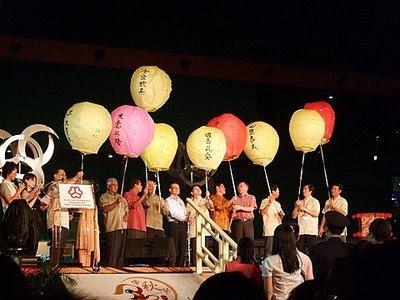
Watching the performance, I could not help thinking that we have come a long way. Many of these young performers must have had one of their grannies or relatives who once upon a time had lived in Chinatown. It is indeed a good occasion to gather in Chinatown again, the source or water head of the Chinese diaspora from Chinatown in Singapore? In such celebrations, it is great to remember the people who have helped what we have arrived to today.

Ah, as I looked back at Chinatown of my childhood days and watching these kids performed, I thought to myself, it is and will be a Chinatown Redefined. Many would not have known about Chinatown that we know. But so long there are roots, the trees will grow, bigger.
Saturday, August 30, 2008
Mid-Autumn arrives in Chinatown
Or is it? The flowers remind me of Spring. (^^)

30 Aug 2008 this year marks the last day of the month of the Hungry Ghosts (a term used locally to mean the 7th Lunar Month). And so, from 31 Aug 2008 this year, it is the first day of the 8th Lunar Month, which signals the preparation for the 15th of the Lunar Month, which is celebrated by the Chinese as Zhong Qiu Jie or Mid-Autumn Festival. Again, locally, they call it the MoonCake Festival.

Come Mid-Autumn, when we used to offer our prayers to the Moon Goddess with moon-cakes, water caltrops, Pomelo and mini-yams with tea and cake-powder (once popular with the Chinese Ladies who use it to powder their faces) and kids carrying the lanterns, in modern times, it would be different. Lanterns would not be those made of glass papers with candles. But there will still be some. While the eating part continues, there might be less prayers to the Moon Goddess.
The MoonCakes bring along its tales of history in ancient China, just as the bright moon on this 15th Day with its shadows would remind grannies to tell the stories of Chang Er and the rabbit on the moon.
While Chinatown used to be the scene of much activities with the wet marketing selling pomelos, water caltrops, mini yams and moon cakes, these days, one could get them anywhere, everywhere. Moon cakes have gone upmarket with aggressive marketing by hotels, aided by credit card companies. Would there be still queues for the traditional Cantonese moon cake shops in Chinatown like Dai Zhong Kok? I think there will as the elderly folks would still prefer to the traditional taste.
In the days when there were less light and less bright, there was the additional fun as the kids would gather to light up the candles inside their lantern and do the walk. Adults would gather with the neighbours, sharing their peeled pomelos (in those day, the pink ones from Ipoh, Malaysia, were said to be the best), boiled small yams and moon cakes. Dai Zhong Kok's moon cakes used to be the ones. For some, they would come with the tomboh or hammer to crack open the boiled water caltrops to eat.

Would Mid-Autumn Festival be still as exciting to modern kids?
Wednesday, July 23, 2008
From the ashes arose a Phoenix
Abandoned school buildings seem to be the right candidates for hostels, or now, boutique hotels. Many could be the older buildings with some older characteristics of probably the 50s.
But here by the Pearl's Hill, a rather modern looking school building, although it has a long and interesting history with some proiment people coming from this school (see my earlier blog) , has become a hotel!

Would anyone have guessed that once upon a time, children ran up and down this first multi-storey school? Ah, many fathers and mothers would be telling their children about their days in this school, when they pass by or come to this hotel.

But here by the Pearl's Hill, a rather modern looking school building, although it has a long and interesting history with some proiment people coming from this school (see my earlier blog) , has become a hotel!
And, so this tallest school in Singapore has reincarnated as the Re! Hotel.
Would anyone have guessed that once upon a time, children ran up and down this first multi-storey school? Ah, many fathers and mothers would be telling their children about their days in this school, when they pass by or come to this hotel.
An interesting name, Re! In Chinese it is Re Li .. and this Re - pronounced as Swee in Hokkien -could it be part of the Chin Swee Road that runs by it?

Subscribe to:
Posts (Atom)