Tuesday, August 30, 2005

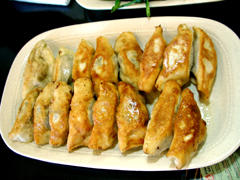
Guo Tie Anyone?


It used to be in one of the stalls in the old People's Park food centre, and a favourite with many. With the closing of the food centre for renovation, this northern Chinese food stall has moved to a small niche of People's Park Complex, next to the KFC. It's faithful customers followed, and come lunchtime, the place would be crowded with people.

The specialties include Jiao Zi (boiled dumplings), Guo Tie (Fried dumplings) and Zha Jiang Mian (Noodles with minced pork). The fried kangkong was surprising good too!

The name and address of the restaurant:
Tian Jin Fong Kee
1 Park Rd #01-100
People's Park Complex
Singapore 059108
Tel: 6532-3319

Email: service@fongkee.com
URL: www.fongkee.com

[Disclaimer: No Commercial Interests]

Monday, August 22, 2005

A shrine at People's Park Complex


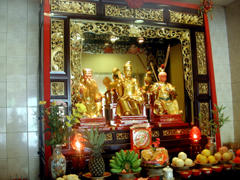
Unknown to many, especially shoppers, at the back of the People's Park Complex, next to the garbage centre, is a very well-kept shrine. The shrine is in honour of Da Bo Gong, Ji Gong and the Monkey God.

Early in the morning each day, one could see a steady stream of people going there to pray and probably going on to work. As in typical Taoist mentality, many Chinese passing by would drop in to pray to the Gods, burn some joss-sticks, before continuing on their journey. Joss-sticks are available for anyone to use. There is a safe into which anyone could contribute. The Chinese calls this "Tiam Yu" (in Hokkien), meaning giving money for the oil so that the oil lamp remains lighted.

From the appearance of the shrine, it must have been well maintained by some people, who could be working in People's Park Complex. And the Deities must have provided good support to the businesses in People's Park. An interesting relationship

Monday, August 15, 2005

Kwong Zhou Hui Koon 岡洲会馆


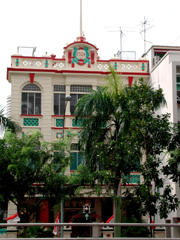
This building of the Kwong Zhou Hui Koon (Cantonese) or Gang Zhou Hui Guan (Mandarin) has been standing there since 1924. It has seen much changes around it and has now found most of its neighbours gone. It has also undergone much facelift. The picture that I took last Friday show it at one of its best. I have not been inside for a long time to see if there were renovations as well.

My wife's "grandma" (not sure if she was adopted) had her tablet placed on the third floor of this building. And so every year, on Chinese New Year eve, we would go there to pay respects. As we entered the ground floor, we could not help noticing the typical Chinese Association set up, of very fine big black table in the centre surrounded by many wooden chairs, with more flanking from the wall. The furniture showed the better days that the Association has seen.

This Association has been and is still active with its own Lion and Dragon troupes (when there were few in Singapore) and its own opera group. Culture is passed down through its activities. You would notice that Cantonese Operas still draw the crowds.

Some of the furnitures of the Association are being displayed in the Chinatown Museum at Pagoda St.

Friday, August 12, 2005

Chinatown Basement Wet Market


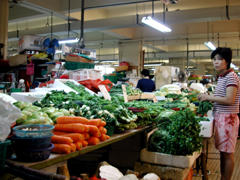
Today, I am off from work and so had the time to take a stroll through the basement wet market of Chinatown, at Smith St. It is very different from the days when the stalls were lined on Smith St, Trengganu St, Temple St and Sago Lane. They was hardly any "shows" like the killing of snakes and turtles to be sold as food.

During weekends, this market is still thronged with people, not from Chinatown alone, but from elsewhere, probably formerly Chinatown residents. This is probably one of the three or four wet markets where tourists jostle with the locals, one buying for the week's meal, the other capturing the scenes of the diminishing wet markets in Singapore.

Here, live fishes such as the Toman (Snakehead, said to be good for after surgeries because it could lessen the pain), and others like bullfrogs, terrapins, and mud crabs are for sale. There are wonderful things like yong-tau-fu which you could buy back to make soup, fry and cook any style. Yes, there are trays and trays of different greens, fruits, eggs - fresh, salted or even century eggs (pi-tan), pork - chilled and rosted, freshly slaughtered chicken (gone are the days when one could pick up a live chicken and have it killed and defeathered rightaway) and yes, ducks - freshly slaughtered or roasted.

Visiting the wet market is an experience. Wet markets in China are also the same, except that the varieties are more.

Tuesday, August 09, 2005

Old People's Park


There was once a People's Park. And then, a new one took its place as the old one was burnt down. The old one was more of a big place that had sundry shops, cloth, clothes and yes, it came alive with many restaurants and alfresco dining in the evening. There were "singing girls" to entertain. The new one was an HDB styled one, taking away all that atmosphere.

Now that new People's Park has become the old People's Park as the People's Park Complex (first shopping centre in Singapore?) and People's Park Centre took over as the modern shopping centres. After seeing its heydays as the only specialised retail cloth centre in Singapore and late night makan(food)-centre, this old People's Park is now under renovation. Come January, 2006, we might see a new People's Park. Will it be the same? Will it invoke an atmosphere of yesteryears or in the new millennium? That remains to be seen.

Chinatown is renewing itself, albeit at a rather fast pace.

Saturday, August 06, 2005

Hungry Ghost Festival - Offerings


Many shopping centres and some offices have begun organising combined offerings to the wandering spirits. Some held on to the age old traditions of putting joss-sticks and the triangular paper flags (which we love to collect as kids) on every dish of food on offer.

It is interesting that this is one occasion that many offices would allow their staff to organise such an offering. It's for the peace of mind for the staff. Especially if there had been cases of accidents, all the more important. So, in construction areas, this is a almost a must for the workers. It's happening in the hotels too. For those with a big number of "subscriptions" - people contributing towards this prayer - it might include dinners and even street operas, on top of the pailful load of goodies to bring home. Auctions during the dinners are also common, as this brings in more income for the next year's prayers. A few charcoal pieces could fetch thousands of dollars.

Such prayers and dinners are also good opportunities for company or community gathering and interactions.

Friday, August 05, 2005

Hungry Ghost Festival


Today is the first day of the 7th Lunar Month, the day when it is believed that the Hell Gate opens and the wandering souls are allowed to wander on earth. As in traditional Chinese practice, it is the time to offer food and "money" for these wandering souls to use.

For the Hokkien and Teochew, today, they would put candles, joss sticks, some food and joss-papers on the road side. In the old days, the whole streets could come alive with lighted candles and filled with smoke from the burning joss-sticks and joss-papers. While not in that grand scale of yesteryears, Chinatown still finds many streets filled with candles, joss-sticks and joss-papers. Where there are constructions, this becomes even more necessary to appease the wandering spirits.

More formal rituals are also conducted. Today, there is a Taoist event at the open field by Upper Hokkien St and a Buddhist event at the open field facing Maxwell Food Centre.

Wednesday, July 27, 2005

Recycling Ecosystem

At the third storey of Block 34, Upper Cross St, where now the toiletry shops are making great sales, they also have an informal symbiotic relationship with this old lady. When the shops close at 9.30pm, this old lady would come to flatten out all the empty carton boxes that they throw on the walkway.

By midnight, depending on the sales on that day, she would have more or less completed flattening all the cartons and tie them up together. In return for these discarded cartons, she would clean up the whole walkway, making it clean ready for the next day's business.

I don't know where she stays. Sometimes, past midnight I still saw her sleeping by her pile of flattened cardboards. Perhaps, that is the better way to guard the cardboards and bring them to sell the next morning.

There used to be an old man who does the same, but he would go round collected old newspapers. Many neighbours took kindly on this friendly old man and would gladly give him the newspapers and whatever he could sell. He was always grateful, cheerful and friendly. Alas, one day, I saw her being supported by a maid, suffering from a stroke. Since then, I have not seen him anymore. From what I heard, he had been doing this trade for a long time, supporting his children through university education.

There is still another old man who is still collecting old newspapers. But age is catching up. I am not sure for how long I would still be seeing him in the lift and being greeted by him in the traditional Hokkien greetings, "Jia Ba Buay" (Have you eaten enough?). Then, it might be the end of this ecosystem and a way of life.
Monday, July 25, 2005

Old Chinatown

Ronni Pinsler is a familiar face to residents of old Singapore, especially Chinatown, and in the Clarke Quay area. I first met him some thirty years ago when we were taking photographs of a Chinese temple at Duxton Road. Thirty years on, he is still chasing after temple events. Alas, many of the old scenes are no longer around. But Ronni's thousands and thousands of pictures stay, thankfully.

Some of these pictures are archived electronically in the National Archives of Singapore. Go to this website and key in his name, and you may see scenes of Singapore that the young Singaporeans might not be able to relate with.

http://picas.nhb.gov.sg/public/internetSearch/index.jsp

He shuttles between Singapore and Penang these days, but at times, you could still see him at a Chinese temple events. He still contributes his vast knowledge on the Chinese temples of Singapore, many of them no longer in existence in the email forum: taoism-singapore.

To join in the list, send a blank email to taoism-singapore-subscribe@yahoogroups.com

In many ways, Ronni has helped to archive many scenes of the past, many of which we now have learnt to treasure. We have Ronni to thank for.

Saturday, July 23, 2005

Claypot Rice


Chinatown is also about food, Chinese food. In the old days, 1960s, in the evening, one could find tables decked out on the streets and one could order many kind of food. One of the popular ones must be the claypot rice (called sar-poh fan in Cantonese). Rice with an assortment of ingredients and add-ons, depending on the orders, are cooked in a claypot, first on a stove with very strong charcoal fire, and then, moved to the next stove, progressively, with each stove giving less heat.

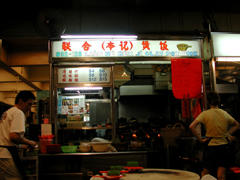
These days, squeezed in a small stall space in the Chinatown Food Centre (along Smith St), it was quite feat handling it and meeting diners' demands in a small space. For those of us who enjoyed the claypot rice, the patience to find a place and wait for the pot will pay off.

I tried this at the Chinatown Food Centre, the stall named Lian He (Ben Ji) at 02-128, Chinatown Food Centre, facing the Sago Road side. While it may not be the best, well, it is surely something synonymous with the old Chinatown.